
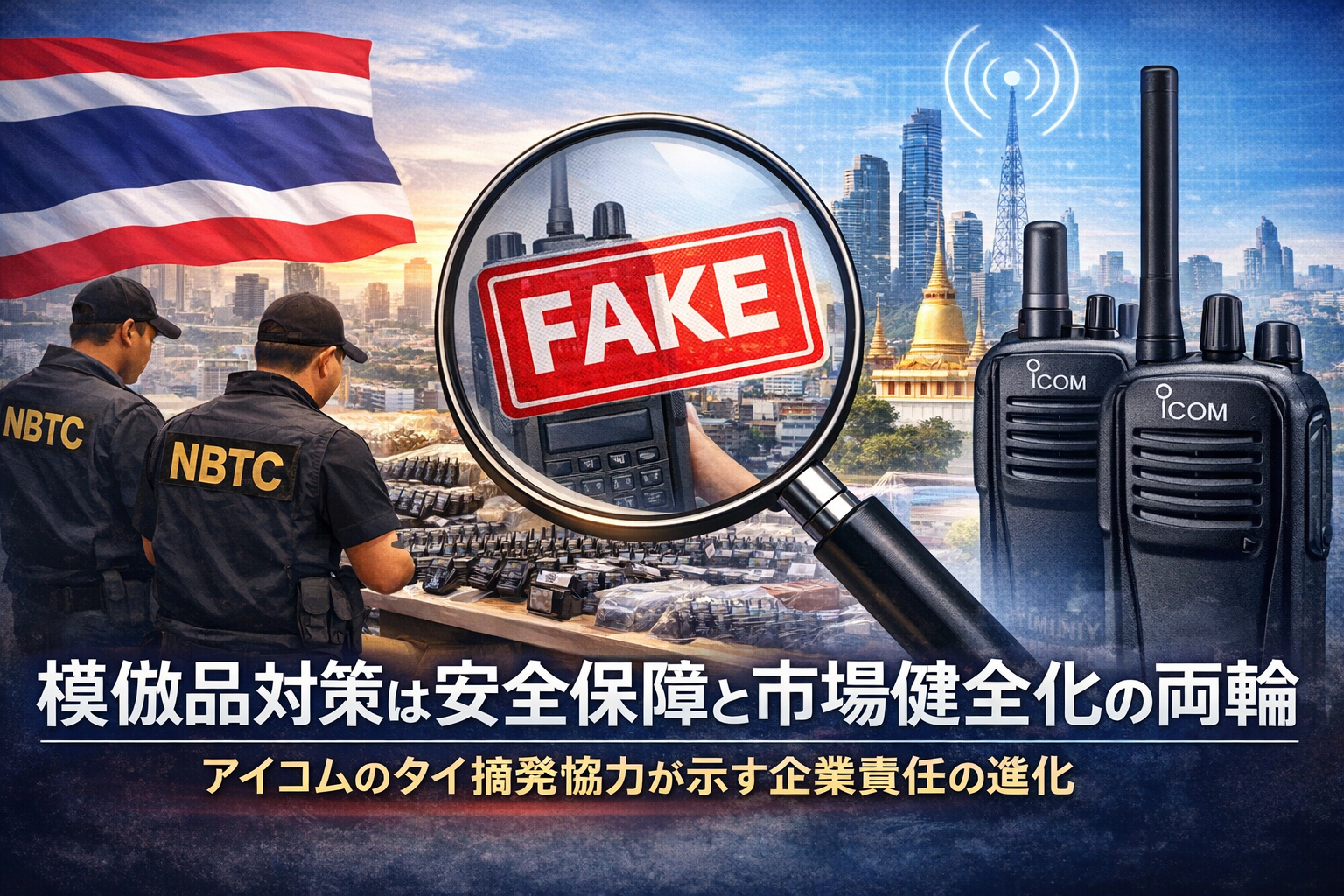
The news that Icom, a manufacturer of wireless communication equipment, cooperated in a local crackdown on counterfeit products at the request of Thailand’s National Broadcasting and Telecommunications Commission (NBTC) carries significance that goes beyond a simple response to intellectual property infringement. This case can be seen as a clear example of how corporate efforts to protect their own brands directly contribute to public safety and the maintenance of orderly markets.
In this enforcement action, the NBTC conducted a search of a company in Bangkok in July 2025 and seized a large number of counterfeit communication devices, including approximately 20,000 unauthorized transceivers. These products violated the Radio Communications Act, the Trademark Act, and laws concerning forged official documents, and individuals involved were arrested. Of particular note is the fact that the circulation of substandard communication equipment itself increases the risk of communication failures and accidents, thereby threatening the safety of social infrastructure. As emphasized by the NBTC, cracking down on counterfeit goods is not only a matter of consumer protection but also an economic policy aimed at safeguarding legitimate distribution channels.
According to local reports, many of the seized counterfeit products had been sold at unnaturally low prices through online shops. Responding to requests from local distributors, Icom cooperated with the investigation at an operational level, including conducting on-site inspections of physical products in warehouses together with agents and dealers. Such direct involvement by the manufacturer enhances the effectiveness of administrative enforcement while also serving as a strong deterrent against the circulation of counterfeit goods.
In Thailand, there has already been a track record of public–private cooperation, including a 2021 case in which the Department of Special Investigation (DSI) under the Ministry of Justice cracked down on counterfeit operators and Icom presented letters of appreciation. Furthermore, an explosion incident in Lebanon in 2024 involving counterfeit products has heightened global awareness that counterfeits are not merely “cheap substitutes,” but can entail serious safety risks.
Icom also announced in June 2025 that it had removed more than 4,500 counterfeit product listings identified on e-commerce platforms, mainly in Asia, and has been advancing multi-layered measures that include awareness-raising activities at trade exhibitions. What emerges from these efforts is the recognition that anti-counterfeiting initiatives are not a temporary response, but a continuous management issue embedded in the company’s business strategy.
Icom’s cooperation in the recent Thai enforcement action demonstrates that protecting a company’s intellectual property can ultimately lead to enhanced consumer safety, healthier markets, and the building of international trust. For companies operating on a global scale, anti-counterfeiting measures are increasingly being recognized not as a cost, but as an investment that strengthens social responsibility and corporate value.