
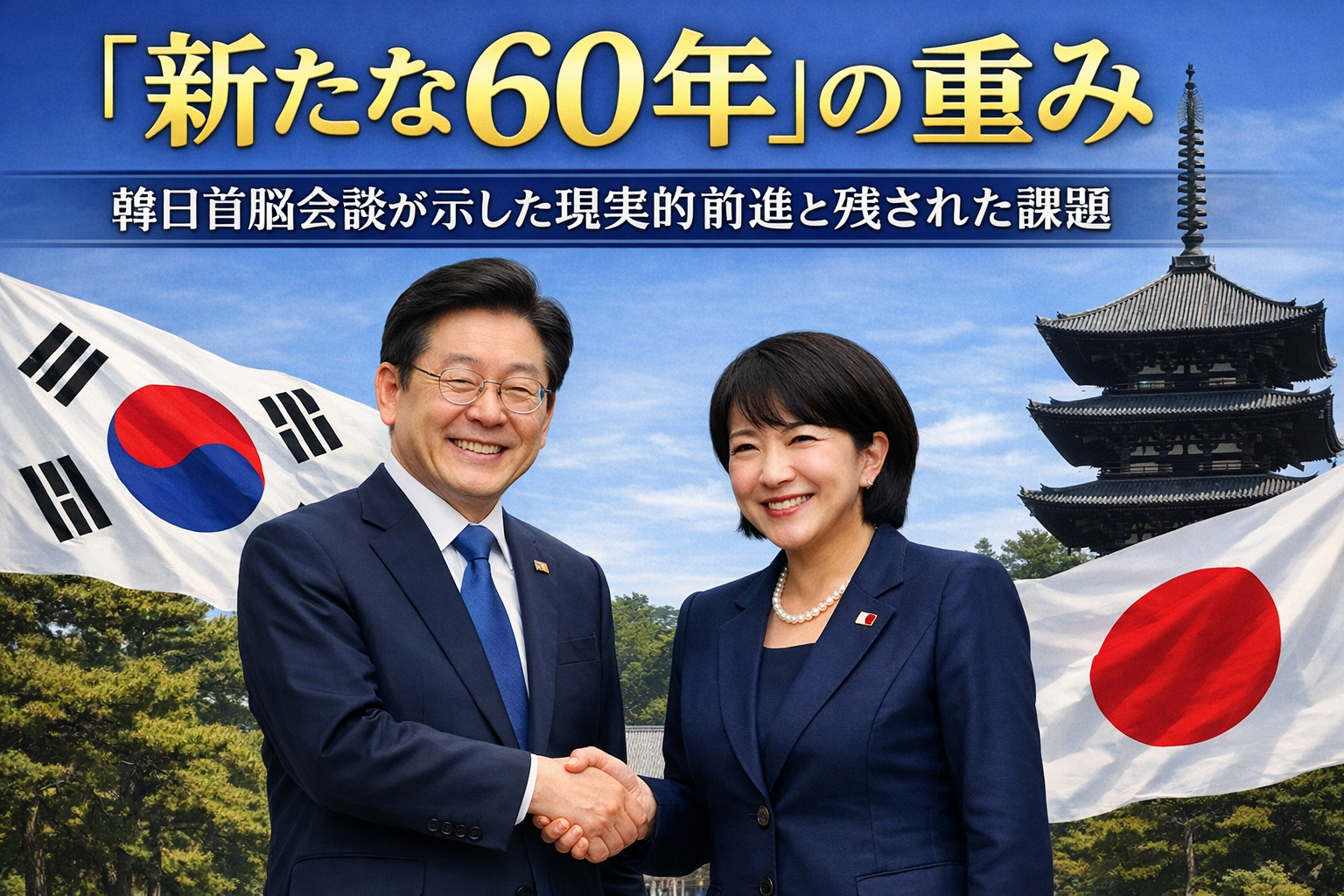
South Korean President Lee Jae-myung and Japanese Prime Minister Sanae Takaichi met in the city of Nara and shared the view that “this year should mark the starting point of a new sixty years in Japan–South Korea relations.” This was their fifth summit meeting overall and the second with Prime Minister Takaichi, strongly underscoring that mutual visits by the two countries’ leaders—so-called shuttle diplomacy—have entered a phase of consolidation.
A defining feature of this meeting was that it went beyond symbolic messaging and produced concrete outcomes directly linked to citizens’ daily lives and the economy. These included confirmation of continued working-level consultations on cooperation in the fields of AI and intellectual property protection, the simplification of immigration procedures, encouragement of school trips to the partner country, and joint responses to cross-border crime. All of these are areas in which the people of both countries can readily feel the effects of an improving relationship. In particular, the agreement for Japan to participate in an international consultative framework led by the Korean National Police Agency deserves recognition as a step toward deepening security and public safety cooperation at the operational level.
There were also noteworthy developments on historical issues. Regarding the 1942 flooding accident at the Chosei Coal Mine, Japan and South Korea agreed to jointly proceed with the excavation and identification of the remains of victims, including those from the Korean Peninsula. Rather than avoiding points that often lead to direct confrontation, the two sides approached the matter from the shared perspective of “an incident in which citizens of both countries were victims” and treated it as a problem to be solved cooperatively. This marks a clear departure from past patterns of confrontation. President Lee’s description of the agreement as “small but meaningful progress” likely reflects a sense of confidence in this pragmatic approach.
At the same time, issues most prone to emotional confrontation between the two countries—such as demands for apologies over the so-called comfort women issue, forced labor, and the territorial dispute over Dokdo/Takeshima—do not appear to have been substantively addressed. Restrictions on imports of seafood from Fukushima and other prefectures were also absent from the joint press statement. This suggests a deliberate choice to postpone contentious issues that could undermine momentum, while prioritizing trust-building and practical cooperation.
This summit was not an attempt to “resolve everything at once.” Nevertheless, the stance of steadily accumulating achievements in areas where agreement is possible, thereby laying the groundwork for tackling more difficult challenges in the future, was clear. Whether the phrase “a new sixty years” becomes merely a slogan or a genuine turning point with substance will depend on how far this incremental progress can be sustained and expanded.
The true value of improved relations is not tested by grand declarations, but by quiet, continuous cooperation. In that sense, this meeting can be regarded as a realistic and commendable first step.