
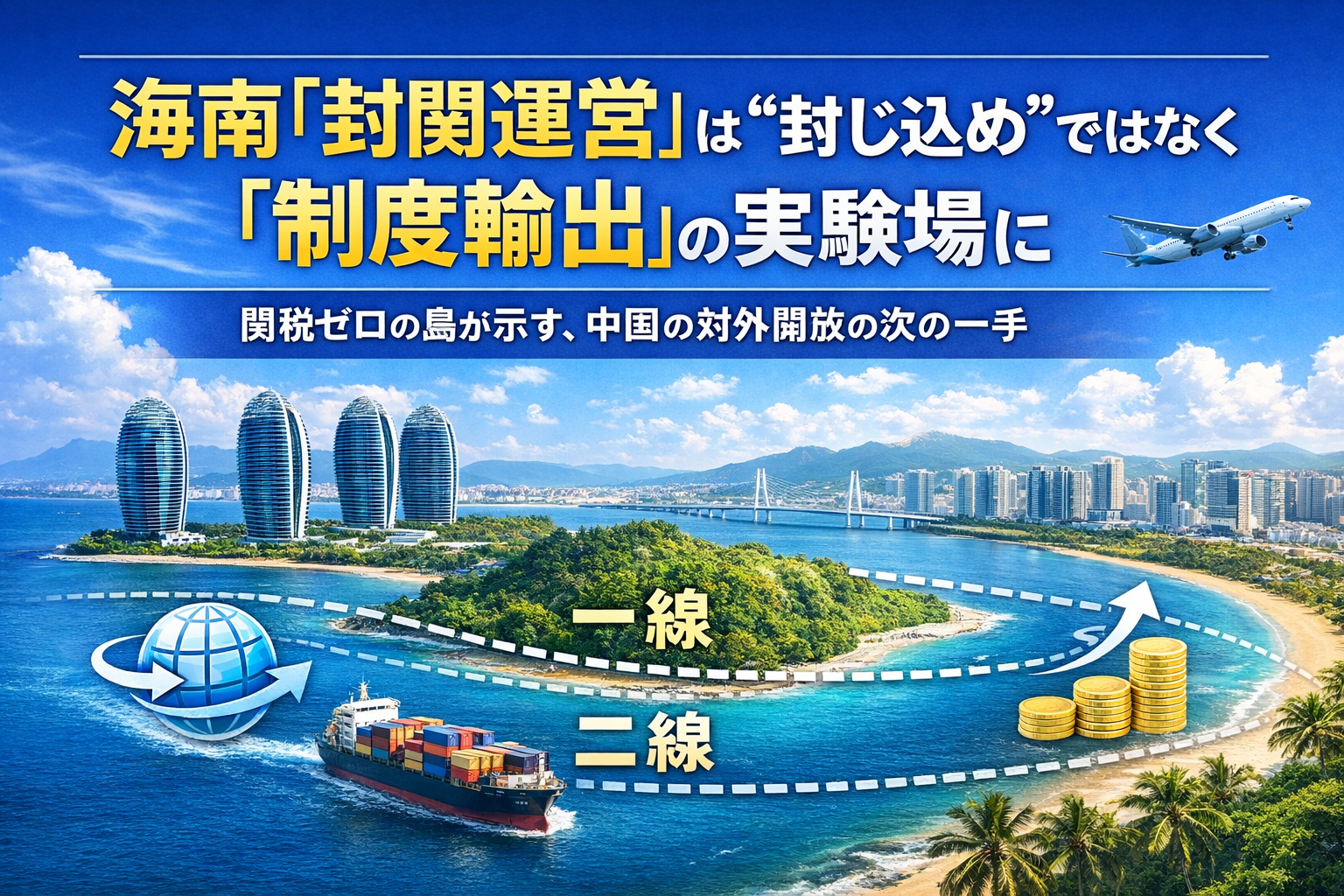
On December 18, 2025, Hainan Free Trade Port officially launched its “closed-loop customs operation,” under which the entire island of Hainan is designated as a zero-tariff zone. Judging solely from the nuance of the Japanese term, the phrase may evoke impressions of “sealing off” or “closing,” but what is actually being articulated is quite the opposite. The closed-loop customs operation is not a policy aimed at isolating Hainan inwardly; rather, it is positioned as an attempt to institutionalize a higher level of external openness and to demonstrate how such openness can be operated in practice.
This article organizes the policy objectives and initial outcomes observed one month after the launch of the closed-loop customs operation, while examining what this initiative could mean for the Chinese economy—and, by extension, for the global economy.
The Essence of the Closed-Loop Customs Operation: Redrawing Boundaries
At its core, the closed-loop customs operation redefines Hainan Island as a special institutional space. The boundary between overseas markets and Hainan is designated as the “first line,” while the boundary between Hainan and mainland China is designated as the “second line.” The “first line” is opened boldly, while appropriate controls are applied at the “second line.” Within the island, factors such as people, goods, and capital are designed to flow with relative freedom.
What matters is that this is not merely a tariff reduction policy. Trade, investment, logistics, cross-border movement of people, and data flows are collectively institutionalized within the geographical unit of an island, with the aim of demonstrating credibility through actual operation. Hainan is not simply proclaiming openness as a principle; it is becoming a testing ground that shows the world how openness is implemented.
Why Hainan, and Why Now
The timing of the closed-loop customs operation reflects changes in both the domestic and international environments surrounding the Chinese economy. Internationally, supply chains are being restructured and geopolitical risks are rising. Domestically, China faces the challenge of balancing high-quality growth with further opening to the outside world.
Against this backdrop, Hainan Free Trade Port was chosen as a place to “test first.” Institutional arrangements that would entail high political and economic costs if introduced nationwide can be tested within the limited space of an island. In this sense, Hainan serves as a testbed for China’s transition to the next stage of opening up.
What the First Month’s Figures Indicate
Data released during the first month after the launch of the closed-loop customs operation clearly indicate increased flows of people and goods. The number of entities benefiting from zero-tariff policies has grown, and many indicators—such as import value, duty-free consumption, cross-border passenger traffic, and new business registrations—have increased year-on-year.
These figures can be seen as reflecting market interest in and expectations for the new system. At the same time, the faster such activity expands, the greater the burden on administrative oversight. In particular, how efficiently and accurately “second-line management” is conducted—balancing security with smooth customs clearance—will be a decisive factor in the success or failure of the closed-loop customs operation.
Hainan Aims to Be a “Rules Hub,” Not a “Logistics Hub”
A point repeatedly emphasized in interviews is the vision of transforming Hainan into a strategic hub linking domestic and international markets, rather than merely a regional trade or logistics center. Here, “hub” does not refer only to physical infrastructure such as ports and airports.
The goal is to develop an integrated package of systems—including taxation, customs procedures, investment rules, intellectual property protection, and data governance—and to earn trust through their consistent operation. If Hainan succeeds, corporate decision-making may gain a new dimension: alongside questions of where to produce, process, and sell, companies may increasingly ask which institutional space to operate within.
What Investors Are Really Watching
For overseas investors, zero tariffs and tax incentives are attractive, but predictability matters even more. Clear rules, consistent enforcement, and reliable mechanisms for dispute resolution are what ultimately shape investment decisions.
From this perspective, Hainan’s emphasis on intellectual property protection and the rule of law is well founded. That said, evaluation will be based not on written制度 alone, but on the accumulation of real operational precedents. The closed-loop customs operation has now entered precisely this phase of building a track record.
Implications for Japanese Companies
From the standpoint of Japanese companies, Hainan is worth considering not merely as a sales base for the Chinese market, but as an option for integrated base design encompassing procurement, processing, research and development, and service provision. In particular, when considering where value is created and through which institutional space products and services are delivered to the market, Hainan may grow in strategic relevance.
That said, making hasty decisions based solely on preferential policies would be risky. Companies must carefully assess how their businesses would be positioned within the framework of the closed-loop customs operation, and how smoothly customs clearance and administrative processes function at the operational level.
“Operation” Will Determine the Success of the System
Hainan’s closed-loop customs operation is a test not merely of a zero-tariff policy, but of whether a high level of openness can be operated in a stable and sustainable manner. The institutional design has already been presented. What now draws attention is how effectively these systems function in daily operations and whether they can steadily build trust.
If Hainan overcomes these challenges, the closed-loop customs operation could transcend the scope of a regional policy and become an internationally referenced case that reshapes China’s model of opening up to the world.