
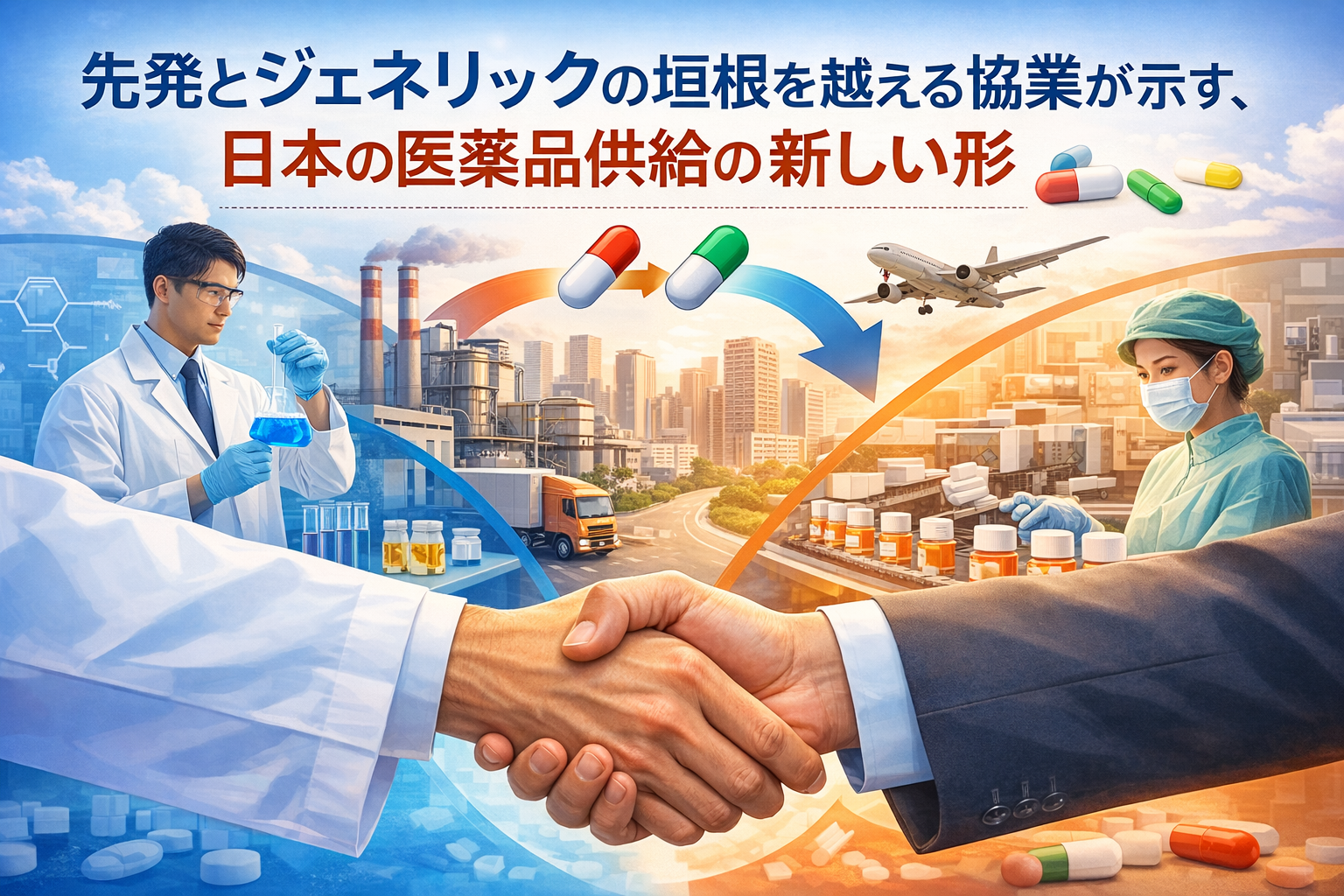
The news that Towa Pharmaceutical and Otsuka Pharmaceutical have entered into a basic agreement toward building a strategic collaboration in pharmaceutical manufacturing can be regarded as a highly suggestive development when considering Japan’s pharmaceutical supply system. That an originator pharmaceutical company and a generic pharmaceutical company are joining forces beyond their traditional division of roles represents a step forward from the industry’s conventional structure.
The “Structural Challenge” of Pharmaceutical Supply Instability
In recent years, limited shipments and supply suspensions of pharmaceuticals have become increasingly commonplace in Japan. According to figures published by the Ministry of Health, Labour and Welfare, as of October 2025 approximately 14% of prescription drugs were subject to limited shipment or supply suspension, forcing healthcare providers to routinely change prescriptions or switch to alternative medications.
Behind this situation lie multiple interrelated factors, including responses to quality-related misconduct, instability in the procurement of raw materials, and constraints on production capacity.
In particular, within a market structure where products rapidly shift to generics after patent expiration, it has long been pointed out that the manufacturing technologies and quality-control know-how accumulated by originator companies over many years are often lost without being adequately transferred.
The Essence of This Collaboration: A “Redesign of Roles”
Under this basic agreement, Towa Pharmaceutical is expected to undertake manufacturing with the assumption of product succession, focusing on long-listed products and essential medicines, while utilizing data and licenses held by Otsuka Pharmaceutical in generic drug development.
This goes beyond a simple contract manufacturing arrangement. Rather, it can be viewed as a redesign of roles—clarifying “who should demonstrate which strengths, and at which phase.”
Originator companies possess deep expertise in research and development, manufacturing technologies, and quality design. Generic companies, by contrast, have strengths in cost-efficient mass-production systems and operational capabilities that support stable supply. By building a complementary rather than adversarial relationship, the two can optimize the pharmaceutical lifecycle from a holistic perspective.
Supply Stability Through Mutual Backup Systems
A particularly noteworthy aspect is the effort by both companies to establish a system that enables mutual backup production. Production structures dependent on a single company or a single site inherently carry the risk of supply disruption when problems arise. In contrast, mutual supplementation of manufacturing sites and production leveling through contract manufacturing are effective means of enhancing the resilience of the overall supply chain.
From the perspective of logistics and supply networks as well, cross-company production collaboration is expected to improve responsiveness to uneven inventory distribution and sudden demand fluctuations. This can also be seen as a shift in perspective—from viewing pharmaceuticals as something “completed within a single company” to something “supported as social infrastructure.”
Anticipated Ripple Effects Across the Industry
Production preparations are expected to begin sequentially from the agreed products after March 2026. While this initiative will not eliminate all supply instability in the short term, if it proves successful, similar collaboration models may spread to other originator and generic companies.
Stable pharmaceutical supply is not an issue that can be resolved through the efforts of individual companies alone. The collaboration between Towa Pharmaceutical and Otsuka Pharmaceutical is significant in that it reexamines an industry structure long premised on competition and division of labor, and presents “optimization through collaboration” as a new option.
Going forward, it will be important to closely observe what results this collaboration achieves and how it may transform Japan’s pharmaceutical supply system.