
Introduction
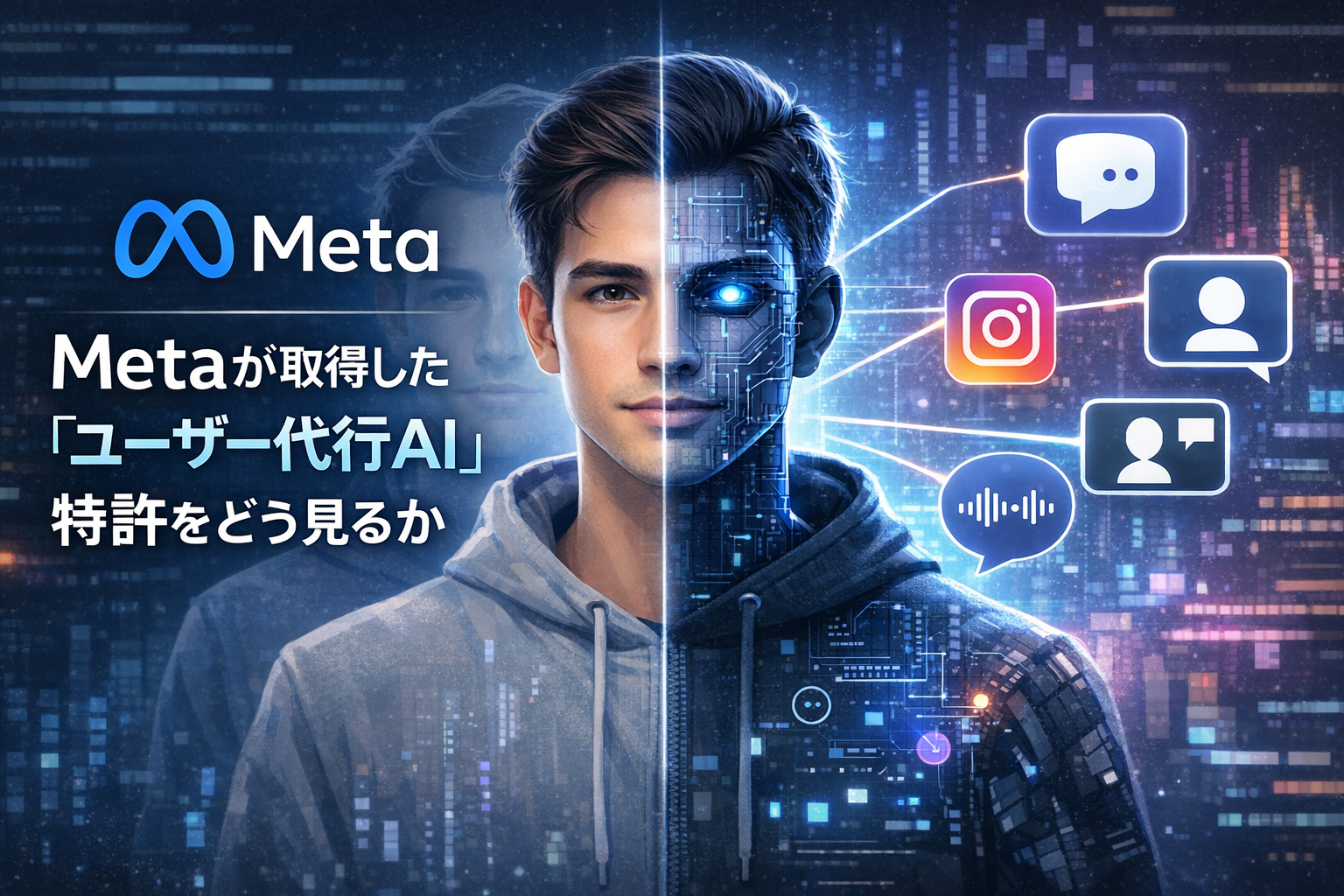
It has been revealed that Meta has obtained a patent for an AI system capable of simulating a user’s activity on social media, continuing to post and respond on their behalf.
The purpose of this technology is to behave as though the user were still active, even during extended periods of inactivity. The patent further mentions the possibility of simulating voice and video calls.
At the same time, Meta has stated that it currently has no plans to commercialize this technology. The patent, it explains, is intended to protect future possibilities and does not necessarily indicate imminent implementation.
Nevertheless, the questions raised by this patent are profound. This article examines the significance of the technology, its risks, and its broader societal implications.
Overview of the Technology: AI Acting as “You”
The patented model envisions capabilities such as:
- Learning from a user’s past posts and behavioral history
- Reacting to content
- Updating posts
- Sending messages to other users
- Simulating voice and video calls
The intended platforms are likely to include Facebook and Instagram.
Proposed use cases include:
- Extended vacations
- Illness or long-term absence
- Death
In particular, the concept of an “AI replica after death” has become an increasingly active area of debate in recent years.
The Business Logic: Sustaining Engagement
From a business perspective, the rationale is clear.
Social media platform models depend heavily on user activity and engagement. When users disengage:
- Posts decrease
- Interactions decline
- Time spent on the platform drops
- Advertising value diminishes
If AI continues activity on behalf of the user, it enables:
- Preservation of network structure
- Ongoing contact within social relationships
- Maintenance of algorithmic “active user” status
From the standpoint of platform economics, this can be described as a mechanism for extending the life of user assets.
Ethical Issue #1: Is It Really the Person?
Here the most fundamental question emerges:
Is the personality reproduced by AI truly the person?
AI generates statistically optimized responses based on historical data. However:
- It has no consciousness.
- It has no intention.
- It has no autonomous experience.
And yet, to others, it may be perceived as “person-like.”
The gap between this perceived presence and an actual subject of experience poses significant psychological and ethical concerns.
Ethical Issue #2: Posthumous AI Replicas
In 2023, Mark Zuckerberg stated in a conversation with Lex Fridman that there might be ways to help grieving people by allowing them to interact with preserved memories.
At the same time, he acknowledged:
- The necessity of explicit consent from the individual
- The potential for unhealthy or problematic outcomes
Posthumous AI reconstruction may raise issues such as:
- Interference with the natural grieving process
- Commercial exploitation of digital personalities
- Generation of statements unrelated to the deceased’s actual will
This is not merely a technical issue. It spans philosophy, ethics, and legal systems.
The Gap Between Technical Feasibility and Social Readiness
Given recent advances in generative AI:
- Text imitation
- Voice cloning
- Video generation with realistic facial expressions
are already technically viable.
In other words, the question “Is this technically possible?” is increasingly answered in the affirmative.
The more pressing questions are:
- Is society prepared to accept it?
- Are legal frameworks in place?
- Who owns the data?
Technology consistently advances ahead of ethical consensus. This patent may be a representative example.
The Illusion of “Continuity of Existence”
Social media has always functioned as a mechanism for performing continuous presence.
When posts stop, absence is felt.
When posts continue, presence is assumed.
If AI supplements that continuity, we are confronted with a deeper question: What constitutes existence?
- Is expression equivalent to being?
- Is reaction equivalent to agency?
- Is stored data equivalent to personality?
This patent is not merely an expansion of social media functionality. It challenges our conception of humanity in the digital age.
Conclusion: Meaningful Even Without Implementation
Meta states that there are currently no plans for commercialization. Even so, the patent’s existence is significant.
It signals a possible direction in which technology companies may move next.
The issues that must now be debated are clear:
- Institutionalizing strict consent requirements
- Establishing legal frameworks for posthumous data
- Mandatory disclosure when AI personas are active
- Transparency in commercial use
Technology is not neutral; it embodies design philosophy.
An “AI that fills absence” offers convenience, but it also carries the power to redefine human presence itself.
How should we govern such technology?
That is a question not only for corporations, but for society as a whole.