
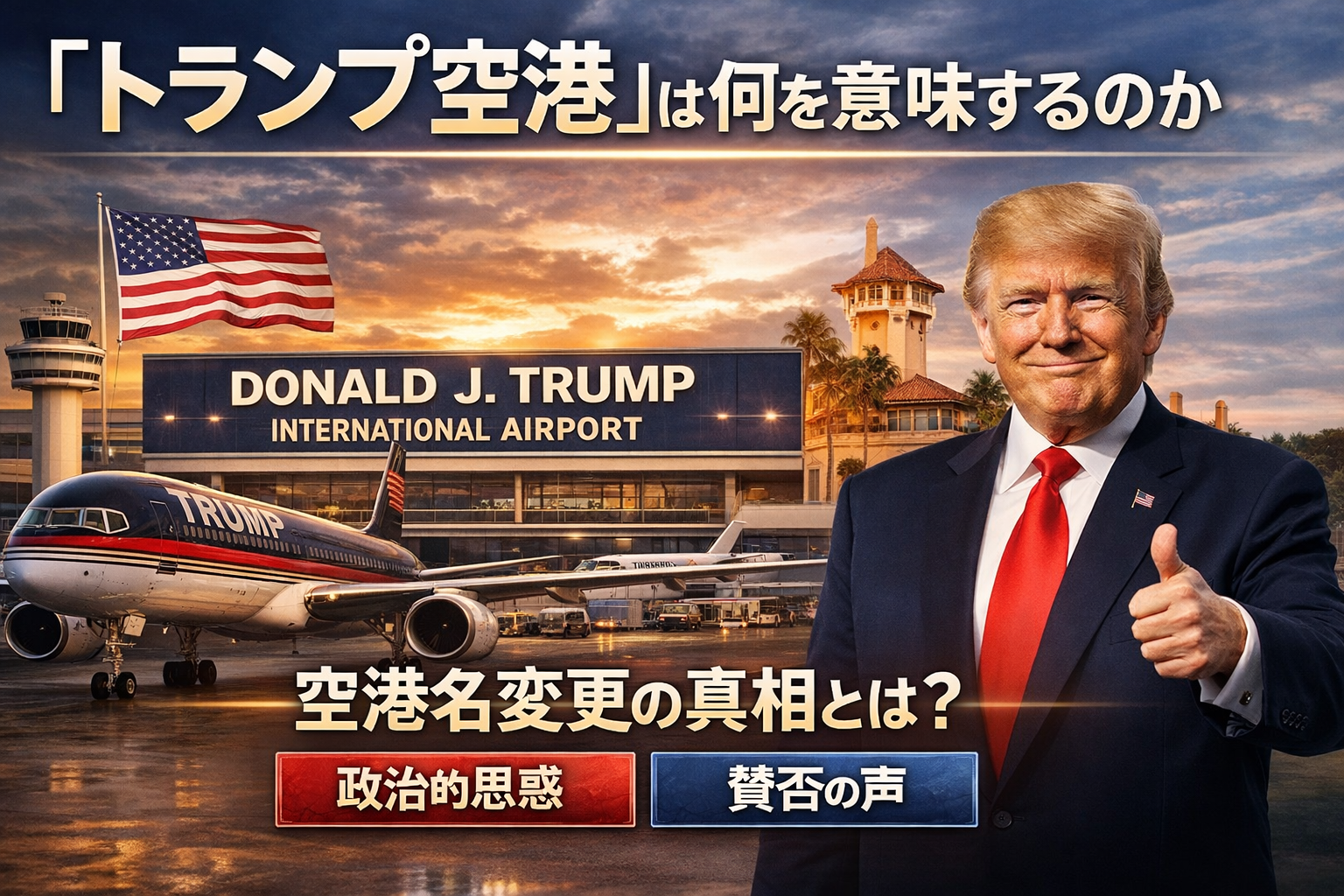
In the U.S. state of Florida, a bill to rename Palm Beach International Airport as “Donald J. Trump International Airport” has been passed by the state legislature. If signed by the governor and approved by the Federal Aviation Administration (FAA), the airport could be officially renamed as early as July.
The airport is located near President Trump’s residence, Mar-a-Lago. In a sense, it is a place where a personal symbolic base and public infrastructure geographically overlap. This proposed name change goes beyond a simple replacement of signage; it encompasses complex issues involving politics, economics, brand strategy, and the nature of public space.
Is Airport Naming an “Honor” or “Politics”?
It is not uncommon for airports and public facilities to be named after prominent figures. Across the United States, many airports bear the names of former presidents or individuals who have made significant contributions to their regions.
However, this case is distinctive in that the individual in question is still alive and is a sitting (or very recent) president with a strong political profile. This may be perceived not merely as an act of commemoration, but as a symbolic gesture carrying a political message.
An airport is the “face” of a region and a piece of infrastructure that embodies a city’s brand. Its name represents an expression of regional identity. While supporters may view the renaming as a source of pride, opponents may perceive it as a political imposition.
The Issue of an 800 Million Yen Cost
Democratic lawmakers have criticized the proposal, arguing that the cost of the name change could amount to approximately 800 million yen.
Renaming an airport involves far more than updating signs and displays. It requires changes to airline systems, adjustments in the management of international airport codes, revisions to contracts and documentation, updates to promotional materials, and modifications to digital databases. Rebranding is often more costly than it appears.
The core issue is not merely the amount of money involved, but whether such expenditure is reasonable as a public purpose. If it generates economic spillover effects or promotes tourism, it may be regarded as an investment. If it remains purely a political symbol, however, its cost-effectiveness may be called into question.
Another Issue: Trademark Applications
Further attention has been drawn to the fact that a company associated with the Trump family has reportedly filed a trademark application for the new name.
If trademark rights were granted, future legal relationships concerning brand usage could become more complex. While the Trump side has stated that the name would be used free of charge, from an intellectual property perspective, the boundary between a public facility name and a private corporate brand could become blurred.
This is not merely political news; it also raises the broader theme of “the branding of public assets.” When the name of public infrastructure such as an airport becomes linked to an individual brand, how far might the economic and legal consequences extend?
An Aspect of Urban Branding Strategy
At the same time, Palm Beach is already strongly associated with Trump.
The name change can also be interpreted as an urban strategy to reinforce that existing image. From the standpoint of tourism and investment attraction, it reflects the idea of leveraging the strong name recognition of “Trump.” In terms of mobilizing supporters and generating publicity, a certain marketing effect may be anticipated.
However, branding simultaneously generates support and division. Attaching a strongly political brand to an airport name carries the risk of fixing the region’s image in one particular direction.
How Much Neutrality Should Public Infrastructure Have?
This development raises a fundamental question: what does neutrality mean in the context of public infrastructure?
Airports are public spaces used by everyone. Some argue that their names should be broadly acceptable to as many citizens as possible. Others contend that, once decided through democratic procedures, such a renaming constitutes a legitimate political decision.
A name is not merely a label. It embodies values and messages. If the renaming is realized, it may be remembered as a symbolic event representing the fusion of politics and branding in the United States.
In Conclusion
Whether “Trump Airport” ultimately comes into being has not yet been finally decided. Nevertheless, this news prompts renewed reflection on the meaning of naming public facilities.
As a case where political symbolism, economic impact, intellectual property, and public interest intersect, it merits close attention going forward.
An airport’s name is not simply geographical information. It is a powerful message indicating what a region and a nation choose to symbolize.