
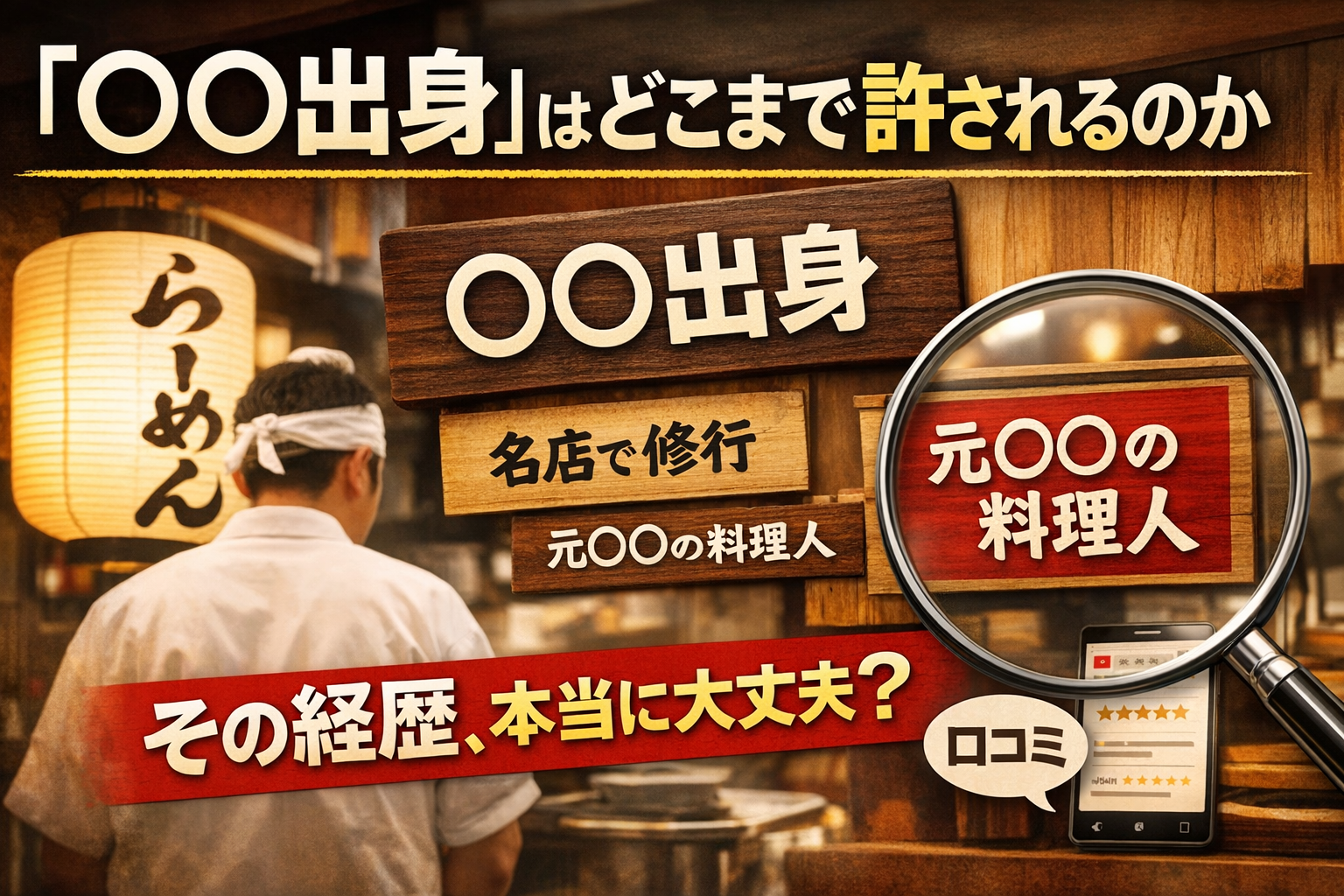
In March 2026, it was reported that the ramen shop Ginza Hachigo issued a public warning after confirming that multiple restaurants were describing themselves with claims such as “from Ginza Hachigo” or “former second-in-command at Ginza Hachigo.” According to the reports, Ginza Hachigo explained that “there is no fact that our techniques have been formally inherited,” and also clarified which shops were officially operated by, or receiving technical support from, the restaurant. At first glance, this may look like a dispute involving a single establishment, but I think it actually made very visible a broader issue affecting the entire restaurant industry: how professional background and pedigree are presented.
In the restaurant business, phrases like “from ___,” “trained at a famous establishment,” or “formerly a chef at ___” are hardly unusual. For consumers, such phrases are also a convenient shorthand for forming expectations about flavor and skill in a very short time. But now, through social media and review sites, a sentence in a shop profile or a short phrase on a sign can function directly as a customer-acquisition device and circulate as part of the brand itself. That is precisely why we now live in an era in which even expressions that look like nothing more than self-introductions are scrutinized for the extent to which they rely on someone else’s credibility.
The core issue is not “falsehood,” but “misleading impression”
What matters when considering this kind of representation is not simply whether it is true or false. Legally, a major dividing line is whether consumers are likely to be misled about the extent of the relationship between the shop and the famous establishment in question. According to explanations by the Japan Patent Office, “acts causing confusion through the use of a well-known indication” under Article 2, Paragraph 1, Item 1 of the Unfair Competition Prevention Act refers to conduct in which a person uses an indication of goods or business that is widely recognized among consumers and thereby causes confusion with another party’s goods or business. The explanation also makes clear that it is not necessary for actual confusion to have already occurred; a mere likelihood of confusion is enough.
From this perspective, even if it were true that someone “worked at Ginza Hachigo for a short time,” that alone does not necessarily mean they may go so far as to say they “carry on the taste of Ginza Hachigo” or were “directly taught by Ginza Hachigo.” That is because consumers may read into such wording not merely a history of employment, but a technical succession, official endorsement, or even a relationship close to a noren wake arrangement. The issue is not the person’s background itself, but how that background is packaged and presented to the market.
“From ___” may be gray, but “inherited” or “directly passed down” becomes much heavier all at once
According to the attorney’s view introduced in the reporting, statements such as “from ___,” “trained at ___,” or “formerly worked at ___” are, by themselves, not highly likely to immediately constitute a violation of the Unfair Competition Prevention Act. That is because ordinary consumers will usually understand that the business being operated is a separate shop from the famous establishment. By contrast, expressions such as “inheriting the taste of ___” or “directly passed down from ___” are more likely to create the impression that the business has received some degree of approval or recognition from the well-known establishment, and depending on the facts, may even raise issues of tort liability. What is clearly visible here is that, beyond the wording of the statute itself, the market implications carried by these words differ significantly.
In other words, what is truly risky in restaurant representations is not only outright falsehood. It is the type of expression that contains a small element of truth while inviting consumers to draw a much broader inference. Someone with experience limited to a short-term part-time job presents themselves as though they had been at the technical core of the restaurant. Someone who worked only on floor service calls themselves “formerly a chef at ___.” Such discrepancies are not merely a matter of exaggeration; they begin to resemble borrowing another party’s credibility. I think that is the real heart of this case.
What the law seeks to protect is not the shop name itself, but the circulation of goodwill
The underlying logic of the Unfair Competition Prevention Act is highly practical. What it seeks to protect is not only the name or logo itself, but the business goodwill accumulated in those identifiers. According to the Japan Patent Office’s explanation, “well-known” does not require nationwide fame; it is enough that a factual situation deserving protection has formed, even within one local area. Conversely, in the case of famous indications, there is a framework that regulates unauthorized use itself even without confusion, and the explanation notes that indications known on a nationwide scale are the typical example. In other words, even if a shop is not a large corporation, once it has acquired strong goodwill within a certain commercial area, the law may treat that goodwill as something deserving protection.
This framework is extremely important for the restaurant industry. The value of a ramen shop or restaurant does not arise from a single sheet of paper containing a recipe. Consumers’ choices are influenced by the entire story of who learned where, under what kind of training, and how that taste is being recreated. That is exactly why, when another person’s shop name is incorporated into that story, the matter no longer remains one of mere freedom of expression. Goodwill is intangible, but that is precisely why the damage caused by unauthorized use can be so great.
Trademark issues arise along a separate route
Another point that is easy to overlook is trademark law. Even if the way a representation is made is just barely acceptable under the Unfair Competition Prevention Act, if the name being used is a registered trademark and falls within the scope of infringement in relation to the designated goods or services, a separate trademark infringement issue may arise. The Japan Patent Office explains that using a registered trademark on the same designated goods or services, or using it within a similar range, may constitute trademark infringement, and that remedies such as injunctions and damages may be available.
In that sense, a shop cannot rest easy merely because it thinks, “this is just profile language, not the shop name itself.” Representations function everywhere consumers encounter the business: on signs, menus, websites, social media profiles, and advertising copy. A modern brand does not exist only at the entrance to the shop. Even a single sentence in a profile field can carry substantial legal significance.
What this news shows about the future etiquette of restaurant management
What this news showed, I think, is that the old success formula of borrowing the name of a famous establishment to attract customers is becoming increasingly dangerous. In the age of social media, exaggerated credentials can spread instantly, but denials and warnings spread just as quickly. And once legal issues overlap with that process, the result is no longer merely an online backlash; it leads directly to questions of credibility and to the costs of handling disputes. What is needed in the early stage of launching a restaurant is not borrowed authority, but the judgment to determine exactly how far one can speak accurately as one’s own shop.
A truly strong restaurant is not one that gains support by blurring its distance from a famous establishment. Rather, it is one that can honestly distinguish between what it learned where, and where its own identity begins. Consumers are not looking only at taste; they are also watching how words are used. The Ginza Hachigo case, I think, clearly showed that a restaurant’s profile text is no longer a mere decoration, but has itself become a matter of brand law and legal risk management.