
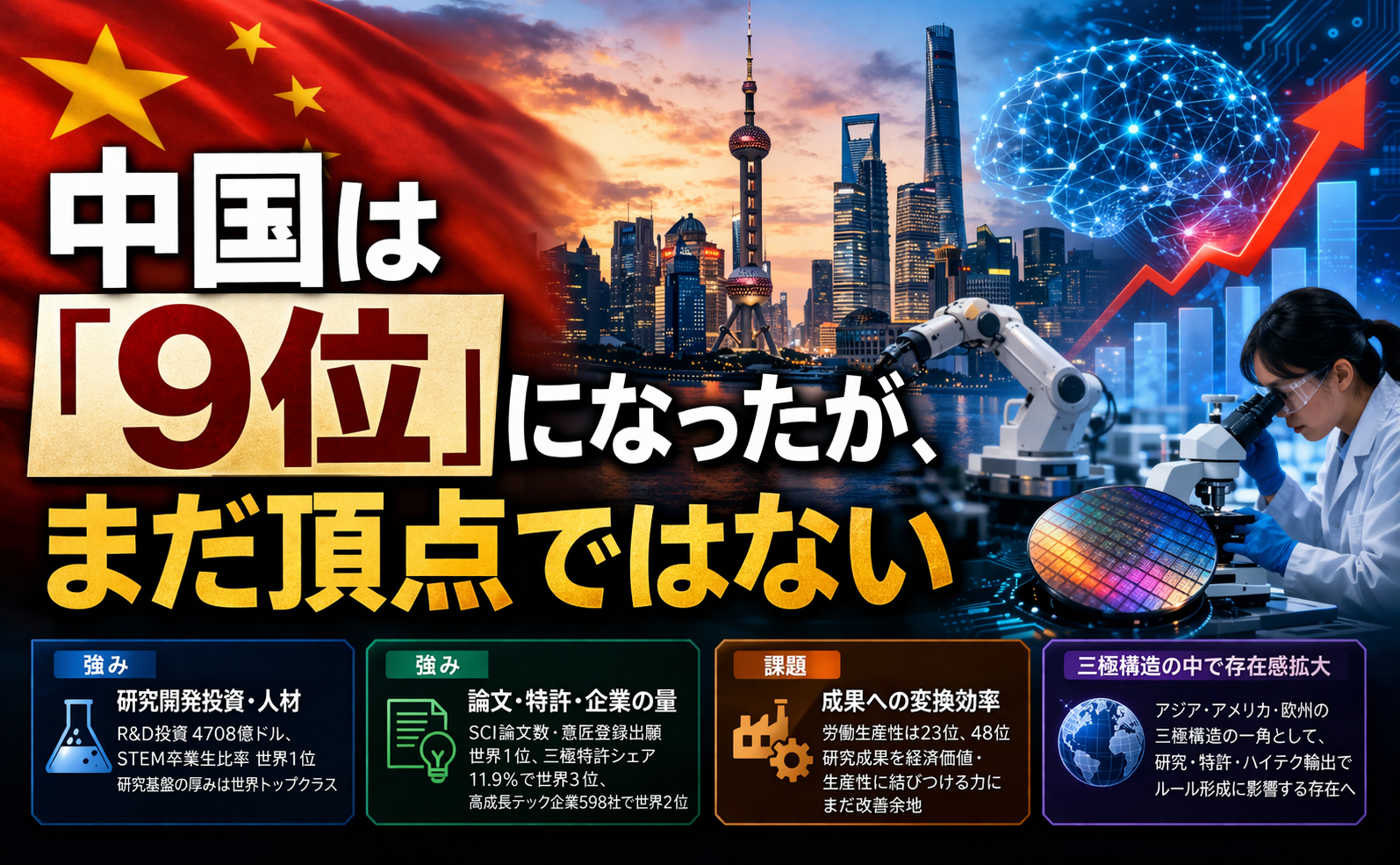
At the 2026 Zhongguancun Forum Annual Conference, which concluded on March 29, the Chinese Academy of Science and Technology for Development released the National Innovation Index Report 2025, showing that China’s overall ranking rose by one place from the previous year to ninth. This news should be viewed not simply as a story of ranking improvement, but as a lens through which to understand what stage China’s innovation development has now reached. It should also be noted that this “National Innovation Index” is China’s own index, composed of 43 indicators across five categories covering 60 countries, and is therefore different from WIPO’s Global Innovation Index, which covers 139 economies. Accordingly, the figure that “China ranks ninth in the world” cannot be compared directly and side by side with other international rankings.
More important than the higher ranking is where China is strong and where it is bottlenecked
What is particularly important in this report is that China’s strengths and weaknesses are now quite clearly differentiated. China ranks fifth in innovation resources, tenth in knowledge creation, and ninth in enterprise innovation, placing it among the top performers in R&D input, the output of papers and intellectual property, and corporate technological activity. On the other hand, it ranks only 23rd in innovation performance and 18th in innovation governance. In other words, China is already quite strong in phases such as investing research funds, attracting talent, producing papers and patents, and increasing the number of promising companies. However, there is still significant room for improvement when it comes to translating those strengths smoothly into economy-wide productivity and institutional reliability.
China’s strength lies in scale and sustained investment
What supports China’s current position is, above all, its overwhelming scale. According to the report, China’s R&D expenditure in 2023 reached US$470.88 billion, about half that of the United States, while its R&D intensity stood at 2.58 percent. In addition, China ranked first in the world in the share of STEM graduates, and second in the number of world-class research institutions, highly cited scientists, and graduate students enrolled. This clearly indicates the depth of its research base and its strong capacity to supply research talent. On the corporate side as well, China ranked third in the world with an 11.9 percent share of triadic patents, and second with 598 high-growth technology companies, showing that the foundation of scale has been built up substantially in both research and corporate activity. Moreover, according to explanations from China’s Ministry of Science and Technology as of March 2026, total nationwide R&D spending in 2025 exceeded 3.92 trillion yuan, while the share allocated to basic research reached 7.08 percent. This shows that the country’s commitment to continued investment remains quite clear.
Why this still does not represent the finished form of a science and technology superpower
That said, the report also presents China’s weaknesses with considerable frankness. In knowledge creation, China ranks first in the world in the number of SCI papers, citations, highly cited papers, and design patent applications. Yet it ranks only 49th in papers per US$1 million and 39th in the share of highly cited papers. Furthermore, in innovation performance, its labor productivity ranks 48th. This suggests that even though China produces a large absolute volume of papers, patents, and startups, there are still challenges in turning those outputs efficiently into high added value and broader gains in social productivity. When officials at the Chinese Academy of Science and Technology for Development said that China is at a critical stage of “climbing from the plateau to the summit,” I believe this is exactly what they meant. China has come up the mountain with great momentum, but what is needed to reach the top is no longer scale alone, but quality and conversion efficiency.
What deserves attention is China’s changing role within the world’s tripolar structure
The report states that global innovation continues to maintain a tripolar structure consisting of Asia, the Americas, and Europe. In fact, in WIPO’s GII 2025, six economies from East and Southeast Asia and Oceania—South Korea, Singapore, China, Japan, Hong Kong, and Australia—were included in the top group, showing that East Asia continues to hold a strong presence. Within that structure, China is no longer merely a country catching up. In areas such as research clusters, patents, high-tech exports, and corporate R&D, it is increasingly becoming a player capable of influencing the formation of global rules. In the 2025 WIPO edition as well, China placed in the top 10 and stood out clearly among the middle-income economies. China’s own index and the WIPO index are different measures, but the fact that both point in the same direction—toward China’s rise—should not be dismissed lightly.
What this news means for Japan
From Japan’s perspective, the important thing is not to be satisfied with a superficial comparison such as “China was ninth and Japan was sixth.” In fact, in WIPO’s GII 2025, Japan ranked 12th and China 10th, showing that the ordering changes depending on the index used. In other words, the strengths of countries cannot be fully captured by a single ranking. What matters more is that China is pushing forward, on a national scale, the linkage among research talent, research funding, intellectual property, startups, and industrial implementation. For Japan, the real issue is not simply how to preserve its rank, but how to redesign, as an integrated whole, its research capacity, talent base, commercialization, startup ecosystem, and productivity improvement. China’s rise is not just an external piece of news for Japan; it is also a mirror reflecting the weaknesses in Japan’s own innovation policy linkages.
Conclusion
This latest “China at No. 9” story means both that China is already very strong and that it is still not a finished product. Its strengths lie in R&D investment, talent supply, the sheer volume of papers and patents, and the depth of its corporate sector. Its weakness lies in its ability to convert those assets efficiently into economic outcomes and institutional trust. Therefore, the essence of this news is not simply that “China moved up,” but that “China’s innovation system has entered a phase in which it is shifting from expansion in scale to a phase where quality and conversion efficiency are being tested.” Whether China can truly move closer to the summit as a genuine “science and technology superpower” will depend on how effectively it can link research outputs to productivity, corporate value, and institutional quality.