
Introduction
At first glance, the U.S. presidential proclamation issued on April 2, 2026, appears to be a sweeping hardline measure against imported pharmaceuticals, especially when viewed only through the headline of “a 100% additional tariff on patented pharmaceuticals.” However, when one looks at the actual institutional design, this measure is not a uniform tariff. The scope is limited to pharmaceuticals that remain covered by valid U.S. patents and are listed in the FDA’s Orange Book or Purple Book, as well as related raw materials, while generics are excluded for the time being. In addition, the tariff rate is finely differentiated depending on factors such as onshoring plans, drug pricing agreements, and the status of agreements with particular countries or regions, with the lowest applicable rate to be used.
The Essence of the 100% Tariff
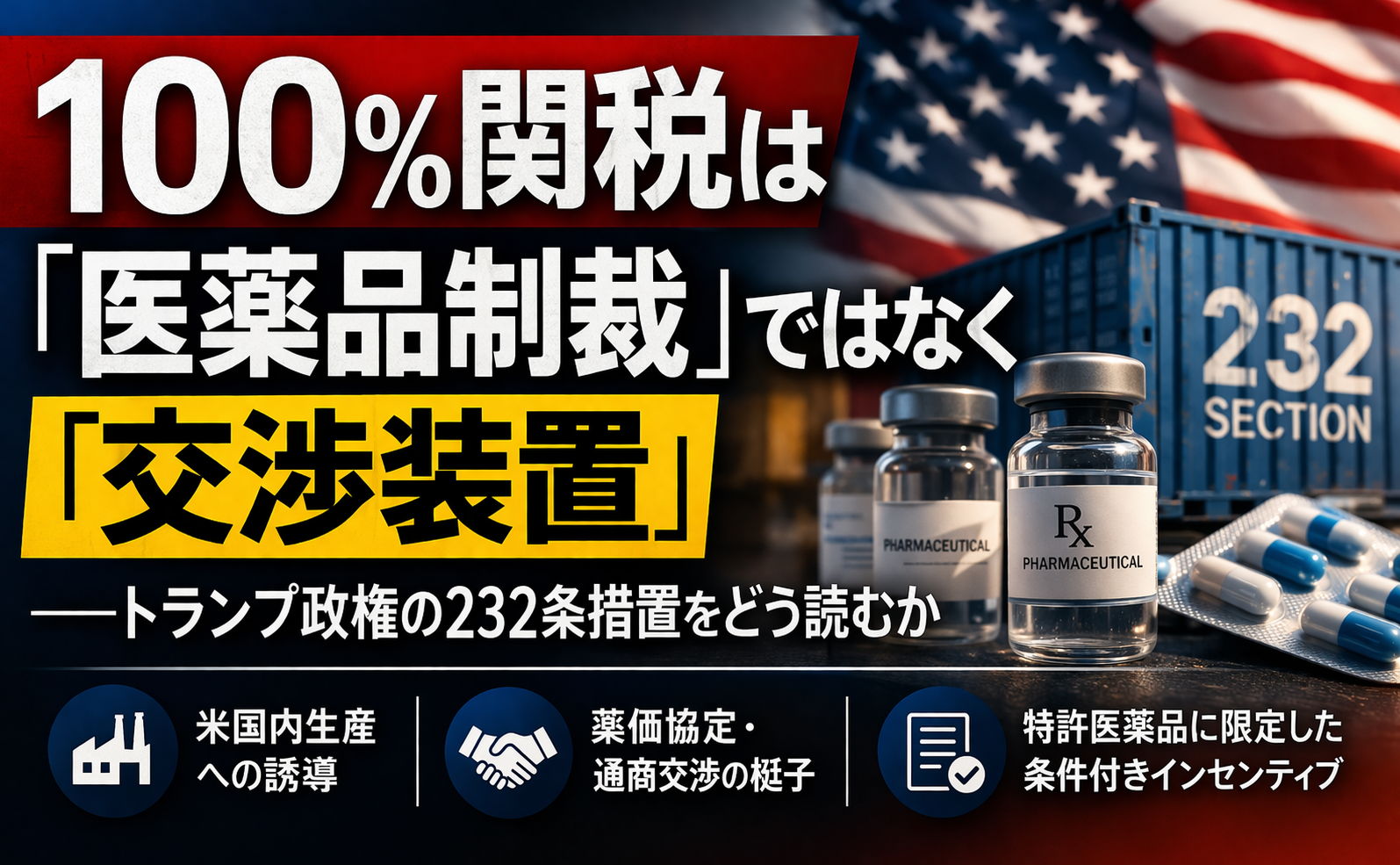
The essence of this measure lies less in the tariff itself than in the attempt to use tariffs to alter corporate behavior. The presidential proclamation sets the base tariff rate at 100%, while granting a 20% rate through April 1, 2030, to companies with U.S. production plans approved by the Secretary of Commerce. Products from Japan, the EU, South Korea, Switzerland, and Liechtenstein are subject to a 15% rate, and products from the United Kingdom to a 10% rate. Furthermore, companies that satisfy both the MFN drug pricing agreement requirement and the onshoring requirement are eligible for a 0% rate through January 20, 2029. If multiple tariff rates could apply to the same product, the lowest rate is to be applied. This is therefore better understood not as a “punitive tariff,” but as a conditional incentive structure designed to encourage companies and governments to commit to “U.S. domestic production,” “drug price concessions to the United States,” and “participation in trade negotiations.”
The Changing Use of Section 232
Section 232 was originally designed as a mechanism under which the Secretary of Commerce investigates whether imports threaten U.S. national security, after which the President may take action based on the findings. With respect to pharmaceuticals, the Secretary of Commerce began the investigation on April 1, 2025, examining the impact of imported pharmaceuticals, pharmaceutical ingredients, and derivative products on national security. Based on the results of that investigation, the current presidential proclamation characterizes patented pharmaceuticals and related raw materials as indispensable to both U.S. military and civilian healthcare, and frames foreign dependence as a national security problem. What is especially important here is that the proclamation does not stop at a discussion of “supply stability.” It also incorporates the view that intervention by foreign governments has undermined the competitiveness of U.S. industry. In other words, while clothed in the language of a national security provision, this Section 232 action is in substance being used as an instrument of industrial policy and external economic pressure.
The Policy Intent Revealed by the Narrowing of the Target
It is also telling that the measure focuses on patented pharmaceuticals rather than generics. The annex defines patented pharmaceuticals as “drugs that are the subject of a valid, unexpired U.S. patent and are listed in the FDA’s Orange Book or Purple Book,” while distinguishing generics as off-patent, off-exclusivity products. In addition, zero-tariff exceptions are recognized for certain fields, including orphan drugs, nuclear medicine, plasma-derived products, cell and gene therapies, and veterinary pharmaceuticals. This shows that the policy is not simply aimed at suppressing pharmaceutical imports as a whole, but rather at concentrating on areas that are high-value, possess negotiating leverage, and can readily be linked to price policy.
What This Means for Japanese Companies
Japan has been placed in the 15% category, alongside the EU, South Korea, Switzerland, and Liechtenstein. This does not amount to a full exemption. Japan has not been “excluded from the 100% tariff target”; it has merely been given access to a lower-rate category on a conditional basis. Moreover, that 15% is a level that includes the general tariff rate, and if the conditions for a lower rate are met, that lower rate will take precedence. Accordingly, the key point for Japanese companies is not to take comfort in the idea that “Japan is at 15% for now, so there is no immediate problem.” Rather, this system should be understood as one that forces management to decide how far to go in terms of U.S.-bound production investment, price negotiations, and supply chain restructuring.
The Effective Dates Show “Pressure with a Grace Period”
The tariff does not take effect immediately. For companies listed in Annex III, it becomes effective at 12:01 a.m. Eastern Time on July 31, 2026, and for all others, on September 29, 2026. The fact sheet likewise explains that large companies are given a 120-day grace period, while smaller companies are given 180 days. This design suggests that what the administration really wants is not immediate tariff revenue, but rather progress in negotiations with companies and governments during that grace period. Put differently, this is not only a “tariff decision,” but also the setting of a “negotiation deadline.”
Expected Side Effects
That said, the system also has clear side effects. While the policy objective of reducing import dependence is understandable, pharmaceuticals differ from metals and general industrial products in that production relocation takes time, and the sector is subject to significant constraints relating to regulatory approvals and quality assurance. In fact, industry stakeholders have already voiced opposition, warning that the measure could disrupt global manufacturing and supply networks and impair research and development as well as patient access. Accordingly, this policy can be seen as one that has suddenly brought to the surface the tension between “strengthening national security” and “maintaining access to healthcare.”
Conclusion
How this pharmaceutical Section 232 action should be assessed cannot be determined merely by the size of the 100% figure. What deserves closer attention is that the United States has redefined pharmaceuticals as a “national security sector” and, on that basis, bundled tariffs, domestic investment, drug price negotiations, and trade agreements with allied countries into a single policy package. This is a development that cannot be fully understood through the traditional binary of free trade versus protectionism. The key questions going forward are how far companies will go in accepting U.S.-bound investment and price concessions, how far low-tariff countries including Japan will be able to secure regulatory stability, and whether this logic will spread within one year to the generic drug sector, which has been designated for future review. This measure should therefore be read not only as news about pharmaceutical tariffs, but also as a declaration of a new U.S. negotiating model for the pharmaceutical industry.