
Introduction
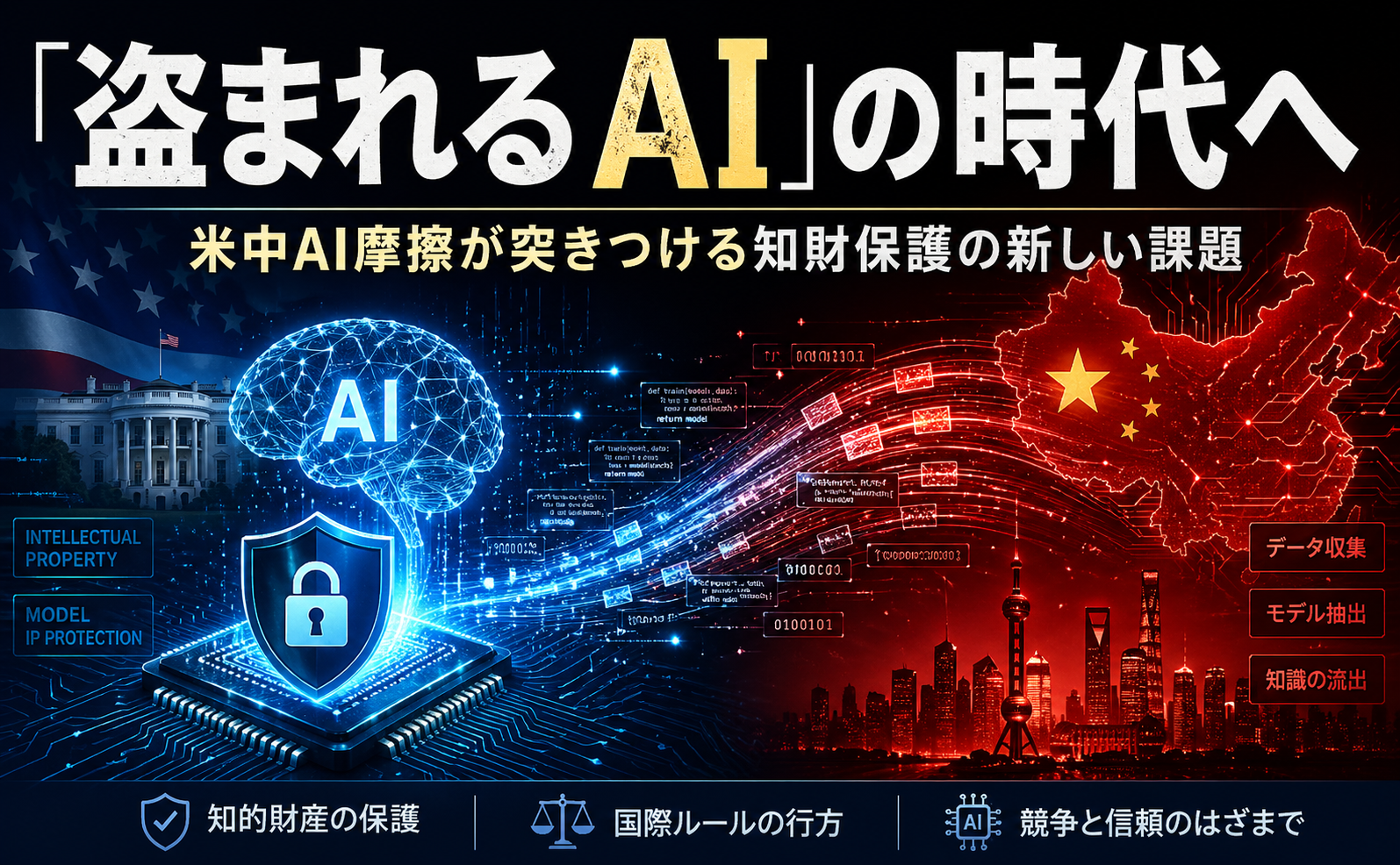
The White House has released a memorandum accusing China-based actors of stealing intellectual property held by U.S. AI research institutions on an “industrial scale.” The memorandum was prepared by Michael Kratsios, Director of the White House Office of Science and Technology Policy. According to the U.S. side, these actors have systematically extracted capabilities and knowledge from America’s most advanced AI models by using tens of thousands of alternative accounts and jailbreak techniques designed to bypass AI restrictions. Meanwhile, the Chinese Embassy has rejected these claims as “groundless,” arguing that China places great importance on the protection of intellectual property rights. With a U.S.-China summit approaching, this issue could further heighten tensions in the technological rivalry between the two countries.
The Core Issue Is That the Form of “Theft” Has Changed
What is important about this news is that the issue is not limited to conventional cyberattacks or the theft of research materials. What the United States is taking issue with is conduct such as feeding massive amounts of input into AI models, learning their capabilities and behavior from their responses, and transferring those capabilities to another model. This relates to areas commonly known as “distillation” and “model extraction.”
Of course, in AI training and research, referring to the outputs of existing models is not always illegal or improper in itself. However, if actors use disguised accounts or circumvention techniques against closed commercial models to extract capabilities on a large scale while bypassing terms of use and safety controls, it becomes difficult to characterize such conduct as mere research use. This is where the difficulty of modern AI-related IP issues lies.
Intellectual Property in the AI Era Cannot Be Protected by “Code” Alone
Until now, intellectual property protection has mainly focused on source code, papers, design drawings, trade secrets, patents, and similar assets. In the case of AI models, however, the core of their value does not lie only in the code itself. Training data, weights, reasoning capabilities, safety measures, response tendencies, and specialized problem-solving abilities together form their competitive strength.
For that reason, once an AI model is made available for external use, users can infer a certain degree of its capabilities from the relationship between inputs and outputs, even if they cannot directly see the model’s internal structure. If this is done on a large scale, it becomes possible to extract competitive value in substance, even without stealing the model itself.
In this respect, IP protection in the AI era cannot rely solely on the traditional idea of “keeping confidential information from leaving the company.” It is necessary to design, from both institutional and technical perspectives, how much use should be permitted on the assumption that the model will be accessed externally, and at what point such use should be deemed improper extraction.
The United States Is Not Only Aiming to Criticize China
This memorandum is a political message naming China, but it is also a warning to AI companies within the United States. The U.S. administration is reportedly considering working with AI companies to detect improper model extraction, develop defensive measures, and examine actions against violators.
This reflects the United States’ posture of treating AI as a foundational technology for national security. Just as with semiconductor export controls, the capabilities of AI models themselves are beginning to be viewed as something close to strategic goods. In particular, as AI capabilities related to cyberattacks, defense, intelligence analysis, and military use become more advanced, the leakage or imitation of models can no longer be treated as a matter of ordinary competition between companies.
In other words, this issue is not limited to the individual question of whether China stole technology from U.S. companies. The essence is that the United States is trying to protect the capabilities of AI models as national assets.
However, Drawing the Line Is Not Easy
At the same time, it would be insufficient simply to accept the U.S. claims as they are. In the AI world, the boundaries among open-source models, commercial APIs, research use, benchmark evaluation, distillation, imitation, and reverse engineering are extremely ambiguous.
For example, a company improving its own model by referring to a publicly available model can be regarded as part of technological development. Conversely, if a company carries out large-scale disguised access to a closed model and intentionally bypasses restrictions to extract capabilities, the issue becomes closer to unfair competition or trade secret misappropriation.
If political confrontation alone moves ahead without clearly defining these boundaries, legitimate research exchange and open technological development may also be chilled. The challenge is how to balance the protection of AI competitiveness with the maintenance of openness in AI research.
U.S.-China AI Competition Is Expanding from “Semiconductors” to “Model Capabilities”
U.S.-China technological friction has so far centered mainly on semiconductors, manufacturing equipment, cloud services, and communications infrastructure. This latest issue, however, shows that the focus of competition is shifting toward the capabilities of AI models themselves.
The Associated Press also refers to a Stanford University report indicating that the performance gap between top AI models in the United States and China is narrowing. As the view spreads that Chinese AI companies are rapidly catching up with the United States, the U.S. side appears to be strongly questioning whether this catch-up is the result of legitimate technological innovation or improper extraction of capabilities from U.S. models.
Going forward, policy issues may expand beyond semiconductor export controls to include restrictions on access to AI models, monitoring of API use, cross-border account management, and traceability of model outputs.
This Is Also Relevant to Japanese Companies
This issue should not be dismissed merely as a matter of U.S.-China confrontation. Japanese companies will face the same challenges as they increasingly use AI models in business operations and research and development.
When companies input their own know-how into AI, they need to confirm how that information will be handled. In addition, when companies provide AI services themselves, they need to take measures against mass access by users, violations of terms of use, model extraction, prompt attacks, and jailbreaks.
Furthermore, when companies use the outputs of another company’s AI to build their own models or services, they must also be aware of contractual terms, terms of use, copyright, trade secrets, and issues under the Unfair Competition Prevention Act. AI outputs are convenient, but if the route by which they are used is opaque, they may later return as an intellectual property risk.
Conclusion
The White House memorandum shows that intellectual property protection in the AI era has entered a new stage. The value of AI models extends beyond visible source code and materials to include response capabilities, reasoning capabilities, safety design, and operational know-how. As a result, merely providing AI externally now carries a certain risk of intellectual property leakage.
That said, it will be necessary to wait for further verification to determine how far the U.S. claims are supported by concrete evidence. China has also pushed back, and this issue is a complex point of contention involving not only technology, but also diplomacy, security, and industrial policy.
What matters is to clarify the boundaries between AI “use” and “extraction,” “learning” and “theft,” and “competition” and “misconduct” from both technological and legal perspectives. The intellectual property war over AI has already moved beyond laboratories and companies, and is now becoming a full-fledged axis of competition between nations.