
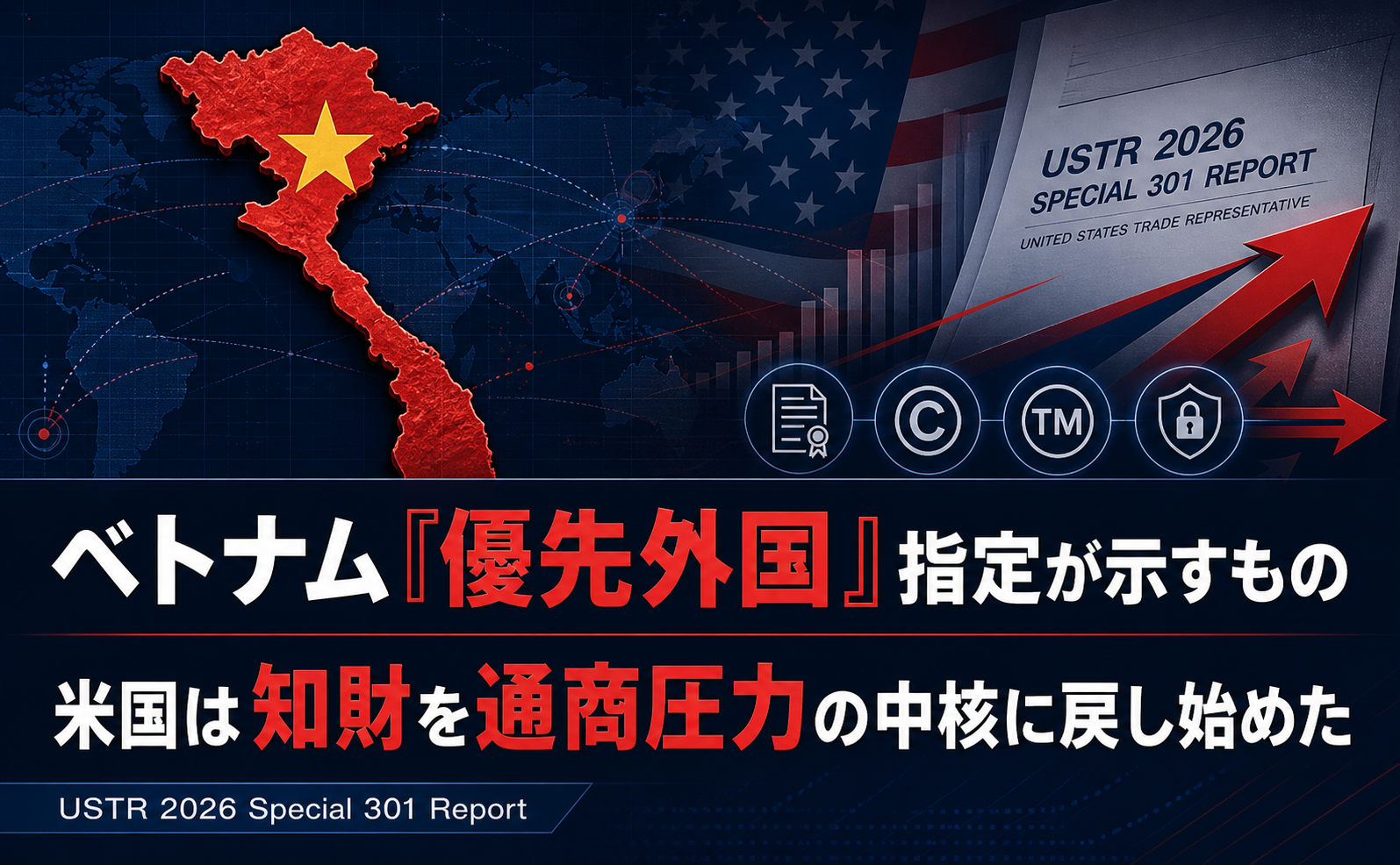
In its 2026 Special 301 Report, released on April 30, 2026, the Office of the United States Trade Representative (USTR) designated Vietnam as a “Priority Foreign Country,” the most serious category of concern regarding the protection and enforcement of intellectual property rights. This is the first such designation in 13 years, and USTR has stated that it will decide within 30 days whether to initiate an investigation under Section 301 of the Trade Act of 1974. At the same time, Argentina and Mexico were moved from the Priority Watch List to the Watch List, while the European Union was newly added to the Watch List. Rather than being merely an update to an annual report, this development should be understood as a signal that the United States is once again beginning to use intellectual property issues as a major instrument of pressure in trade negotiations.
What Was Seen as the Problem
USTR identified five specific reasons for taking issue with Vietnam this time: inadequate measures against online piracy, weak enforcement against widespread counterfeiting, insufficiently effective border measures, inadequate enforcement against the use of unlicensed software, and the absence of criminal measures against cable and satellite signal theft. What this makes clear is that the United States is not concerned only with patents. Rather, it is focusing on the broader intellectual property ecosystem as a whole, including copyrights, trademarks, software use, and customs enforcement.
Why Vietnam, and Why Now?
This designation did not come out of nowhere. According to the USTR report, the United States proposed an intellectual property work plan to Vietnam in 2020 and presented a revised proposal in 2023, but even after subsequent bilateral discussions, sufficient progress was not seen. The report also expressly states that there had been no meaningful progress in the more recent negotiations aimed at a “reciprocal, fair, and balanced trade agreement.” In other words, this measure indicates that the United States has moved from the stage of “encouraging improvement through dialogue” to the stage of “increasing institutional pressure.”
The Real Issue Is Not Simply “Criticism of Vietnam”
What matters is that this news should not be read merely as criticism of Vietnam. The designation of “Priority Foreign Country” is an exceptionally serious institutional classification used for countries that engage in the most severe acts, policies, or practices related to intellectual property, and that also fail to demonstrate good-faith negotiations or meaningful progress. Moreover, in this announcement, USTR explicitly stated that its top priority is to use every available enforcement tool to address unfair trade practices. Accordingly, the key point here is that intellectual property has returned to the forefront not as a peripheral issue of cultural or industrial policy, but as an enforcement tool of external trade policy.
What the Restructuring of the Watch Lists Means
Vietnam was not the only country subject to a tougher posture in this year’s report. In the 2026 edition, China, India, Indonesia, Russia, Venezuela, and Chile remained on the Priority Watch List, while Argentina and Mexico were moved to the Watch List, and the European Union was newly added to that list. This suggests that the United States is not simply hardening its external stance across the board. Rather, it is finely calibrating the intensity of intellectual property pressure by country and region, based on whether conditions are improving or deteriorating. The addition of the EU to the Watch List is particularly symbolic, showing that U.S. intellectual property trade policy is directed not only at emerging economies but also at advanced economies and major economic blocs.
Points Japan Should Be Watching
From the standpoint of Japanese companies and practitioners, this development is not merely a “Vietnam-related intellectual property issue.” For companies with manufacturing bases, sales networks, content distribution channels, software use, or brand operations in Vietnam, intellectual property protection should now be understood not only as a legal issue but also as a matter of trade risk and supply chain management. At the same time, sanctions are not triggered immediately at this stage. The first step is that USTR will decide within 30 days whether to begin a Section 301 investigation, and if it proceeds with such an investigation, the process will move toward consultations. Therefore, the appropriate way to view the current situation is not as “sanctions have been decided,” but rather as entry into a stage where an institutional warning could connect to actual trade measures.
Conclusion
USTR’s latest decision is more than an annual report pointing out deficiencies in intellectual property protection. It shows that the United States is repositioning intellectual property as a practical weapon in trade negotiations. Vietnam’s designation as a Priority Foreign Country is a symbolic first step in that direction. The focus going forward will be on whether USTR actually proceeds to a Section 301 investigation and how far Vietnam can go in presenting concrete improvements within a short period of time. Intellectual property should no longer be seen merely as a matter of rules. It has become a negotiating variable that can influence both market access and broader geopolitical economic relations.