
Introduction
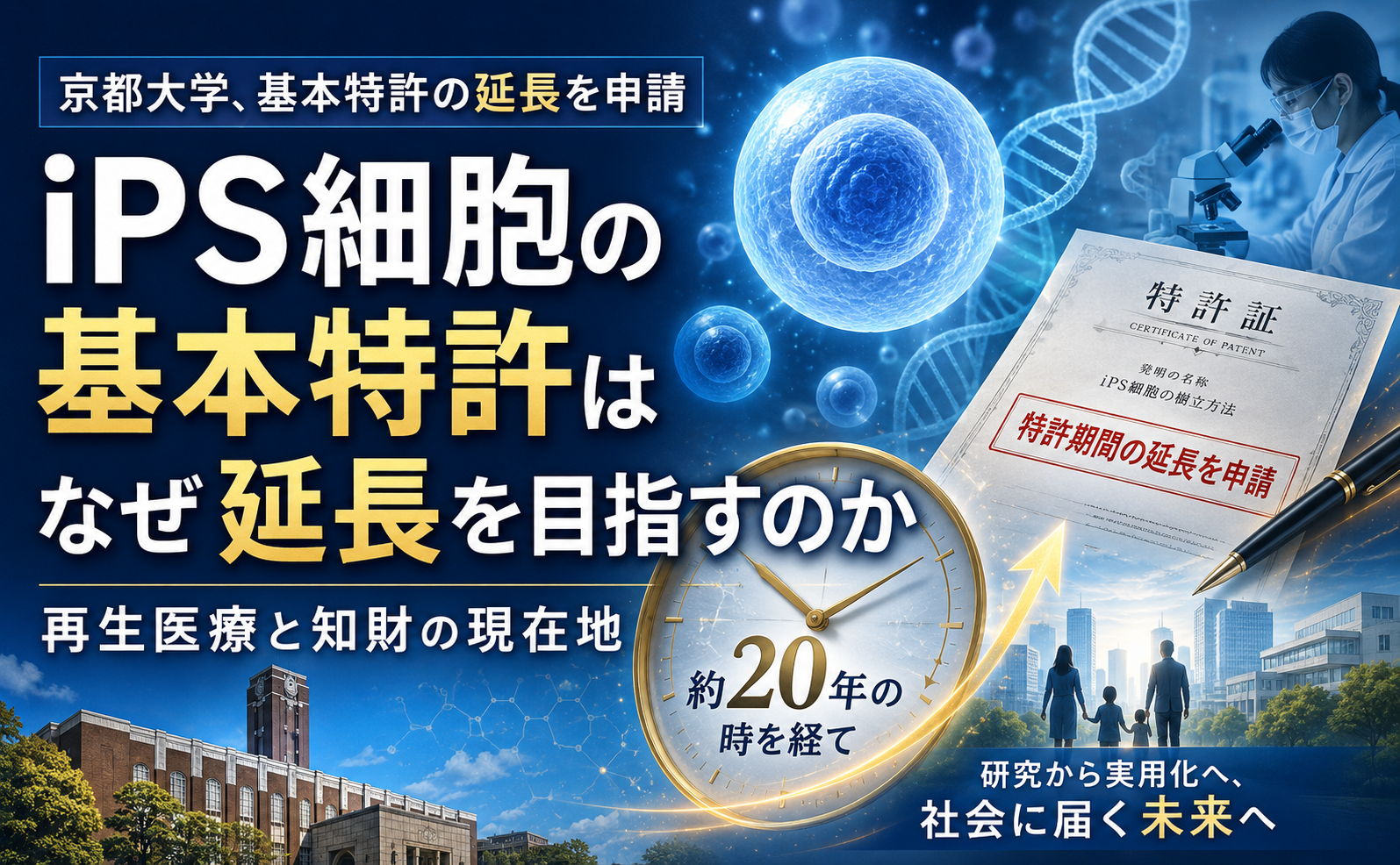
On May 7, 2026, Kyoto University announced that it plans to apply to the Japan Patent Office by June for an extension of the term of a core patent related to induced pluripotent stem cells, or iPS cells. In principle, patents covering foundational iPS cell technology are set to expire this December, 20 years after the international patent application filed in December 2006. However, because two regenerative medicine products using iPS cells received conditional and time-limited approval this March, the possibility has emerged that the patent term extension system may apply. In the pharmaceutical and regenerative medicine fields, it often takes many years for research findings to reach society in the form of actual products, and as a result, the patent protection period and the timing of commercialization can become misaligned. This latest development can be seen as once again raising the broader question of how that gap should be addressed.
What This News Means
This issue is not simply about “a famous university wanting to extend a patent.” More importantly, it highlights the reality that, in the case of foundational technologies such as iPS cells, the long time required for research results to be put into practical use does not necessarily fit neatly with the design of the patent system.
Since the successful creation of mouse iPS cells was announced in 2006 and human iPS cells in 2007, iPS cells have developed into one of the most symbolic technologies in regenerative medicine. Yet despite their enormous scientific significance, it has taken a very long time for them to be approved as actual medical products. That is because commercialization requires a long process distinct from basic research, including safety verification, quality control, the establishment of manufacturing systems, and coordination with regulatory authorities.
As a result, even though the patent system formally grants a 20-year term, the actual period during which the rights holder can obtain sufficient business benefits tends to be considerably shorter. This extension application can therefore be understood as an attempt to make use of a system designed to bridge that gap.
Why the Extension of a “Basic Patent” Is Drawing Attention
What is particularly noteworthy is that the patent in question is not an individual product patent, but a “basic patent” relating to iPS cells. A basic patent is one that covers an invention forming the starting point or common foundation of a technological field, and it can have a major impact on later applications and developments.
If such a patent is extended, the effect is not limited to lengthening the protection period for a single product. It may also influence the overall use of the technology and the structure of licensing arrangements. From the university’s perspective, this has significance in securing proper protection for research achievements built up over many years and in maintaining the foundation for the circulation of research funding and technology transfer. On the other hand, from the standpoint of industry and research and development, important concerns include exactly what falls within the scope of the extension and how far the exercise of rights may reach.
In other words, this extension application should not be viewed as a simple administrative use of the system. It should be understood as an issue concerning the balance between the protection and use of foundational technologies.
Regenerative Medicine Is an Industry That Takes Time
One of the defining characteristics of regenerative medicine is the high level of uncertainty in research and development, combined with the long period required before commercialization. In the case of ordinary industrial products, the cycle from invention to commercialization is often relatively short, and a 20-year patent term may be sufficient. In regenerative medicine, however, the situation is different.
With technologies involving cells, it is not enough for something to be theoretically possible. It is also necessary to ensure, on a stable basis, the level of quality and safety required for actual treatment. In addition, strict review is required before such technologies can be applied to patients. Given these circumstances, the importance attached to patent term extensions in regenerative medicine should be seen not as an exceptional privilege, but as an adjustment measure that reflects the nature of the industry.
It is particularly symbolic that the two products granted conditional and time-limited approval by Japan’s Ministry of Health, Labour and Welfare have, as a result, created the conditions necessary for Kyoto University’s extension application. The fact that the original patent is already close to expiration just as the research results are finally being recognized, in institutional terms, as products illustrates how long a process regenerative medicine truly is.
An Issue That Should Also Be Viewed as Part of a University’s Intellectual Property Strategy
This news is also highly suggestive from the perspective of a university’s intellectual property strategy. Universities have traditionally been seen as institutions that place primary importance on academic publications and scholarly evaluation. In recent years, however, they have increasingly been expected to protect research results through patents and turn them into partnerships with companies and licensing revenue.
In particular, with research themes such as iPS cells that possess international competitiveness, patents are not merely legal rights. They are also a source of negotiating power for bringing research achievements into society. It is also important for companies to have clear rights relationships surrounding a technology so that they can invest in development with confidence. From that perspective, Kyoto University’s effort to extend the basic patent can be seen not only as a defensive move, but also as a strategic decision aimed at sustaining industry-academia collaboration.
Moreover, the more widely a university-originated technology is used in medicine and industry, the more its management takes on a public character. A university’s intellectual property strategy is no longer an issue for universities alone. It is now connected to national research policy and industrial policy as well.
Expectations and Concerns If the Extension Is Approved
If the extension is approved, it may provide a certain degree of predictability for research institutions and licensees, thereby supporting continued investment. This is especially significant in fields such as regenerative medicine, where the time required to recover investment is long. For those who have devoted substantial funding and time to basic research, it is reasonable as a matter of policy that the results should receive a certain period of protection once they finally reach the stage of social implementation.
At the same time, if the effect of the extension is interpreted too broadly, it could raise psychological barriers for subsequent research and development and for market entry. This is particularly true in the case of rights relating to foundational technologies, where clarity of scope and transparency in operation are essential. The purpose of the extension system is to protect inventors and rights holders, but that purpose should not be the enclosure of technology. Ultimately, it should serve the broader spread of technology throughout society.
Accordingly, rather than treating the use of the system itself as problematic, it is necessary to calmly observe how the exercise of rights and licensing practices will actually be handled after any extension is granted.
The Essential Point This News Reveals
The essential point of this news, in my view, is that iPS cells as an advanced technology have entered a stage in which they are being dealt with not only as research achievements, but also within the real frameworks of institutions and industry. Roughly 20 years after the spectacular success of basic research, the question now is no longer simply what has been discovered, but how it can be firmly established in society.
Patents are often discussed as tools of exclusivity, but in essence they are mechanisms designed to promote technological development by exchanging disclosure for protection. In fields such as regenerative medicine, where commercialization takes many years, whether the institutional design is keeping pace with reality has a direct bearing on both the speed of technological diffusion and the continuity of investment. Kyoto University’s latest move shows that the value of iPS cells remains high, while also raising anew the question of how Japan’s intellectual property system should respond to the time horizon of advanced medical technologies.
Conclusion
Kyoto University’s policy of applying for an extension of the basic patent for iPS cells is a natural development against the backdrop of progress in regenerative medicine, while at the same time carrying highly important policy implications. As long as it takes a great deal of time for research achievements to reach society in the form of products, the patent system must also be operated with enough flexibility to reflect that reality.
At the same time, the stronger the protection granted to foundational technologies, the more essential fairness and transparency become in their operation. The key issue going forward will be how to balance protection that promotes research with openness that expands social implementation. This news should be understood not only as a matter affecting the future of iPS cells, but also as an opportunity to reconsider the very nature of regenerative medicine and university intellectual property in Japan.