
Introduction
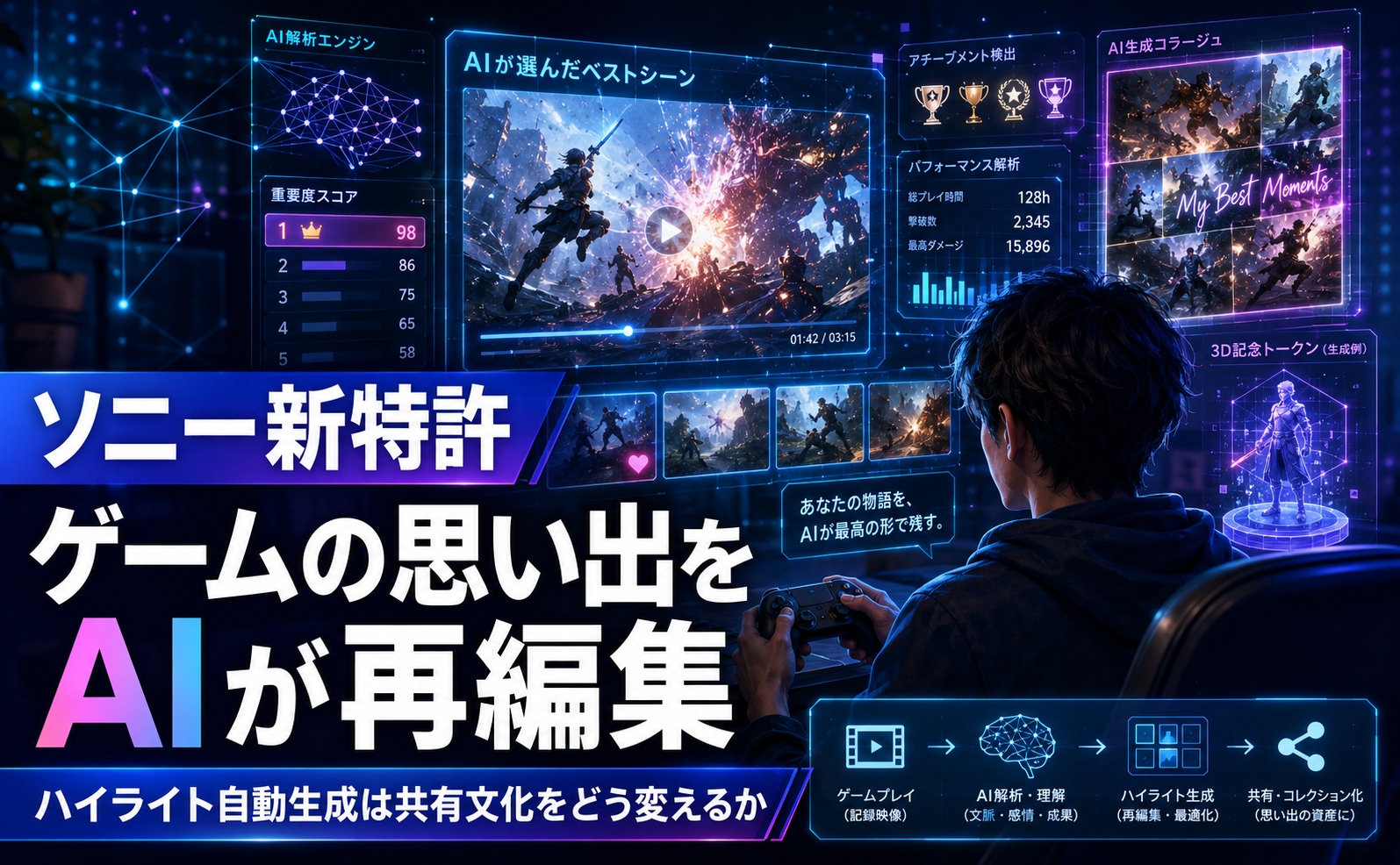
It has been reported that Sony Interactive Entertainment obtained a patent on May 5, 2026, for a system that analyzes gameplay state data and user profiles with machine learning, then feeds the results into a generative image AI to create images, videos, and 3D representations referred to as “moment assets.” The patent document describes a mechanism that references a user’s play history and characteristics to output multiple images and text descriptions representing a given session, while also adjusting the layout of a collage. It also explicitly states that external generative AI systems such as Stable Diffusion may be used.
What stands out is not “automatic highlights,” but “moments that feel true to the individual”
What is truly striking about this patent is not simply the automatic extraction of highlight scenes. Sony already has an earlier patent, filed in 2008 and granted in 2013, for “automatically generating game highlights,” which presented the idea of identifying in-game events and turning them into reels. By contrast, this new patent goes further: it refers to a user’s play history, scores, trophies, and play characteristics, selects moments that are relatively important to that particular person, and even changes the way those moments are presented according to their priority. In other words, this should be understood not as a technology for preserving “what happened,” but as a technology through which AI edits “what was meaningful to that person.”
From “recording” the game experience to “staging” it
The patent document envisions several formats, including structured collages that place the most important moment at the center, collages that mix moments randomly, and hybrid models that combine both approaches. Moreover, the generated assets are unique each time; they do not need to be simple composites of the game’s original screen images. Instead, the game content itself can be used as a “style guide” to create something more visually appealing than the original gameplay footage. What emerges from this is a shift away from preserving game memories as saved screenshots and toward AI-driven restaging. What remains after play may come to resemble not so much a record as a “memorial piece” transformed into a work.
Beyond convenience lies “playing in order to be seen”
There is no doubt that this technology is convenient. The patent’s background section also explains that there is demand for sharing memorable moments on platforms such as Discord, Twitch, YouTube, and Twitter, and that the conventional process of reviewing recordings and editing them is burdensome. In practice, if that process can be automated, the barrier to posting will drop significantly for many players.
At the same time, the easier sharing becomes, the more games become not only something to play, but also something to show. What is more, this system determines what counts as a valuable moment for a given user by using that user’s past performance and comparisons with others. It is an extremely clever design, but it also raises the possibility that players may begin, unconsciously, to play with an awareness of the kinds of moments AI is most likely to select. There is a concern that the meaning of achievement may gradually shift away from one’s own felt sense of accomplishment and toward how effectively it will present itself for sharing.
The expanded vision suggested by NFTs and 3D printing
This patent does not assume that the story ends with posting generated images to social media. The document states that the generated output may also take the form of videos or 3D structures, may be turned into statues, figurines, medals, or tokens through 3D printing, and may even use NFTs to indicate authenticity and ownership. This reflects an effort to expand a single moment in a game from “postable content” into an “owned asset.” It suggests a vision in which the play experience leads in a straight line to media production, commercialization, and collectibility.
The twist of using generative AI to prove “authenticity”
What is interesting here is that, while the patent seeks to guarantee authenticity through NFTs, the generated assets themselves are described as including randomization, being unique every time, and being remade to look better than the original game screen. In other words, what is being authenticated is not a “raw record” in the strict sense, but an “official commemorative representation generated from this play session.” There is an idea here that is close to sports photography or commemorative medals in the digital age. The value lies not in the bare fact itself, but in how that fact is symbolized and preserved.
What will truly be tested when this is implemented
It is still unclear whether this patent will eventually become a product in its current form, but the direction it points to is quite clear. What game companies are aiming for is not merely assistance during play, nor simply automated editing, but control over the entire flow in which each player’s experience is analyzed and then transformed into a form that is easy to share, easy to own, and easy to display. I think they are trying to design this as a single experience that includes not only the game itself, but also the surrounding ecosystems of social media, community, and collection culture.
Conclusion
Sony’s latest patent is not merely about using AI to automatically generate highlights. It outlines a system that identifies moments meaningful to each individual player, reconstructs them into visually appealing forms suited for sharing, and then extends them into ownable commemorative objects. There is certainly convenience in that vision, but at the same time, it also suggests that game memories may be shifting from something that remains within oneself to something that AI organizes and presents outwardly. That is why this news is interesting to read not simply as a story about a new feature, but as a sign that the very meaning of the game experience itself is gradually being rewritten.