
Introduction
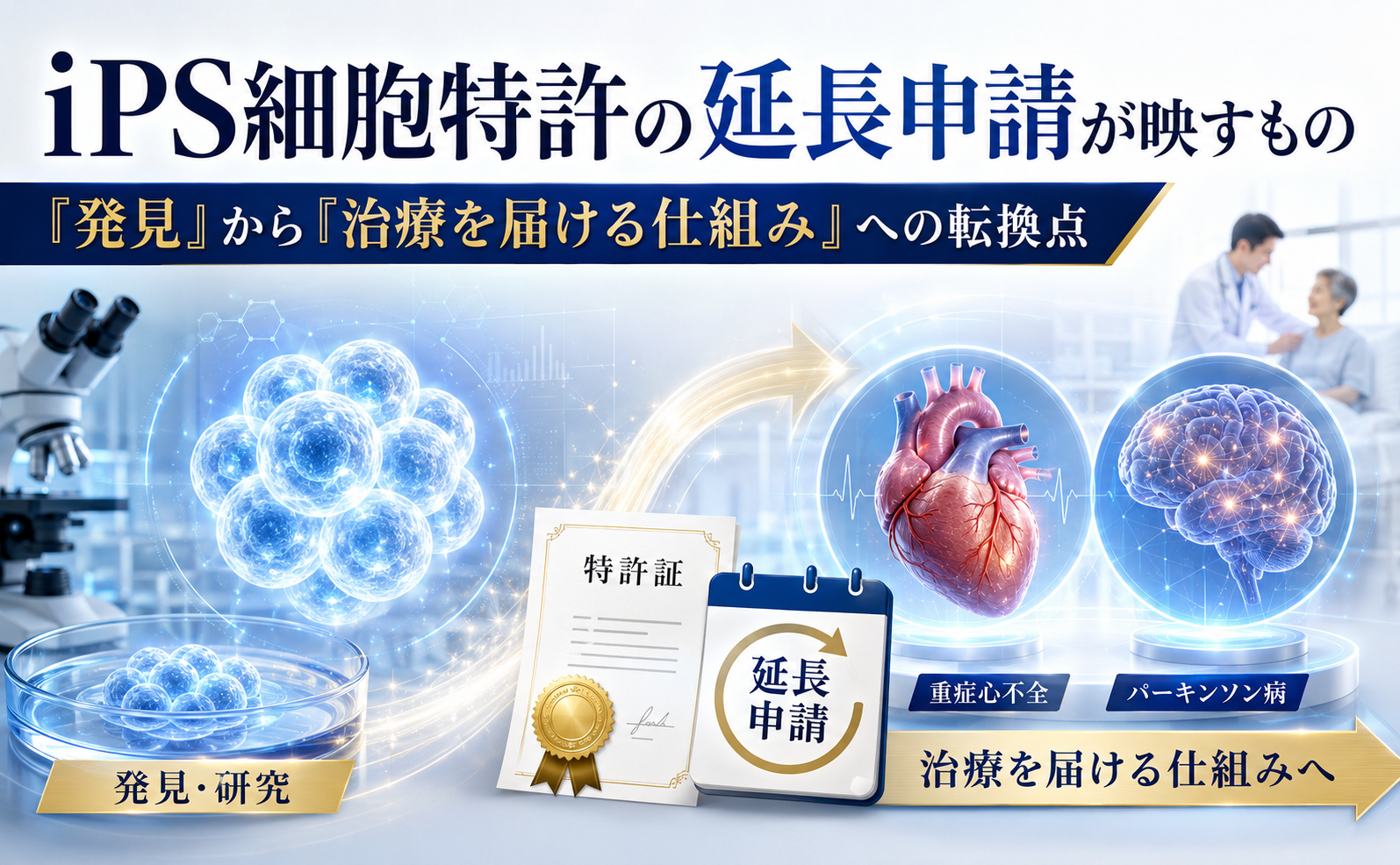
Kyoto University has announced its intention to apply for an extension of the term of the patent right for a basic patent relating to iPS cell production technology developed by Professor Shinya Yamanaka and his colleagues, ahead of the patent’s expiration in December 2026. Behind this move is the fact that, in March 2026, a myocardial cell sheet for severe heart failure and a cell product for Parkinson’s disease were approved on a conditional and time-limited basis as regenerative medicine products using iPS cells. On March 6, 2026, the Ministry of Health, Labour and Welfare approved two regenerative medicine products using iPS cells, which are regarded as the world’s first approved iPS cell therapy products originating from Japan.
This news is not merely an intellectual property story about Kyoto University seeking to extend a patent. It is an event showing that iPS cells are beginning to move beyond laboratory achievements and future expectations and into the realm of medical technology actually delivered to patients.
Not a Story About “Protecting a Patent,” but a Story About “The Start of Practical Application”
iPS cells are pluripotent stem cells established by introducing reprogramming factors into somatic cells. Professor Yamanaka’s group reported the successful establishment of iPS cells using mouse somatic cells in 2006 and human somatic cells in 2007. This technology has had an enormous impact across a wide range of fields, including regenerative medicine, drug discovery, and the elucidation of disease mechanisms.
However, it takes a long time for medical technology to reach society. Before it can be used for patients, it must go through safety verification, clinical trials, the establishment of manufacturing systems, and regulatory approval reviews. With the approval of the myocardial cell sheet and the cell product for Parkinson’s disease, iPS cells can be said to have advanced one step further: from “a technology with potential” to “a technology recognized under the regulatory system as medical treatment.”
In this sense, the application to extend the patent term is not merely a move to enclose research results. Rather, it raises the question of how to design a mechanism that continuously supports the social implementation of a technology that has finally reached practical application after long-term research and development and regulatory compliance.
Why Patent Term Extension Becomes an Issue
In principle, the term of a patent right is 20 years from the filing date. However, in fields such as pharmaceuticals and regenerative medicine products, where products cannot be sold or used without national approval, there are periods during which the patented technology cannot be practiced even though the patent exists. The Japan Patent Office’s examination guidelines also provide that applications for registration of patent term extension relating to pharmaceuticals and similar products must be filed within a certain period after the date of the disposition prescribed by Cabinet Order.
In other words, the patent term extension system is not simply a system for giving preferential treatment to rights holders. It is a system that compensates, within a certain scope, for the patent term that could not be used before approval was obtained. Regenerative medicine in particular requires a long path from basic research to clinical application, and advanced technology is also required for manufacturing and quality control. For this reason, without a certain degree of patent protection, companies may find it difficult to undertake large-scale investment.
That said, an application for extension does not automatically result in an extension. The relationship between the approved product and the patented invention, the period for which extension is sought, and the statutory requirements are all examined. We will need to wait for future decisions to see the extent to which this application will be accepted.
Kyoto University’s Role Is Closer to “Traffic Control” Than “Monopoly”
Kyoto University has set licensing fees so that companies and others can use the basic technology related to iPS cells, and it has allocated part of those fees to research funding. This mechanism is important for implementing university-originated platform technologies in society.
If a platform patent is too strong, it may hinder entry by companies and research institutions. On the other hand, if its use is left completely uncontrolled, quality control, safety, and the circulation of research funds may be weakened. Especially for a technology such as iPS cells, which is directly connected to medical applications, unrestricted use by anyone is not necessarily the optimal solution.
What matters is not using patents as tools for enclosure, but operating them as a common platform that many actors can use under appropriate conditions. As indicated in the comments from Kyoto University’s Center for iPS Cell Research and Application, the perspective of maintaining an environment in which companies can use the technology at an appropriate price is precisely an attempt to strike this balance.
The Joy of Practical Application and the Caution Required by Conditional Approval
The products approved this time received conditional and time-limited approval. For example, the package insert for the myocardial cell sheet “Reheart” states that because clinical results are limited, patients and their families must be informed that the product has been approved on a conditional and time-limited basis in light of that fact. Sumitomo Pharma has also announced that it obtained conditional and time-limited approval for “Amshepri,” a product for Parkinson’s disease, on March 6, 2026.
This point should not be viewed with excessive optimism. While iPS cell therapy is groundbreaking, issues remain to be examined, including long-term safety, efficacy, manufacturing costs, and the impact on healthcare finances after insurance coverage is applied.
That is why the current application to extend the patent term should be viewed not as the goal of practical application, but as the beginning of responsible operation after practical application has started. The future focus will be whether the approved products are actually used in clinical practice, whether data are accumulated, and whether they become established as safer and more effective treatments.
An Intellectual Property Strategy for Making the Technology Reach Patients
For platform technologies such as iPS cells, the quality of the intellectual property strategy affects not only the speed of research and development, but also patient access. If patent protection is too weak, it becomes difficult to recover research and development investment. Conversely, if licensing fees or contractual conditions are too burdensome, they may hinder corporate entry and the spread of treatment.
What is required of Kyoto University’s decision this time is not merely the maintenance of rights. It is to maintain a usage environment acceptable to research institutions, companies, medical institutions, and patients, while circulating funds into the development of future treatments.
Regenerative medicine, in particular, does not end when a single product is approved. The types of cells, methods of administration, quality control, immune responses, and safety evaluations differ by disease. If licensing income from platform patents is returned to future research, that mechanism can function as a system through which society as a whole nurtures research achievements.
Conclusion
The application to extend the iPS cell patent is both intellectual property news and news showing that regenerative medicine in Japan has entered its next stage. The groundbreaking discovery reported in 2006 has, after 20 years, led to the approval of actual therapeutic products and to debate over patent term extension.
What will be questioned going forward is not only whether the patent should be extended. The real issue is how the extended rights will be used, under what conditions they will be made available to companies, how they will be returned to research funding, and ultimately how treatments will be delivered to patients.
The social implementation of iPS cells cannot advance through scientific achievements alone. It moves forward only when intellectual property, regulation, pricing, manufacturing, and clinical infrastructure are all in place. This application is a symbolic event showing that this complex mechanism has begun to operate in earnest.