
Introduction
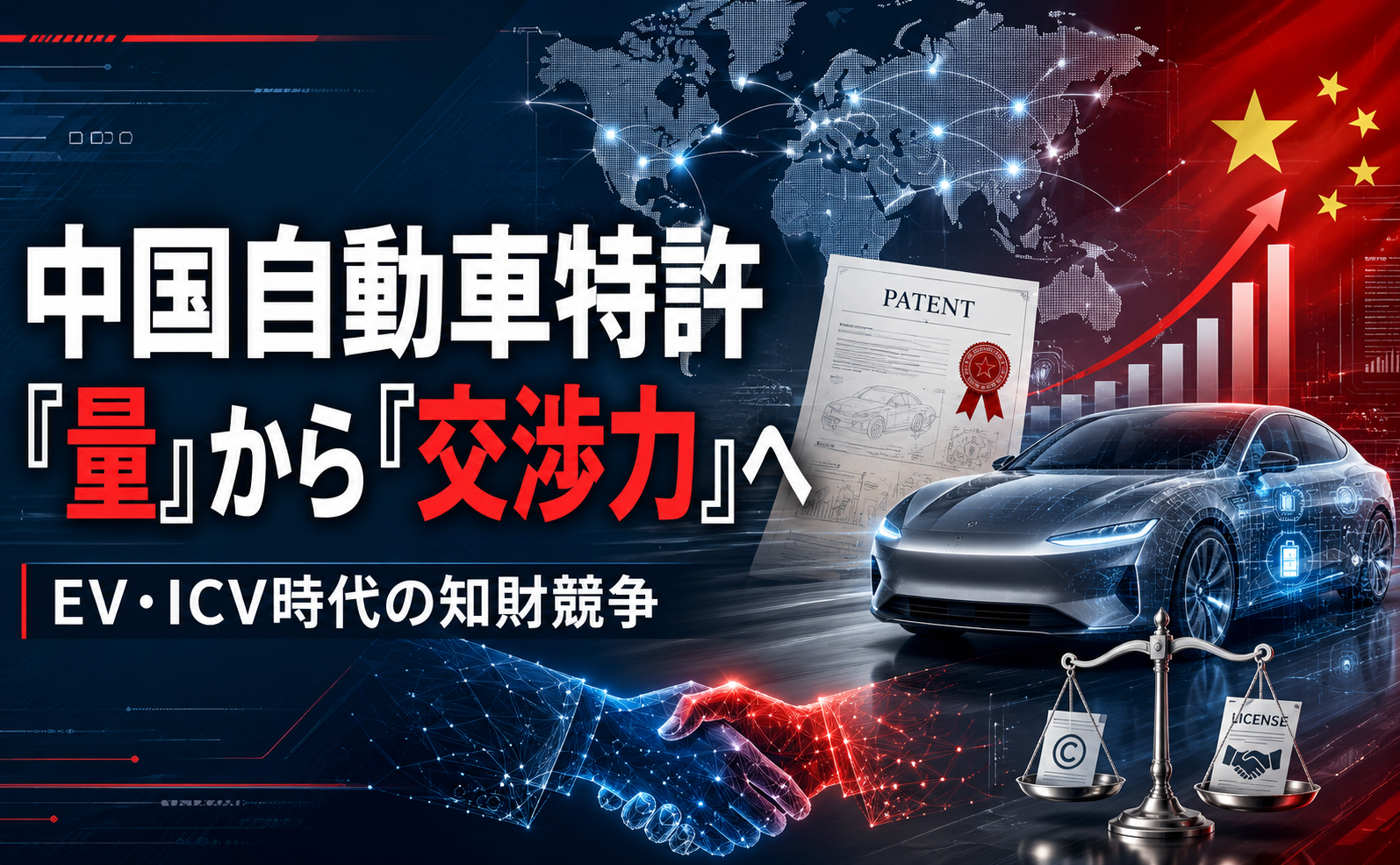
On the 16th, the China Automotive Technology and Research Center released its “Ten-Year Development Report on Intellectual Property Rights in the Automotive Industry.” According to the report, intellectual property rights related to electrification and smart technologies in China’s automotive industry have expanded significantly over the past decade and have become an important factor supporting competitiveness in the global market. In particular, the number of published patent applications in the field of new energy vehicles increased from over 50,000 in 2016 to over 110,000 in 2025. In the field of ICVs, or intelligent connected vehicles, the number of patents also grew from 44,000 to 93,000. Chinese companies’ overseas patent filings have also expanded to more than 50 countries and regions, suggesting that competition in the automotive industry is shifting in earnest from manufacturing capability and sales volume alone to competition over intellectual property.
What Does the Increase in Patent Filings Mean?
The first point to note in this report is that China has maintained the world’s top position in the number of published automotive patent applications over the past decade.
Of course, a large number of published patent applications does not immediately determine technological superiority or business advantage. Patents include basic inventions, improvement inventions, peripheral technologies, and applications filed for future defensive purposes. For that reason, the number of patent applications is only one indicator.
However, in a field such as the automotive industry, where the accumulation of technology and standardization are important, the depth of a patent portfolio cannot be ignored. The thicker the patent portfolio, the more options a company has in negotiations with other companies, licensing, joint development, cross-licensing, and dispute resolution.
In other words, the increase in patent filings in China’s automotive industry does not merely indicate more active research and development. It means that “negotiating materials” for doing business in the global market are being accumulated.
Electrification and Smart Technologies Have Changed Patent Competition
In the traditional automotive industry, the core areas of intellectual property competition were engines, vehicle body structures, transmissions, safety devices, and production technologies. Today, however, the axis of competition has changed significantly.
In new energy vehicles, batteries, motors, power control, charging, and thermal management are important. In the ICV field, communication, sensors, in-vehicle operating systems, AI, driver assistance, map information, data processing, and cybersecurity have become competitive domains.
The news also states that patents are rapidly increasing in fields such as software, algorithms, and semiconductors. This indicates that automobiles are changing from “mechanical products” into “software-controlled mobility devices.”
As a result of this shift, not only automakers but also IT companies, semiconductor companies, telecommunications companies, battery manufacturers, and AI companies are becoming deeply involved in automotive-related intellectual property competition. Intellectual property strategy in the automotive industry is no longer an issue only for finished vehicle manufacturers.
What Chinese Companies’ Overseas Patent Expansion Means
Another important point is that Chinese companies’ overseas patent expansion now covers more than 50 countries and regions.
If there were only a large number of domestic filings, that intellectual property would mainly remain a defensive tool for the Chinese market. However, the meaning changes when overseas filings increase. This is because such filings are likely to reflect an intellectual property strategy that takes into account sales in overseas markets, local production, parts supply, partnerships, licensing negotiations, and litigation responses.
Automobiles, in particular, are closely connected to each country’s regulations, sales networks, supply chains, charging infrastructure, and telecommunications environment. To seriously expand business overseas, simply exporting products is not enough. In order to continue doing business locally, companies need to prepare for intellectual property risks.
If Chinese companies are actively obtaining overseas patents, this may not be merely a defensive move. In the future, it may develop into an offensive intellectual property strategy that includes licensing negotiations and enforcement of rights.
The Increase in Litigation Is a Sign of Maturing Competition
The news also points out that related litigation has continued to increase over the past five years.
At first glance, an increase in intellectual property litigation may appear negative for the industry. Litigation certainly creates costs and uncertainty. It can also lead to delays in product launches, injunction risks, damages, and impacts on brand image.
From another perspective, however, an increase in litigation is also a sign that the technology and market in that field have matured and that the value of rights has increased. When a market is still small, the benefits obtained from enforcing patents are limited. However, as the market expands and competition among companies intensifies, patents become business weapons.
In the fields of electrification and smart technologies, a single vehicle incorporates a large number of technologies. As a result, it becomes difficult for any company to conduct business while completely avoiding other companies’ patents. Consequently, rights enforcement, invalidation trials, licensing negotiations, and cross-licensing will increase.
This resembles the structure of intellectual property disputes that occurred in the smartphone industry. In the automotive industry as well, intellectual property disputes over technical standards, communications, software, and semiconductors may increase in the future.
Implications for Japanese Companies
This news shows the growth of China’s automotive industry, but it also has important implications for Japanese companies.
Japanese companies have built strong technological capabilities and quality control capabilities in the automotive field over many years. However, with the progress of electrification and smart technologies, the premises of competition are changing. In addition to conventional mechanical, control, and production technologies, intellectual property strategies concerning software, AI, communications, semiconductors, and data utilization are becoming indispensable.
Moreover, given that Chinese companies are widely expanding their overseas patent portfolios, Japanese companies can no longer ignore Chinese companies’ patent networks when competing with them in overseas markets. Until now, the dominant view may have been that “Chinese companies are strong in manufacturing and price competition.” Going forward, however, it will be necessary to think on the premise that “Chinese companies are competitors with negotiating power in intellectual property as well.”
In particular, parts manufacturers, software companies, sensor companies, and telecommunications-related companies will be required to design their businesses not only in relation to finished vehicle manufacturers, but also with awareness of overseas companies’ patent portfolios.
The Future Focus Is Not “Number,” but “Quality” and “Use”
The fact that China has maintained the world’s top position in the number of automotive patents has a major impact. However, what will become more important going forward is not the number of patents itself, but their quality and how they are used.
For example, important points include whether the patents cover technologies essential to actual products, whether they relate to standardized technologies, whether they have been granted in a form that can be enforced overseas, and whether the claims make it difficult for competitors to design around them.
Moreover, merely owning patents is not enough. Patents demonstrate their value only when they are linked to business strategy, research and development strategy, standardization strategy, licensing strategy, and litigation strategy.
If China’s automotive industry uses patents not simply as assets to be held, but as a source of negotiating power and revenue in international markets, the intellectual property map of the global automotive industry will likely change even further.
Conclusion
The “Ten-Year Development Report on Intellectual Property Rights in the Automotive Industry” shows that China’s automotive industry is increasing its presence in intellectual property as well, amid the trends of electrification and smart technologies.
The increase in published patent applications, growth in the fields of new energy vehicles and ICVs, expansion of overseas patent filings, increase in patents related to software, algorithms, and semiconductors, and rise in litigation all point in the same direction. Competition in the automotive industry is shifting from competition based only on product performance and price to comprehensive competition that includes intellectual property.
In the automotive industry going forward, companies will be judged not only by their ability to build excellent vehicles, but also by how they protect their technologies, how they turn those technologies into negotiating tools, and how they connect them to business revenue. The intellectual property expansion of Chinese companies can be seen as evidence that the competitive environment has already entered the next stage.