
Introduction
Ahead of the opening of the FIFA World Cup in North America, counterfeit merchandise such as uniforms has become a major issue in Mexico, one of the host countries. In Mexico City, authorities have seized more than 105,000 counterfeit items worth approximately 1.3 million dollars over the past three months. FIFA’s trademarks, as well as tournament-related names and symbols, are legally protected, and the sale of products using them without authorization is not permitted.
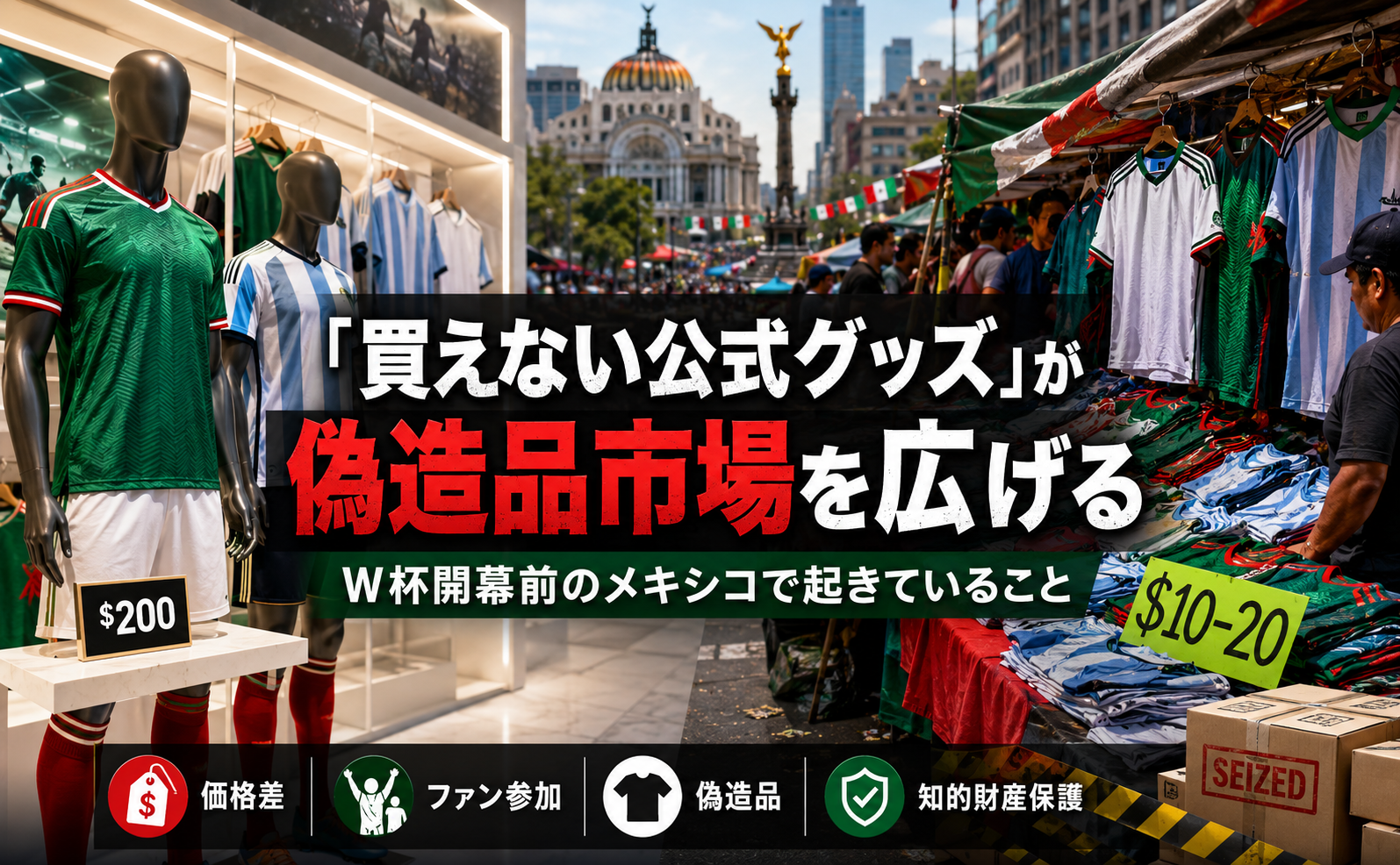
Even so, inexpensive copies of Mexico and Argentina national team uniforms and other items are being sold at street stalls in the city. Behind this is the large price gap: official uniforms can cost around 200 dollars, while counterfeit versions can be bought for about 10 to 20 dollars. This news story raises questions not only about cracking down on counterfeit goods, but also about brand value, fan psychology, and the difficulty of pricing in sports events.
Counterfeit Goods Are More Than Just “Cheap Alternatives”
Many people who buy counterfeit uniforms do not necessarily intend to support crime. One buyer mentioned in the news says they simply want to wear the item to enjoy the World Cup period. In other words, the demand for cheap copies is supported by people who may not be willing to buy official goods, but still want to participate in the event.
However, counterfeit goods are not merely “cheap alternatives.” They free-ride on official brands and take profits away from properly licensed companies and retailers. They also raise consumer protection concerns because quality labeling and manufacturing processes are unclear. In addition, as seen in cases where sellers take payment but do not hand over the product, the counterfeit goods market is not a safe market even for consumers themselves.
The Divide in Fan Participation Created by Price Differences
What deserves particular attention in this issue is the price difference between official goods and counterfeit goods. While official uniforms cost around 200 dollars, copies sold at street stalls are priced at about 10 to 20 dollars. Considering income levels and people’s sense of prices, this difference is extremely large.
Of course, official uniforms include the cost of materials, quality control, licensing fees, distribution costs, and brand value. It is not possible to simply conclude that the price itself is too high. However, in a national and global event like the World Cup, there are many people who want to show their support. If official merchandise becomes something only for highly devoted fans or people with financial room to spare, casual fans are more likely to turn to unofficial markets.
This is also a difficult issue for brand owners. Maintaining brand value through high-priced products is important, but if the entry point for participation becomes too narrow, the space for counterfeit goods to take over the market expands.
A Structure That Cannot Easily Be Solved by Crackdowns Alone
Mexican authorities have carried out large-scale raids, mainly in historic districts, and are also moving forward with anti-counterfeiting measures in Guadalajara and Monterrey. Since FIFA’s trademarks, names, and symbols are protected, such crackdowns are necessary. Protecting intellectual property rights is also essential for safeguarding official sponsors and licensed businesses connected with the tournament.
However, it is not easy to eliminate the counterfeit goods market through enforcement alone. The news also describes street vendors who resumed selling after being raided. As long as demand remains, sellers will continue doing business by changing their locations or methods. Sales methods such as quietly approaching customers and hiding products until payment is completed show that the market is going underground while those involved are aware of its illegality.
This symbolizes the difficulty of intellectual property enforcement. Even if something is illegal under the law, when there is strong consumer demand and sellers can make a profit, enforcement tends to become an endless game of cat and mouse.
The Need for Official Brands to Make Participation Easier
An important point in considering this issue is that protecting official goods and creating an environment in which fans can participate more easily should not be treated as opposing goals. While maintaining the value of official uniforms, preparing products in more accessible price ranges can also be an effective anti-counterfeiting measure.
For example, in addition to high-end official uniforms or player-specification models made with high-performance materials, official brands could expand lower-priced goods such as simplified spectator versions, T-shirts, towels, and stickers. Before fans start thinking, “Official goods are too expensive, so a fake is good enough,” it is important to provide options that make them think, “At this price, I will buy the official product.”
Intellectual property rights are not merely a system for prohibiting things. They are also a mechanism for protecting brand trust and building relationships with consumers through legitimate products and services. In that sense, anti-counterfeiting measures are not only a matter of enforcement, but also a matter of market design that makes it easier for consumers to choose genuine products.
Who Should the Excitement of the World Cup Belong To?
The World Cup is a massive event that excites people around the world across national and regional borders. That is precisely why related merchandise generates significant commercial value. To protect that value, it is only natural that FIFA and national authorities protect trademark rights and crack down on counterfeit goods.
At the same time, from the fan’s perspective, a uniform is not merely a product. It is also a symbol of participation in supporting a team. If only people who can afford expensive official goods are able to wear that symbol, the temptation of counterfeit goods becomes stronger.
The recent news from Mexico raises questions not only about whether people should buy counterfeit goods, but also about how official brands should design their points of contact with fans. Protecting intellectual property is important. However, for that protection to gain broad support, choosing genuine products must be a realistic and attractive option.
Conclusion
The expanding market for counterfeit uniforms in Mexico ahead of the World Cup is an intellectual property issue, but it is also an issue of price and opportunities for participation. Strengthening enforcement will have a certain effect, but if demand itself does not disappear, the counterfeit goods market will continue to remain in different forms.
What official brands need is not only a commitment to protecting their rights. It is also important to devise pricing and product lineups so that a diverse range of fans can participate in the tournament through legitimate channels. To eliminate counterfeit goods, it is necessary not only to tell people, “Do not buy them,” but also to create an environment in which people want to choose official products.