
Introduction
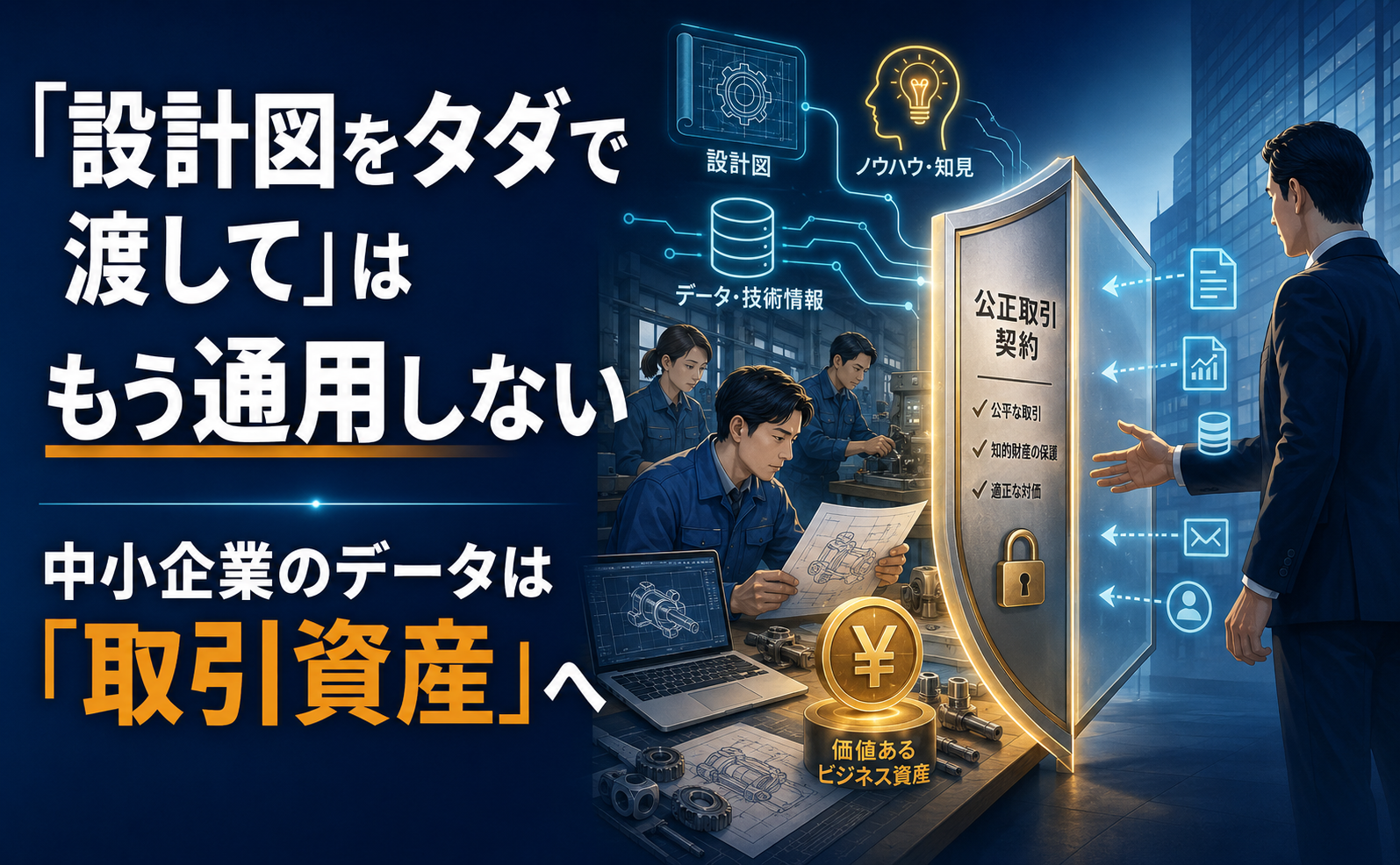
Cases in which small and medium-sized enterprises are asked by business partners to provide design drawings, manufacturing technologies, know-how, various types of data, and other information free of charge have become a growing problem. In response, the Japan Fair Trade Commission, the Small and Medium Enterprise Agency, and the Japan Patent Office have released the “Guidelines on Abuse of a Superior Bargaining Position, etc. for Appropriate Transactions Involving Intellectual Property Rights, Know-How, and Data,” as well as model contract forms. A key feature of these guidelines is that they cover not only intellectual property rights, but also non-registered know-how and data, and apply across all industries.
The essence of this news is not simply that large companies must not make unreasonable demands of SMEs. Rather, it shows that information that has long been treated ambiguously under labels such as on-site cooperation, long-standing business relationships, or technical consultation is beginning to be reassessed as an asset with clear economic value.
Data and Know-How Are Not “Extras”
Design drawings and manufacturing know-how are not mere working documents. They embody accumulated knowledge, including failed prototypes, improvements made on the shop floor, techniques for stabilizing quality, and ideas for reducing costs. In other words, while their value may not be readily visible in the price of finished products, they are important intellectual assets that support a company’s competitiveness.
Nevertheless, companies with a stronger bargaining position may request data or know-how without paying compensation, citing reasons such as “for future transactions,” “because it is needed for quotation purposes,” or “for standardization.” SMEs, concerned about whether the business relationship will continue, may find it difficult to refuse and may accept unfavorable conditions.
However, if data or know-how provided free of charge is used as a basis for placing orders with other suppliers, bringing production in-house, developing competing products, or demanding cost reductions, the SME’s competitiveness itself may be undermined. This is not merely a matter of contractual terms; it is an issue that concerns fairness across the entire supply chain.
What It Means to Be Viewed as an “Abuse of a Superior Bargaining Position”
The new guidelines present the concept of abuse of a superior bargaining position under the Antimonopoly Act in relation to transactions involving intellectual property, know-how, and data. According to materials published by the Ministry of Economy, Trade and Industry, the guidelines present approximately 70 examples concerning the interpretation of the Antimonopoly Act and related laws, and approximately 50 examples of practical measures for appropriate intellectual property transactions.
The important point is that requesting data is not, in itself, immediately problematic. There are naturally situations in which information sharing is necessary for reasonable purposes, such as product quality confirmation, joint development, maintenance, or ensuring traceability.
What becomes problematic is requesting information unilaterally while the necessity or purpose of use remains unclear. In particular, competition-policy risks increase when a company treats the provision of information as something that should be “obvious” because of its bargaining power, without discussing matters such as the scope of information to be provided, the purpose of use, confidentiality, whether disclosure to third parties is permitted, compensation, return or deletion after use, and the treatment of derivative data.
SMEs Must Also Make Their Value Visible
This news serves as a warning to large companies, but it also sends an important message to SMEs. SMEs need to understand the value of their own data and know-how and prepare to protect it.
Many SMEs regard the drawings, processing conditions, inspection data, records of defect responses, customer-specific adjustment information, and other materials they handle every day as ordinary business documents. From an external perspective, however, such information may be technical information that is difficult to reproduce and may have competitive value.
For this reason, it is important first to take inventory of the company’s information and organize what may qualify as trade secrets, what may be disclosed externally, and what information should require compensation. When asked to provide data, merely saying, based on instinct, that “this would be a problem” makes negotiation difficult. Only by putting the types, value, and conditions of use of the information into words can a company move closer to discussions on an equal footing.
Free Acquisition Also Becomes a Risk for Large Companies
These guidelines are not only intended to protect SMEs. For large companies as well, clarifying rules for acquiring intellectual property, know-how, and data is important from both compliance and business-strategy perspectives.
If information obtained from suppliers is used for product development or in-house production while the rights relationship remains unclear, it may later develop into a dispute. In addition, if business partners lose trust, SMEs with excellent technologies may become cautious about providing information, which may also reduce the quality of joint development and improvement activities.
In the long term, rather than absorbing suppliers’ know-how at low cost, paying appropriate compensation, clarifying the scope of use, and building relationships in which both sides can share information with confidence will enhance the competitiveness of the entire supply chain. Proper intellectual property transactions are not only a matter of regulatory compliance; they are also a foundation for trustworthy technological collaboration.
Points to Watch in Future Transaction Practice
In future business-to-business transactions, not only the price of the deliverables themselves but also the treatment of the data and know-how behind them will become increasingly important. It will be necessary to clarify the conditions for providing information in quotations, purchase orders, basic transaction agreements, non-disclosure agreements, joint development agreements, and other contracts.
For example, companies may need to specifically define the scope of data to be provided, the purpose of use, the period of use, prohibition of disclosure to third parties, whether copying or modification is permitted, ownership of derivative data and improved technologies, whether compensation is required, and return or deletion after the end of the contract. We are moving away from an era in which matters could proceed vaguely on the grounds that something was “necessary for the transaction.”
What these guidelines indicate is a shift from an era in which data and know-how were treated as appendages to contracts to an era in which they are treated as transaction subjects with independent value.
Conclusion
The issue of requiring design drawings and know-how to be provided free of charge is about protecting SMEs in weaker bargaining positions, but it is also about protecting Japan’s industrial competitiveness. If technical information accumulated on the shop floor is not properly valued, a structure will emerge in which companies that work hardest to refine their technologies are the ones that suffer.
In future business-to-business transactions, the question will not only be “how much should goods be supplied for,” but also “under what conditions should information be shared.” Giving data and know-how appropriate compensation and rules is not merely a matter of protecting SMEs; it is a prerequisite for supporting fair and sustainable innovation.