
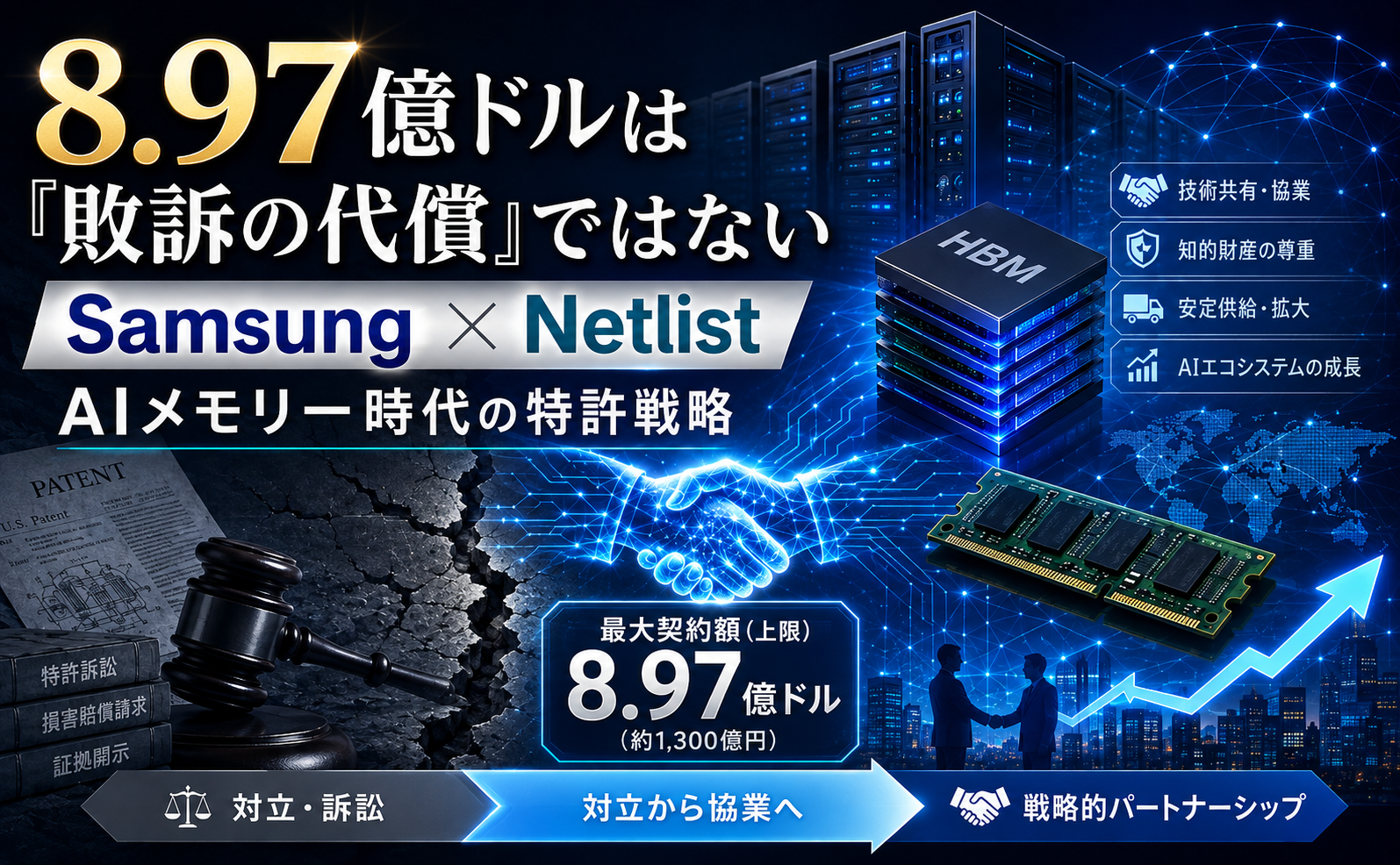
Samsung Electronics and U.S. memory technology company Netlist have brought an end to a patent dispute that lasted for approximately five years. The two companies have entered into a five-year agreement covering a cross-license of their patent portfolios, the supply of memory products such as DRAM and NAND flash, and technical cooperation, while also agreeing to terminate their ongoing patent litigation and related proceedings.
Under the agreement, Samsung will gain access to Netlist’s patent portfolio, including technologies related to server DIMMs and HBM (High Bandwidth Memory). Netlist, meanwhile, will receive memory products from Samsung. Samsung will also make an initial license payment of $239 million, followed by quarterly payments tied to sales from the third quarter of 2026 through the second quarter of 2031, with each quarterly payment capped at $32.9 million. If every payment reaches the maximum amount, total license payments will amount to $897 million.
At first glance, the news may appear to be simply a story of Samsung ending a long-running legal battle by paying an enormous sum. But the more significant aspect of the agreement may not be the amount itself. Rather, it is the transformation of the companies’ relationship—from one in which they fought over alleged past patent infringement through litigation into one in which they will mutually leverage patents and products while pursuing opportunities in the future AI memory market.
The $897 Million Should Not Be Viewed Simply as a “Settlement Payment”
The reported figure of up to $897 million is strikingly large, making it tempting to associate it with the damages awards previously handed down in the litigation.
Indeed, Netlist secured jury verdicts awarding it $303 million in damages in 2023 and another $118 million in 2024 in its litigation against Samsung. Samsung disputed both the validity of the patents and whether infringement had occurred, and appeals and other proceedings continued thereafter.
The maximum $897 million involved in the new agreement, however, is not a lump-sum damages payment for Samsung’s past conduct.
Samsung will first pay $239 million in license fees, with the remainder to be paid quarterly over the next five years based on Samsung’s sales. Moreover, the $32.9 million figure represents the maximum payment for each quarter.
In other words, the agreement has one aspect that resolves past disputes, while also functioning as consideration for Samsung’s future access to Netlist’s technology and its ability to continue using Netlist’s patents in its business.
Viewing the news merely as “Samsung paying Netlist a settlement of up to $897 million” risks overlooking the true nature of the agreement.
“Memory Patents” Are Becoming More Valuable in the AI Era
The significance of the agreement is magnified by the technological field it covers.
Netlist’s patent portfolio includes technologies relating to server DIMMs and HBM. HBM, which enables extremely high-speed data transfer between processors such as GPUs and memory, has rapidly increased in importance alongside the expansion of generative AI and AI data centers. Reuters has also cited surging demand for high-performance memory driven by the growth of AI data centers as part of the backdrop to the agreement.
Semiconductor patents may once have been viewed primarily as rights covering technologies incorporated into particular portions of a product. In today’s AI infrastructure, however, overall system performance depends not only on computing power but also on how quickly enormous volumes of data can be supplied to processors.
As a result, not only memory devices themselves but also technologies involving memory-module architecture, data transfer, load reduction, and related functions have become critical intellectual property supporting the AI industry.
The economic value of the patents that Netlist has spent years enforcing may therefore be taking on a different meaning as AI drives expanding demand for HBM.
What Samsung Bought Was Not Just “Patents,” but “Predictability”
From Samsung’s perspective, the agreement offers another major advantage.
It reduces uncertainty surrounding intellectual property.
The dispute with Netlist involved not only substantial damages verdicts in 2023 and 2024 but also continuing proceedings concerning patent validity and appeals. In addition, in July 2026, the U.S. International Trade Commission (ITC) initiated an investigation into Samsung memory products and related products following a complaint filed by Netlist.
ITC proceedings, in particular, can under certain circumstances affect the importation of products into the United States.
For Samsung, continuing to face legal uncertainty surrounding HBM and server memory at a time when demand for AI memory is rapidly expanding could represent a business risk extending far beyond the direct cost of litigation.
Even if the licensing fees are substantial, securing five years of access to the relevant patent portfolio while terminating existing litigation may have considerable value if it allows Samsung to develop and sell its products under more predictable conditions.
Put differently, one of the things Samsung has purchased through this agreement is not merely “an end to litigation,” but “time in which it can continue doing business with greater certainty.”
For Netlist, This Is a Bigger Shift Than Simply “Winning” in Court
For Netlist as well, the significance of the agreement goes beyond merely securing licensing revenue.
For a patent-holding company to continue litigating against a major corporation requires substantial legal expenses and considerable time. Even after obtaining a jury verdict awarding damages, subsequent appeals and patent-validity proceedings may leave uncertain both how much money will ultimately be recovered and when it will actually be received.
Through the new agreement, Netlist moves from that uncertain position into one in which it may receive sales-linked licensing revenue over a five-year period.
Even more importantly, the agreement includes the supply of products such as DRAM and NAND flash from Samsung to Netlist. According to Reuters, the agreement covers not only patent licensing but also Samsung’s supply of DRAM and NAND products to Netlist.
In other words, Netlist has transformed Samsung from an “opponent in a patent infringement dispute” into a “supplier supporting Netlist’s own product business.”
Continuing to win in court is not the same as converting intellectual property into stable business revenue and supply-chain value. The importance of this agreement lies in Netlist’s decision to pursue the latter.
A “Cross-License” Signals a Relationship That Goes Beyond Settlement
Another noteworthy feature is that the agreement takes the form not merely of a one-way patent license, but of a “cross-license.”
In a cross-licensing arrangement, each party generally gains the right to use certain patents held by the other.
In an industry such as semiconductors, where a single product combines an enormous number of technologies, it is difficult for one company to develop and control every relevant technology entirely on its own. Creating a framework in which patents can be used mutually among competitors or business partners not only reduces litigation risk but can also increase freedom in developing new products.
In this case, moreover, the cross-license is packaged together with product supply and technical cooperation.
This makes the arrangement look less like a defensive settlement in which the parties simply agree to stop fighting and more like a proactive business agreement aimed at creating a relationship in which each side can make use of the other’s technology and commercial capabilities.
The Real Goal of Patent Litigation Is Not Always a Judgment
The Samsung-Netlist agreement also raises a broader question about what patent litigation is ultimately intended to achieve for companies.
For patent owners, obtaining a judicial finding of infringement is, of course, important. From the perspective of corporate management, however, a court judgment itself is not necessarily the final objective.
If patents can be used to establish negotiating leverage—and that leverage can then be converted into licensing revenue, product supply, joint development, cross-licensing, or other business benefits—litigation can also be understood as one stage in the process of reaching a much larger commercial transaction.
In fact, Samsung and Netlist were still fighting in multiple venues, including the ITC, only weeks before this agreement. They have now abruptly shifted toward a five-year strategic relationship.
At first glance, it may appear contradictory for two parties to fight aggressively in court and ultimately end up with an agreement under which they exchange what each side needs.
In the business of intellectual property, however, such an outcome is entirely rational.
The “AI Semiconductor War” Will Not Be Decided by Manufacturing Technology Alone
Competition in AI semiconductors tends to focus on factors such as GPU performance, semiconductor manufacturing processes, and HBM production capacity.
The Samsung-Netlist dispute, however, reveals another form of competition taking place behind the scenes.
That competition is over intellectual property.
No matter how strong a company’s manufacturing capabilities may be, if a third party owns powerful patents covering technologies essential to its products, negotiations with that patent owner may become unavoidable. Conversely, even a company whose manufacturing scale is far smaller than that of an industry giant can possess significant negotiating leverage against one of the world’s largest semiconductor manufacturers if it controls foundational patents.
The fact that Samsung and Netlist’s five-year patent dispute ultimately evolved into a relationship involving a licensing agreement worth up to $897 million, product supply, and technical cooperation vividly illustrates this point.
In the AI era, semiconductor competition is not determined solely by the question, “Who can manufacture the most chips?”
Another question is becoming equally important:
“Who owns the rights to the technologies required to build those chips?”
The Samsung-Netlist agreement can therefore be seen as an example of how, in the memory market that has become central to AI infrastructure, a patent portfolio itself is increasingly becoming a strategic corporate asset on par with manufacturing capacity and supply capability.