
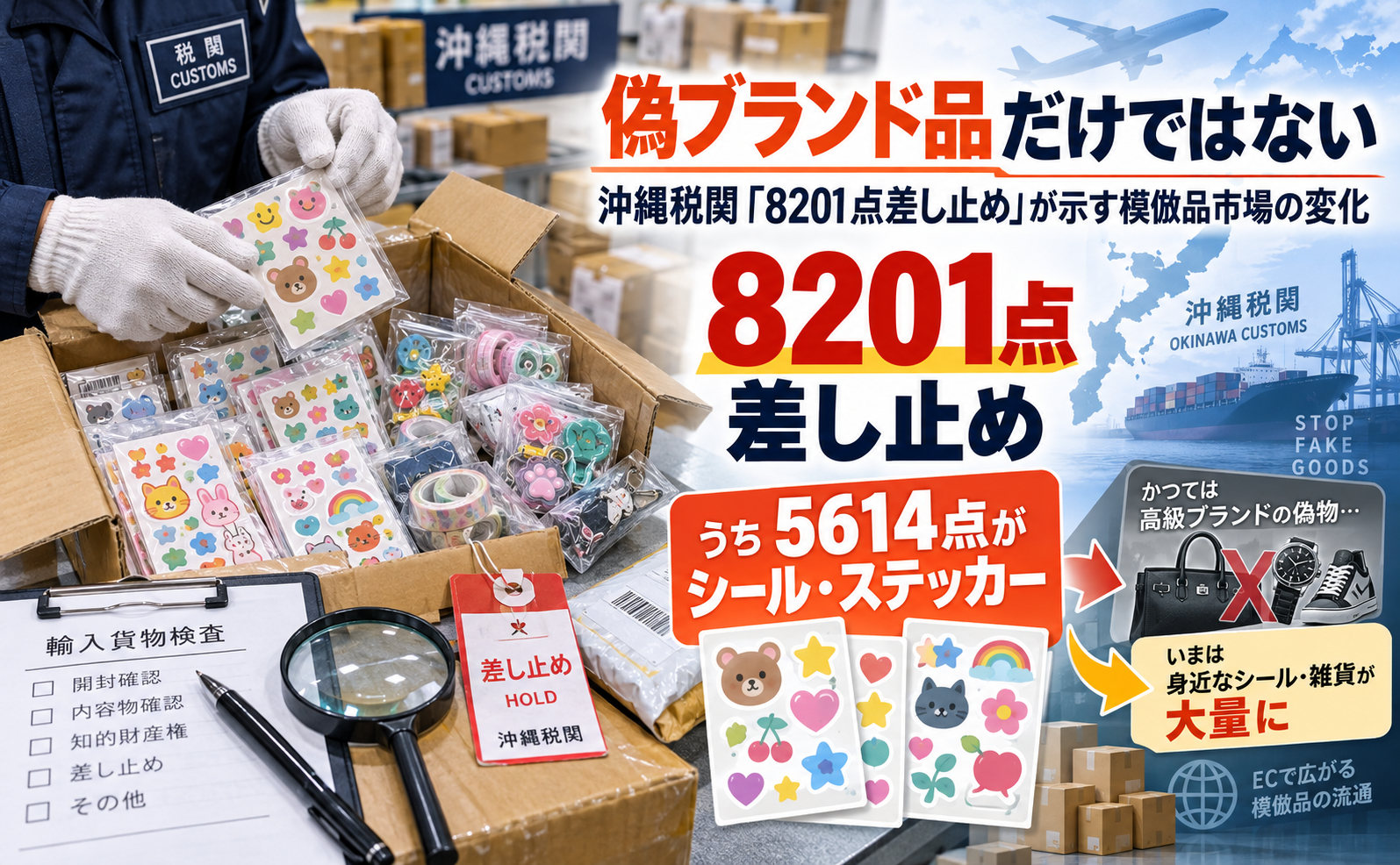
On September 4, 2026, Okinawa Regional Customs announced statistics on imports of “goods infringing intellectual property rights,” including goods that infringe trademark rights and copyrights, that were suspended at the border during the first half of 2026, from January through June.
There were 165 import suspension cases, an increase of 51.4% from the same period of the previous year. Even more striking, however, was the number of items involved. A total of 8,201 items were suspended, representing a 359.7% year-on-year increase. In just the first half of the year, this figure exceeded the highest annual total recorded since statistics began in 2010.
At first glance, this may seem like a simple story about an increase in counterfeit branded goods being imported from overseas. What deserves particular attention in these statistics, however, is that large quantities of familiar and relatively inexpensive products, such as seals and stickers, were intercepted alongside luxury-brand bags and clothing.
This development may indicate that the very structure of the counterfeit business and intellectual property infringement is beginning to change.
5,614 of the 8,201 Seized Items Were Seals and Stickers
One of the most symbolic features of these statistics is the sheer volume of seals and stickers.
By number of cases, goods classified as “other” accounted for the largest category, with 90 cases, of which 84 involved seals and stickers. By number of items, seals and stickers accounted for 5,614 of the 5,857 items classified as “other.”
In other words, seals and stickers represented nearly 70% of all 8,201 items suspended.
The intercepted goods reportedly included counterfeit versions of the currently popular “Bonbon Drop Seal” products.
When people hear the word “counterfeit,” many may traditionally think of famous-brand handbags, wallets, watches, clothing, or sneakers.
Today, however, counterfeiting is by no means limited to expensive products.
Character goods, toys, miscellaneous goods, stickers, and other products can become attractive targets for counterfeiters whenever they become popular, because even low-priced products can generate substantial sales when sold in large quantities.
These statistics show that this type of “low-price, high-volume” intellectual property infringement has reached a scale that can no longer be ignored.
What Gets Counterfeited Is Not Necessarily “Luxury”—It Is Whatever Is Selling
From an intellectual property perspective, one particularly interesting point is that what matters to counterfeiters is not whether a product is luxurious, but whether it is selling at the moment.
When a popular product spreads rapidly through social media and other channels, a market also emerges for those seeking to sell counterfeit versions.
Products such as stickers and small miscellaneous goods are particularly easy to ship in large quantities because they are small and lightweight. Their relatively low prices may also make consumers less inclined to carefully verify whether the products they are buying are genuine.
It is therefore no longer sufficient to think of the counterfeit market simply as a world of obvious fakes bearing the logos of famous brands.
When a product becomes popular, its design, characters, brand identity, labeling, and other features can quickly be copied and sold through overseas e-commerce sites and similar channels.
The range of everyday products affected by intellectual property infringement is expanding.
The Impact of Lower Language Barriers in Cross-Border E-Commerce
Okinawa Regional Customs cited the spread of translation functions in apps and other services as one factor behind the increase in import suspensions, noting that such technology has made it easier for individuals to use overseas e-commerce websites.
This is an extremely important point.
In the past, buying products from an overseas website often required consumers to read product descriptions in a foreign language, enter their address, make payments, and select shipping methods. These language-related difficulties themselves acted as barriers to the use of overseas e-commerce.
Today, however, browsers and apps can automatically translate product descriptions, while payment and logistics services have also become easier to use.
This has made shopping more convenient for consumers, but it has also made it easier for overseas sellers to sell goods directly to Japanese consumers.
As a result, counterfeit goods that might previously have been difficult to distribute within Japan can increasingly be imported directly through small-parcel shipments addressed to individual consumers.
Improvements in e-commerce convenience and logistics sophistication promote the international distribution of legitimate goods, but at the same time they also reduce the cost of distributing counterfeit goods.
Why the Sharp Increase in the Number of Items Matters More Than the Number of Cases
In the latest figures, the number of import suspension cases increased by 51.4%, while the number of items suspended rose by 359.7%.
This disparity is another point worth examining.
Put simply, it indicates that some individual import shipments contained very large quantities of infringing goods.
When 5,614 of the seized items are seals and stickers, as in this case, the presence of small products that can easily be shipped in bulk can dramatically increase the total number of items involved.
This also shows that assessing intellectual property infringement solely by asking “how many cases were detected” may give a misleading picture of the actual situation.
If a single shipment contains hundreds or thousands of products, the volume of infringing goods that could potentially have entered the market may increase substantially even if the number of cases itself does not rise by the same proportion.
When examining customs statistics on import suspensions, it is therefore necessary to distinguish between the number of cases and the number of individual items.
Looking Only at China Does Not Capture the Full Picture
By country of consignment, China accounted for the largest number of cases and items, with 89 cases involving 6,093 items.
China therefore represented 74.3% of all seized items.
At the same time, shipments from Malaysia appeared in the statistics, accounting for 30 cases and 1,786 items, placing Malaysia second only to China in both measures.
This also demonstrates why it is insufficient to view anti-counterfeiting measures simply as a matter of combating “Chinese-made fakes.”
Within international e-commerce and logistics networks, the country of manufacture, the seller’s location, the country in which an e-commerce platform is operated, the logistics hub, and the country of consignment do not necessarily coincide.
Goods may also be shipped to Japan through a country different from the country in which they were originally manufactured.
Future anti-counterfeiting strategies will therefore increasingly need to look beyond simply asking where products were made. It will be necessary to examine the entire distribution route: where the goods were sold, which e-commerce platform was used, which logistics networks they passed through, and from where they were ultimately shipped to Japan.
Rights Holders Need Not Only to Obtain Rights, but Also to Monitor and Enforce Them
This news also carries important implications for corporate intellectual property strategy.
Intellectual property rights such as trademarks and copyrights do not automatically eliminate counterfeit goods simply because the rights have been obtained.
For popular products in particular, post-launch market monitoring becomes extremely important.
Rights holders need to check whether counterfeit products are being sold on e-commerce platforms or social media, request takedowns from platforms when necessary, and consider using customs procedures for the suspension of infringing imports. In other words, intellectual property strategy must extend beyond obtaining rights to include enforcement after those rights have been secured.
Speed is especially important when products have short trend cycles, as is often the case with items such as the stickers involved here.
Even if counterfeit products can eventually be removed several years later, the trend itself may already have passed by that time.
Going forward, intellectual property strategy will increasingly need to focus not only on “which rights should we obtain?” but equally on “how can we identify counterfeit products early, and which measures can we use to remove them quickly?”
Are “Cheap Fakes” Really a Good Deal for Consumers?
Okinawa Regional Customs has warned consumers that purchasing goods that infringe intellectual property rights not only violates the rights holders’ intellectual property but can also contribute to deceptive practices against consumers.
From a consumer’s perspective, some may feel that a product is acceptable as long as it is cheaper than the genuine article.
However, if the counterfeit market expands, profits flow not to the companies and creators that planned, designed, advertised, and developed the original brands, but instead to businesses that imitate their work.
This is particularly significant for character goods and design-oriented products, where a large portion of the product’s value lies not merely in its physical production cost but in intangible assets such as characters, designs, brands, and content.
If a market grows in which the prevailing logic is simply “make something similar and sell it cheaply,” it becomes more difficult for those who create new products and content to recover their investments.
The counterfeit problem is therefore not merely a dispute between rights holders and counterfeiters.
It is also a question of whether markets can continue to support companies and creators that invest in producing new, legitimate products.
The Main Battlefield in the Fight Against Counterfeits Is Beginning to Shift
The fact that Okinawa Regional Customs alone recorded a record 8,201 suspended items in the first half of the year should not simply be dismissed as an exceptional large-scale enforcement case.
What is particularly important is that seals and stickers accounted for the majority of those items.
The counterfeit problem is expanding beyond luxury-brand bags and watches into everyday consumer goods such as products that become popular on social media, character merchandise, and miscellaneous goods.
At the same time, the combination of overseas e-commerce, machine translation, international payment systems, and small-parcel logistics is rapidly narrowing the distance between overseas sellers and individual consumers in Japan.
We now live in an era in which, once a product becomes popular, counterfeit versions can cross borders and enter the market within a very short period of time.
For that reason, simply “obtaining intellectual property rights” will no longer be sufficient as an intellectual property strategy.
It will become increasingly important to continuously monitor what is happening in the marketplace and to combine multiple measures—including e-commerce platform enforcement, customs procedures, and the exercise of intellectual property rights—to act before counterfeit products spread widely.
The figure of “8,201 items” reported by Okinawa Regional Customs tells us more than simply that the number of counterfeit goods is increasing.
It suggests that the types of products targeted by intellectual property infringement, the sales channels through which they are distributed, the logistics systems that carry them, and the ways in which they reach consumers are all changing—and that methods of intellectual property protection must change accordingly.