
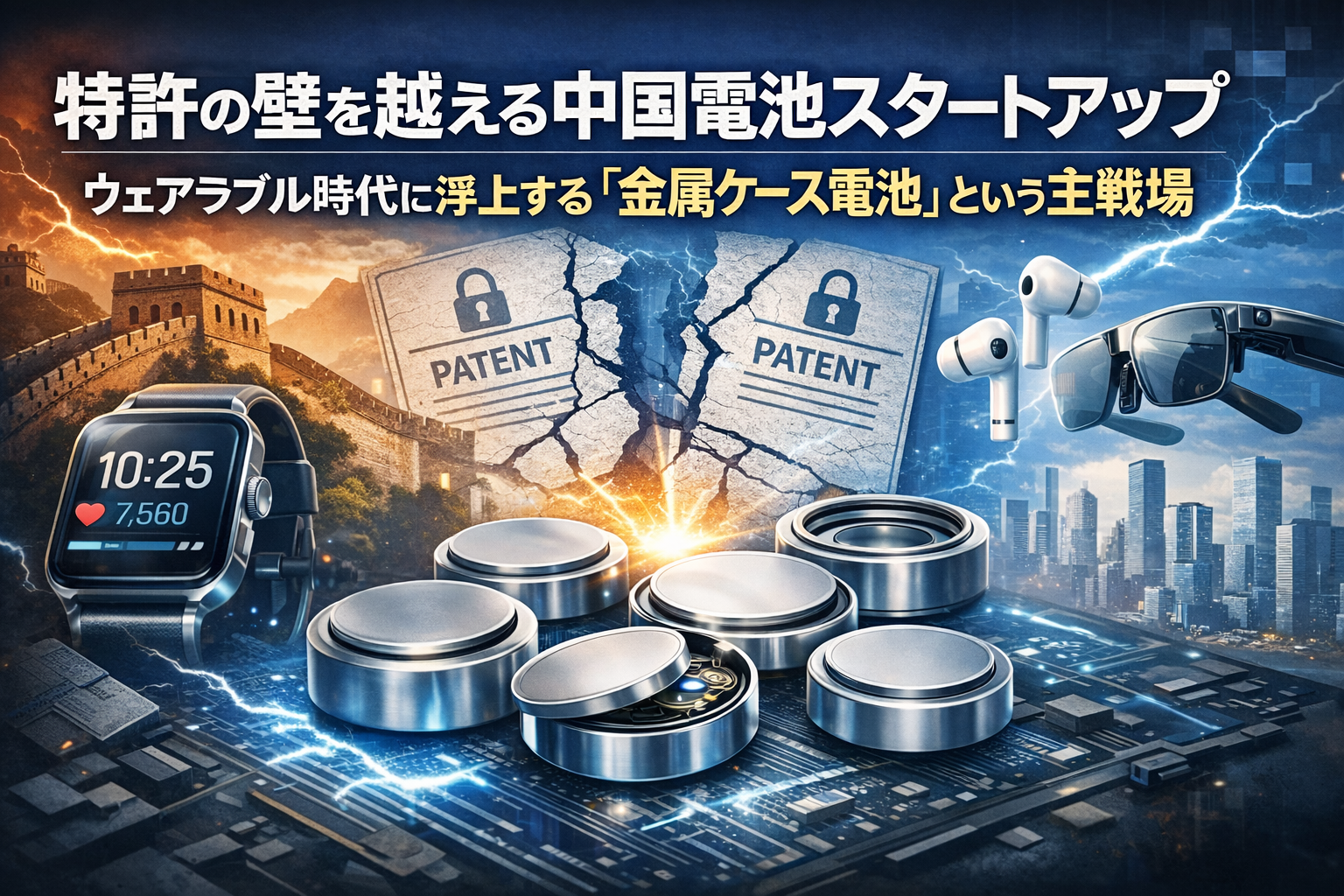
The news that Sritpower (国研新能), a Chinese startup specializing in button-type batteries, has raised approximately RMB 50 million (about JPY 1 billion) in a Series B round is not merely another funding announcement. Rather, it symbolizes a tectonic shift in battery technology driven by the evolution of wearable devices.
What deserves attention first is the sheer difficulty of the market Sritpower has chosen to enter. The field of high-performance button-type lithium-ion batteries has long been dominated by VARTA, which has built an extensive patent portfolio over many years. As a result, it has been extremely challenging for Chinese manufacturers to enter this space head-on. As noted by Mr. Zhang Fengxue, while demand surged explosively following the success of Apple’s AirPods, only a limited number of players were able to reap the benefits.
Sritpower’s chosen strategy was not to extend or incrementally improve upon existing patented technologies, but to construct an entirely new technological approach. By localizing the entire supply chain—from materials to manufacturing—and building a technology framework designed to circumvent existing patents from the ground up, the company demonstrated not only technical capability but also a highly instructive intellectual property strategy. Rather than simply competing on cost, Sritpower effectively “redesigned the entry barriers themselves,” a stance that appears to have been a key factor behind its favorable evaluation.
Equally important is the company’s technological choice of metal-cased batteries. While today’s mainstream pouch-type batteries offer flexibility, they face inherent limitations in terms of swelling, safety, and form-factor freedom. In devices such as AI-enabled smartwatches, wireless earbuds, and AR glasses, internal space is extremely constrained, while safety requirements grow more stringent each year. In this context, the advantages of metal-cased batteries—higher energy density, superior safety, and space efficiency—suggest not merely an incremental improvement, but the potential for a generational shift.
Another noteworthy point is the company’s realization of fully automated production. By integrating multiple core technologies—such as lamination techniques, vertical stacking structures, laser welding, and micro-pore electrolyte injection—Sritpower has improved yield rates and consistency. This indicates a transition from a research-oriented startup to a mass-production-capable enterprise. In the battery industry, even superior technology cannot dominate the market unless quality remains stable at scale. From this perspective, it is highly pragmatic that the newly raised funds are earmarked less for pure research and more for expanding production capacity.
In fact, the company is already supplying batteries for smart glasses under Xiaomi’s home appliance brand, MIJIA, and is jointly developing ultra-thin batteries for VR glasses with overseas customers. This signifies that its technology has moved beyond the laboratory stage and is now being incorporated into actual customer products.
As Mr. Zhang observes, competition in China’s battery industry is extremely intense, leaving little room for survival in commoditized segments. Against this backdrop, focusing on the niche yet high-growth domain of metal-cased batteries, while differentiating on both patent strategy and manufacturing technology, is a rational approach. As long as the wearable market continues to expand, the requirements for “small size, high performance, and high safety” will only grow more critical.
This news should therefore be seen less as a simple example of a successful funding round by a Chinese startup, and more as a signal of where the main battleground of battery technology is shifting in the wearable era. Whether metal-cased batteries will truly replace pouch-type batteries, and whether Sritpower can position itself at the forefront of that transition, remains to be seen. The outcome could have far-reaching implications for the entire device industry.