
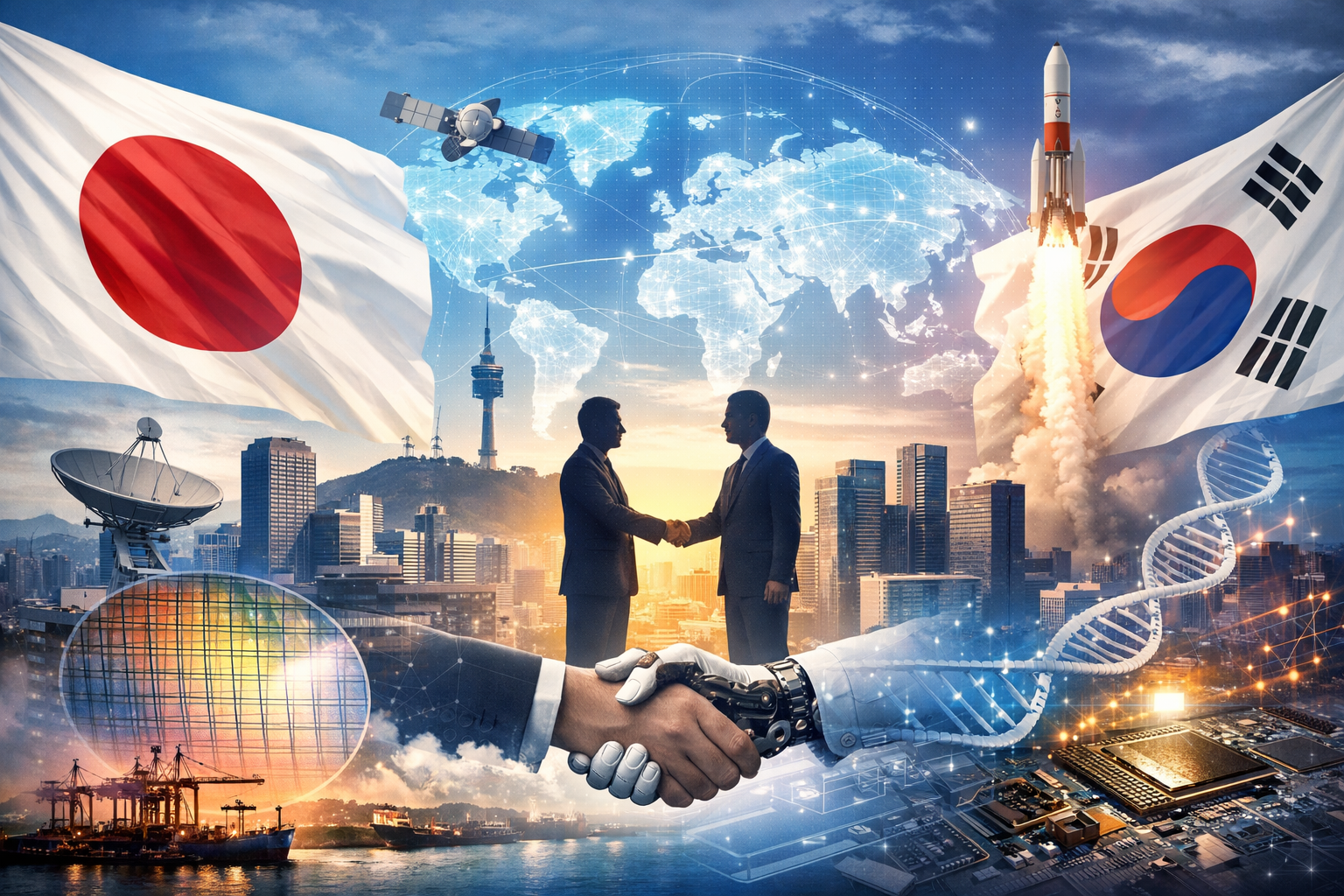
On March 3, 2026, the 17th Japan–Korea High-Level Economic Dialogue was held in Seoul. Amid ongoing global supply chain disruptions and rising geopolitical risks, the governments of Japan and South Korea engaged in wide-ranging discussions on cooperation in economic security and advanced technology sectors.
This dialogue can be seen as more than a simple bilateral economic discussion; it symbolizes the evolving position of Japan–Korea relations within the current international economic environment. This article organizes the content and background of the dialogue and examines its broader significance.
One notable aspect is that the central focus of the discussions was “economic security.” In recent years, international competition over semiconductors, critical minerals, and advanced technologies has intensified. Countries have increasingly positioned the stabilization of supply chains as a key national strategy. In this dialogue as well, cooperation in key technological fields such as artificial intelligence, space, and biotechnology was addressed as a major agenda item. This indicates that the nature of Japan–Korea cooperation is shifting from a traditional economic relationship centered on trade and investment toward one that is closely linked with technological collaboration and security considerations.
Another important point is the broad range of fields covered in the discussions. Topics included the environment and energy, agriculture, forestry and fisheries, people-to-people exchanges, and the protection of intellectual property. These themes encompass not only industrial policy but also institutional and social dimensions. This suggests that economic cooperation between the two countries is expanding beyond individual industries to broader societal and institutional frameworks. In particular, the inclusion of intellectual property protection as an agenda item indicates that both countries recognize it as an essential institutional foundation for advancing technological cooperation.
Furthermore, it is also noteworthy that Japan–Korea cooperation is being connected with multilateral frameworks. During the dialogue, both sides confirmed that they would expand cooperation within international frameworks such as the World Trade Organization (WTO), the G20, APEC, and the Regional Comprehensive Economic Partnership (RCEP). This reflects an approach that situates bilateral cooperation within broader regional and international economic systems. In frameworks such as RCEP, which promotes economic integration in Asia, coordination between Japan and South Korea could allow the two countries to exert a certain level of influence over the economic order in East Asia.
Another background factor behind this dialogue is the recent improvement in political relations between the two countries. Japan–Korea relations had long stagnated due to historical issues, but in recent years shuttle diplomacy between the leaders of both countries has resumed, and efforts toward improving relations have continued. The current economic dialogue can be viewed as a venue for translating that political improvement into concrete cooperation at the working level. There is also the possibility of a positive cycle in which improved diplomatic relations expand economic cooperation, which in turn helps stabilize bilateral relations.
Nevertheless, it is also true that challenges remain. Historical issues and domestic political dynamics still represent potential sources of instability between the two countries. In addition, in sectors such as semiconductors and advanced technologies, there are elements of competition alongside cooperation. As a result, the extent to which the two countries can deepen substantive cooperation will likely depend on future political conditions and the direction of industrial policies.
Even so, this dialogue suggests that Japan–Korea relations may be entering a new phase. Cooperation centered on economic security and advanced technologies has the potential to form the foundation of a strategic partnership that goes beyond a simple trade relationship. At a time when uncertainty in the international environment is increasing, stronger cooperation between neighboring advanced economies may also contribute to regional stability.
Going forward, attention will focus on how the discussions in this dialogue will be translated into concrete policies and joint projects. The extent to which Japan–Korea economic cooperation deepens will likely become an important issue in shaping the economic order of East Asia.