
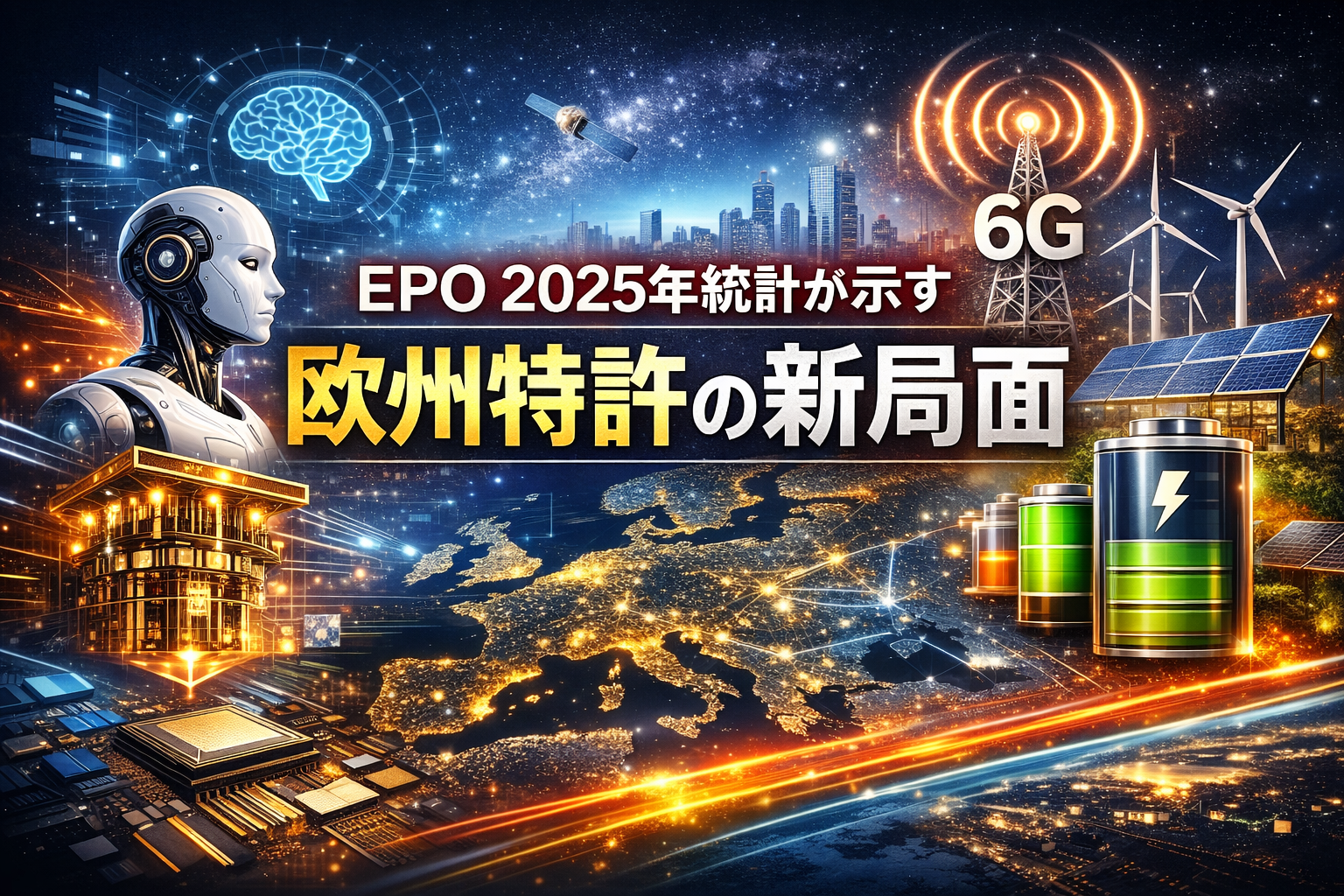
The European Patent Office’s (EPO) 2025 Technology Dashboard is not merely an annual statistical report showing rises and falls in filing volumes. What the latest data reveals is a more multidimensional picture: Europe remains one of the world’s leading technology markets, growth is becoming concentrated in specific technological fields, and institutional competitiveness is being strengthened in distinct ways.
In 2025, the number of patent applications filed with the EPO reached 201,974, up 1.4% from the previous year and marking a new all-time high. Looking only at this figure, one might conclude simply that “European patent filings remained solid.” What is truly important, however, is that the substance of those filings is clearly shifting toward digital technologies and energy technologies.
The Real Meaning of the Record Number of Filings
The latest results show that while filings originating within Europe rose only slightly, filings from outside Europe increased more strongly. This suggests that Europe is being valued not only as a place where inventions are generated, but also as a market where rights should be secured and as a strategic base for future business expansion by global companies.
As the EPO President noted, Europe possesses not only “innovative capacity” but also functions as an “attractive technology market.” In other words, these statistics do not merely reflect the R&D strength of European companies; they also visualize how important companies around the world regard Europe as a destination for patent protection.
Growth Is Centered on AI, Quantum, 6G, and Batteries
Looking at the figures by technical field, the most symbolic point is that computer technology remains in first place, with strong growth in AI-related inventions, particularly in neural networks and image recognition. Furthermore, although still small in absolute scale, quantum technologies are showing a very high growth rate, suggesting that the future competitive axis is already beginning to take shape.
In digital communications as well, strong growth was observed against the backdrop of advances toward 6G. This indicates that securing standard-essential patents and surrounding technologies remains critically important in the communications field. The fact that major players such as Europe, the United States, China, and South Korea are all strengthening their presence in this area reaffirms that next-generation communications remain a central battleground in patent competition.
In the energy sector, growth in electrical machinery, apparatus, and energy technologies is being strongly driven by battery technologies. Growth has been particularly notable in Japan, China, and South Korea, further increasing the presence of Asian players. Because batteries are a foundational technology connected to multiple industries—including automobiles, energy storage, and renewable energy utilization—filing trends in this field carry significance beyond that of a standalone technology statistic.
Europe’s Strengths Remain Intact, but the Competitive Environment Is Changing
At the same time, it would be inappropriate to interpret the data simply as evidence of Europe’s decline. European innovators lead in eight of the EPO’s top ten technology fields, and Europe continues to maintain a strong presence in areas such as transport, measurement, and special machinery. It should also not be overlooked that European players hold high shares in subfields of AI and quantum technology.
However, when looking at country-level trends, traditional European powers such as Germany, France, the Netherlands, the United Kingdom, and Sweden appear subdued, while China and South Korea are showing strong growth. China’s move past Japan into third place by country of origin for the first time should be seen not merely as a ranking change, but as an event demonstrating the serious commitment of Chinese companies to the European market.
Patent competition is no longer simply about “who files the most.” It has become a strategic contest over “which market, in which technology, and through which institutional framework rights are secured.” The latest statistics suggest that the intensity of that competition has risen another level.
The Growing Use of the Unitary Patent Shows Institutional Competitiveness
One of the most noteworthy aspects of this announcement is not only the growth in technology fields, but also the rising uptake of the Unitary Patent. In 2025, unitary effect was requested for 28.7% of European patents granted by the EPO, and among European universities, public research institutions, SMEs, and micro-entities, that figure reached 48.3%.
This carries major significance. The value of a patent system is not determined solely by the strength of protection; it is also shaped by ease of use, cost, and the clarity of procedures. Especially for SMEs and universities, the reduced burden of maintaining rights across multiple countries is highly meaningful, and it can be inferred that institutional reform itself is increasing the incentive to file.
What is even more interesting is that use from outside Europe, particularly from China, is also steadily increasing. This indicates that the Unitary Patent is no longer merely an internal European institutional reform, but is beginning to be recognized by global companies as a practical means of obtaining rights in Europe.
The Slowdown in Medical and Biotech Fields Raises Important Questions
While the growth sectors appear impressive, the decline in biotechnology and pharmaceuticals should not be overlooked. Pharmaceuticals, in particular, have declined for the second consecutive year, returning to roughly the 2019 level. The EPO’s reference to proposed EU legal measures—namely the Unitary SPC and policies to strengthen biotechnology and biomanufacturing—reflects an awareness that the institutional environment directly affects competitiveness in specific technological sectors.
In other words, increases and decreases in patent filings are not determined by R&D capability alone. Institutional conditions such as regulation, term of protection, commercialization environment, and the outlook for return on investment have a substantial impact on filing behavior. The latest statistics once again demonstrate that intellectual property policy cannot be separated from industrial policy.
Implications for Japanese Companies
Japan remains one of the major players in EPO filings, but what stands out in these latest statistics is the momentum of China and South Korea, as well as intensifying competition in strategic sectors such as batteries and communications. European filings have long been important for Japanese companies, but going forward, the mindset of simply “obtaining patent rights in Europe as well” may no longer be sufficient.
Companies will need to redesign their strategies in an integrated manner with business planning: in which fields should European filings be reinforced, whether the Unitary Patent should be used, and which technological themes competitors are concentrating on. In fields such as AI, communications, batteries, and semiconductors—where competition unfolds across entire ecosystems—it will become more important not how many filings are made, but which technological positions are secured first.
From the Age of Numbers to the Age of Structure
The EPO’s 2025 statistics should be read not primarily as a record of filing numbers, but as a source showing where the center of gravity of technology is shifting, who is deepening involvement in the European market, and which segments are being affected by institutional reform.
While strategic technologies such as AI, quantum, 6G, batteries, and semiconductors are growing, the biotech and pharmaceutical sectors are highlighting the need for stronger institutional support. At the same time, Europe still retains a strong foundation, even as competition with Asian players—particularly China and South Korea—has become increasingly clear.
Patent statistics are both a record of the past and a preview of the next stage of competition. The EPO Technology Dashboard 2025 seems to illustrate exactly that. What is needed is not to be overly pleased or discouraged by filing volumes alone, but to have the perspective to discern which technologies and which institutional frameworks will shape the next phase of competitiveness.