
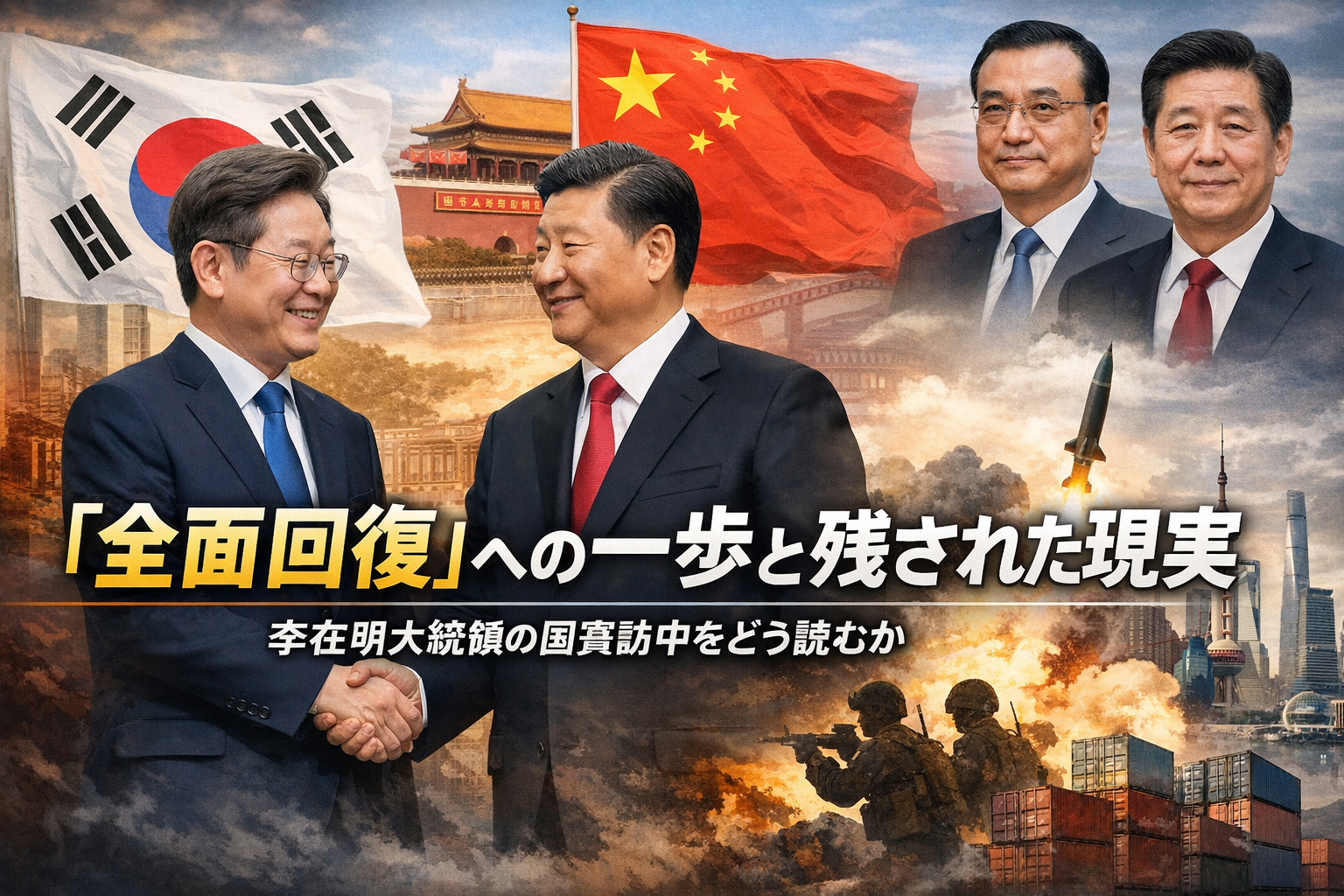
President Lee Jae-myung, currently on a state visit to China, held successive meetings with National People’s Congress Standing Committee Chairman Zhao Leji and Premier Li Qiang, following his summit with President Xi Jinping. That he met with all of China’s top leadership figures, and that the People’s Daily prominently covered the meetings on its front page, can be interpreted as a strong signal that Beijing places considerable importance on its relationship with South Korea. Against the backdrop of intensifying U.S.–China rivalry and growing international instability, the visit, at least in terms of protocol, amounted to an exceptionally warm reception.
There is also a certain rationale behind the South Korean government’s characterization of the visit as the first gateway toward the “complete normalization” of bilateral relations. Following China’s retaliatory measures triggered by the deployment of THAAD and the deterioration of relations under the previous administration, South Korea–China ties had remained in a prolonged chill. It is difficult to deny that this summit restored, at minimum, political momentum toward repairing relations. President Lee’s remark that the visit constituted “an important opportunity to make 2026 the inaugural year of the full recovery of South Korea–China relations” can be seen as a symbolic expression of that intent.
At the same time, the absence of a joint statement despite the visit’s state-level status succinctly highlights its limitations. Discrepancies were evident in both the content and emphasis of the documents released by the two sides, particularly on sensitive issues such as security and regional order, where fundamental differences in position remain unresolved. While some agreements were reached in areas related to people’s livelihoods and economic cooperation, the impression persists that the talks deliberately avoided delving into core political and security issues.
The handling of denuclearization on the Korean Peninsula is especially emblematic. The South Korean side explained that the two countries reaffirmed China’s “constructive role” in resuming dialogue with North Korea and building peace, yet the Chinese readout made little mention of denuclearization or the Korean Peninsula issue. This likely reflects the reality that North Korea’s strategic value has increased amid intensifying U.S.–China hegemonic competition. Although the two sides arrived at an abstract consensus on “cooperation for peace-building,” it would be premature to expect tangible outcomes.
China’s pronounced focus on the Taiwan issue further underscores the nature of the talks. Beijing’s emphasis on the “One China” principle, coupled with references to Japan and the United States, can be interpreted as exerting strategic pressure on South Korea to make certain choices. Remarks invoking historical perspectives while urging “correct strategic decisions” suggest that South Korea’s diplomatic autonomy is being put to the test.
Progress was also limited on the issue of the so-called “Korea ban” (限韓令), which remains a matter of high domestic interest in South Korea. Although the two sides reached a principled agreement to gradually expand cultural exchanges, this fell short of concrete achievements such as the resumption of K-pop concerts or the distribution of Korean dramas and films. While restarting exchanges through activities such as Go and football is symbolically meaningful, substantive easing of restrictions is likely to take more time.
The issue of structures in the West Sea followed a similar pattern. While the two sides confirmed a shared understanding of making it a “sea of peace,” concrete measures were deferred and entrusted to vice-ministerial consultations. Realistically, the situation appears to have entered a management phase aimed at preventing further deterioration.
Against this backdrop, the most tangible achievements emerged in the areas of people’s livelihoods and economic cooperation. The signing of 14 memoranda of understanding, including cooperation on intellectual property protection and in AI and big data, as well as the regularization of ministerial-level commerce meetings, may contribute to strengthening practical ties going forward. Precisely because uncertainty remains high in political and security domains, it is evident that both sides seek to anchor stability in economic cooperation.
This state visit to China clarified both the momentum and the foundations for a future-oriented relationship, while simultaneously exposing its limitations and unresolved challenges. Translating the weighty phrase “full recovery” into concrete outcomes will require gradual engagement and sober strategic judgment. How far President Lee’s emphasis on “strategic autonomy” will be translated into tangible diplomatic action remains to be seen. In that sense, this visit can be regarded as the first stage of a broader test yet to come.