
Introduction
The lawsuit between X and music publishers is not merely about whether anti-piracy measures on social media were too lax. It has become an important case that asks how far an online platform can be held responsible for its users’ copyright infringement. In 2023, seventeen music publishers sued X, seeking more than $250 million in damages based on alleged infringement involving approximately 1,700 copyrighted works. Then, in March 2024, a federal district court in Tennessee rejected the claims for direct infringement and vicarious liability, while allowing the contributory infringement claim to proceed on certain limited issues.
What dramatically changed the atmosphere, however, was the U.S. Supreme Court’s March 25, 2026 decision in Cox Communications v. Sony Music. The Court held that a service provider can be liable for contributory infringement based on user infringement only where the service can be said to have been provided with the intent that it be used for infringement, and that such intent can be shown only in one of two ways: either by actively inducing infringement, or by designing the service itself for infringing use such that it lacks substantial non-infringing uses. In response, X filed a motion on March 27 seeking termination of the entire case, arguing that the legal theory supporting the earlier partial denial of dismissal can no longer be sustained and that the remaining claims are legally defective.
The Center of Gravity Has Shifted
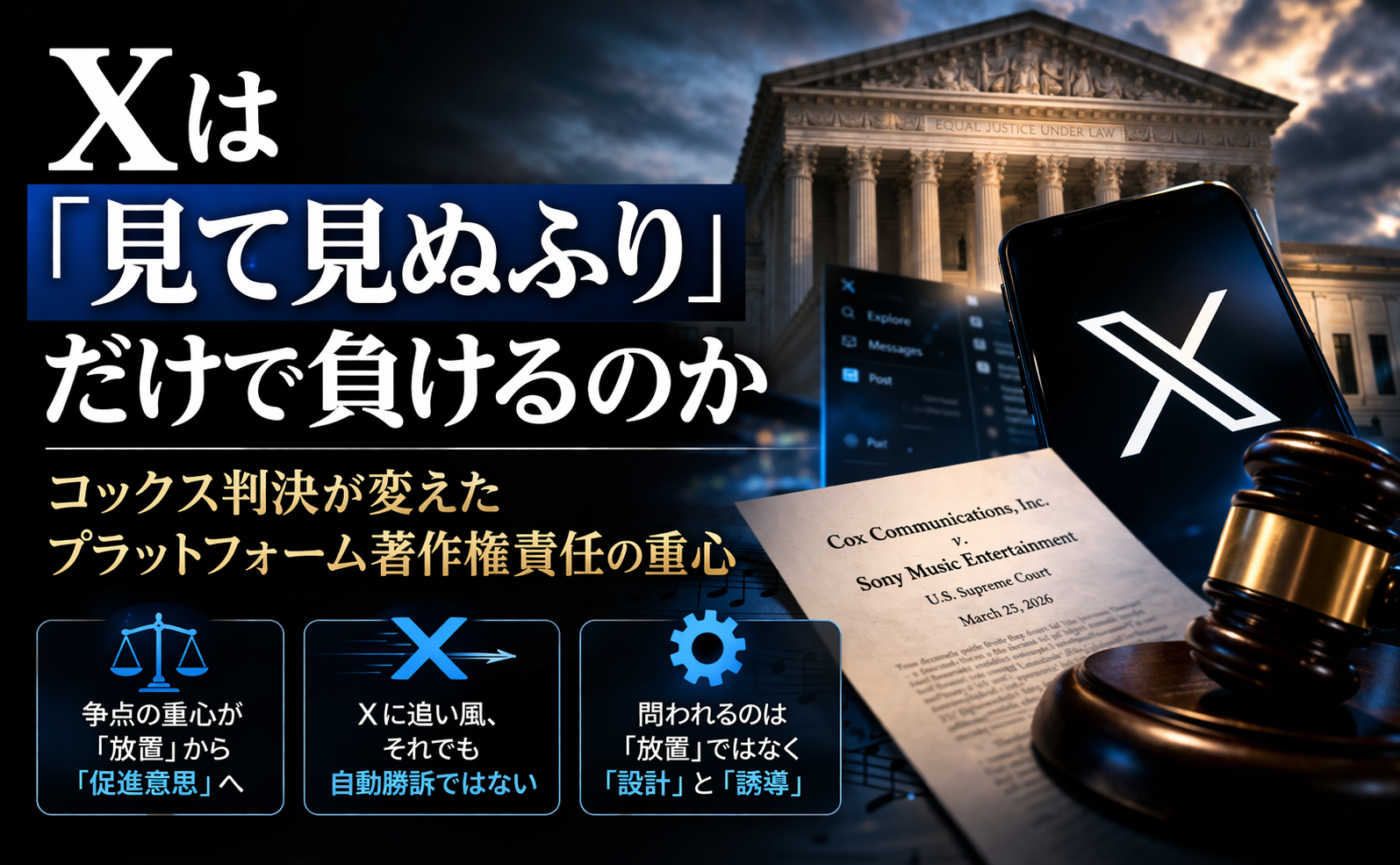
The essence of this ruling is that the focus of the dispute has shifted from “Did the platform know about infringement and fail to do enough to stop it?” to “Can it be said that the platform intended to promote infringing use?” The Supreme Court made clear that it is not enough merely to know that a service can be used for infringement, or to have failed to adequately exclude repeat infringers. In other words, the traditional “turning a blind eye” theory alone has become less effective as a basis for imposing contributory infringement liability on service providers.
In this respect, the Cox ruling is a considerable tailwind for X. X’s service plainly has many non-infringing uses, including news consumption, public commentary, corporate communications, and the dissemination of information during disasters. Given that, it is not easy to fit X neatly into the Supreme Court’s category of a “service designed for infringement.” X’s argument in its recent filing—that its service has substantial non-infringing uses and that the complaint does not identify any concrete acts by which X actively induced infringement—is a direct invocation of the Supreme Court’s new standard.
A Tailwind for X, but Not an Automatic Victory
That said, it is still too early to conclude that “X has won.” The reason is that the district court’s 2024 ruling did not focus on mere inaction in the abstract. Rather, it looked at rather specific aspects of X’s operational practices. The court allowed three issues to remain in the case: the possibility that verified users were given more lenient copyright enforcement, the possibility that X unreasonably delayed responding to takedown requests, and the possibility that X failed to take meaningful action against bad-faith repeat infringers. The court viewed these allegations, if proven, as potentially amounting not to passive inaction but to active and culpable conduct that helped facilitate infringement.
This is the critical point. The Cox ruling said that merely “knowing and failing to stop” infringement is not enough. At the same time, it also indicated that the outcome may be different where specific conduct affirmatively encouraged infringement. That means the music publishers will likely try to recast X’s conduct not as mere mismanagement, but as something closer to “promotion”: differentiated enforcement through the verification system, a system designed to tolerate delayed responses, and preferential treatment of repeat infringers. That is where the real battleground of the litigation is likely to move.
Also noteworthy is Justice Sotomayor’s concurring opinion. Her concurrence suggested that the majority may have defined contributory infringement too narrowly by confining it to two categories, without adequately addressing whether broader common-law aiding-and-abetting principles might still have relevance. Even so, she agreed with the result because, on the facts of Cox, the necessary intent could not be proven. In other words, the Supreme Court has given X a powerful weapon, but it has not completely foreclosed all theoretical avenues for secondary liability. That is the more precise reading.
What Matters Now Is Not “Inaction,” but “Design” and “Steering”
This series of developments has major implications for practice. In future platform litigation, the important questions will not simply be quantitative ones—such as how many DMCA notices were received or how many removals were missed. Greater attention will instead be paid to the substance of operational decision-making: product design, monetization structure, algorithmic preferences, internal reasons for delayed responses, and exceptional treatment of certain users. The Supreme Court also stated that a failure to qualify for the DMCA safe harbor does not, by itself, weaken a defendant’s non-infringement position. For copyright owners, this makes it harder to prevail merely by pointing to noncompliance with the statutory framework.
Put differently, what rights holders will now need is not just evidence that “this service was used for infringement,” but concrete proof that “this company structured its service so that infringing use would be easier to engage in, easier to sustain, and more profitable.” The X litigation may become the first leading example of this new evidentiary contest. Debates over platform liability will certainly continue, but their focal point is steadily shifting from “liability for inaction” to “liability for inducement.”
Conclusion
In my view, the Cox ruling is considerably favorable to X. That does not mean, however, that social media platforms are automatically exempt simply because they are social media platforms. What the Supreme Court weakened was the theory of liability based solely on knowing of infringement and failing to respond adequately. It did not absolve cases in which the design of the service or its operational policies themselves can be characterized as promoting infringement. The core issue in this case will therefore be brought into even sharper focus: was X simply negligent, or was it operating in a way that was content to let infringement happen—or even found it advantageous when it did?