
Introduction
The recently reported case in which two Chinese nationals were arrested for selling earrings bearing a logo resembling Chanel’s on a flea market app should not be dismissed as merely another news story about the crackdown on counterfeit branded goods. Rather, it can be seen as a case that once again brings into sharp relief just how effectively flea market apps, as an everyday trading infrastructure, have come to function as distribution channels for counterfeit products.
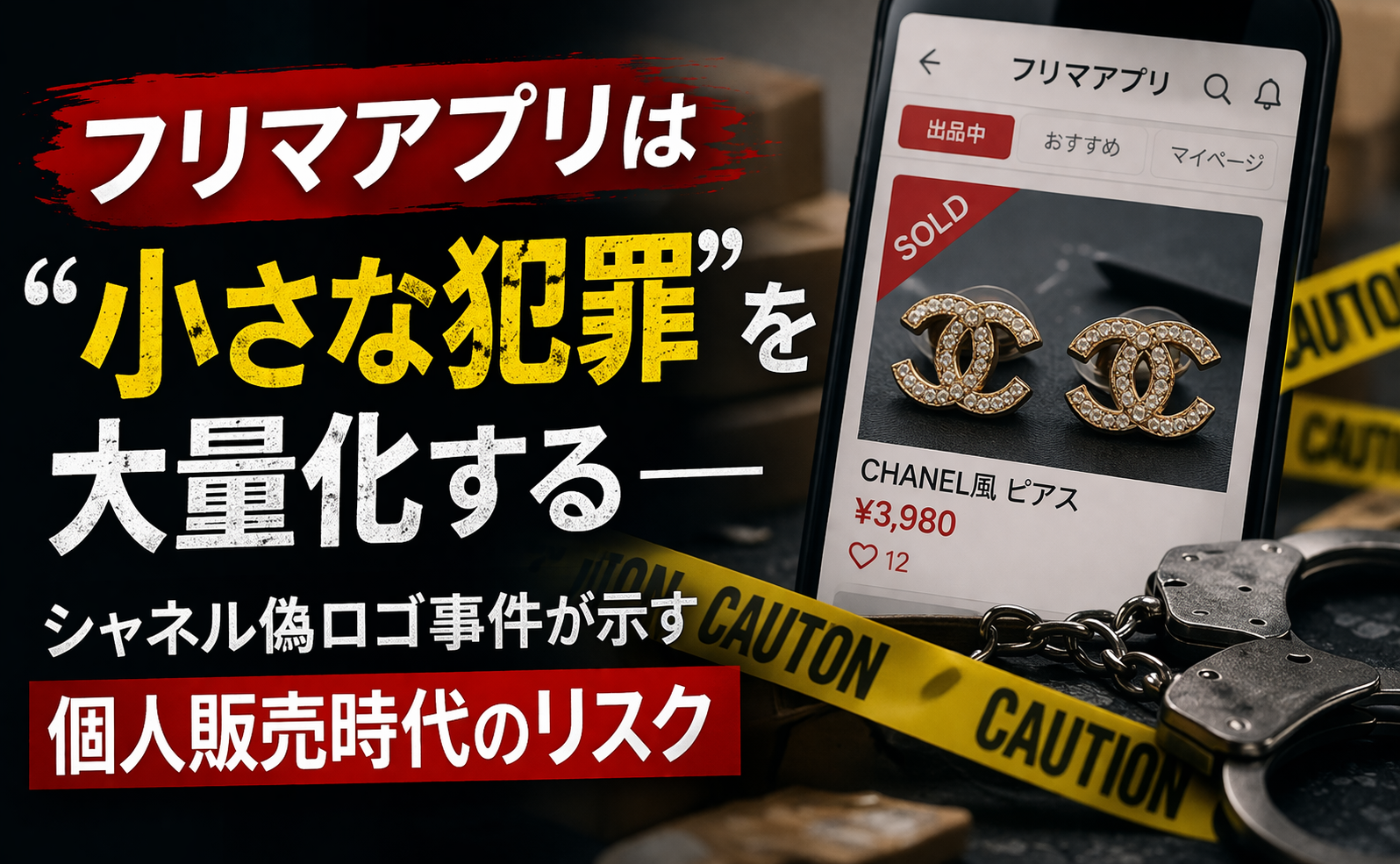
According to news reports, the suspects allegedly procured counterfeit goods in China, brought them into Japan, listed them on flea market apps, and sold them nearly 800 times over a period of about two years, generating sales of approximately 3.8 million yen. Even if the value of each individual transaction was relatively small, the total becomes significant once those transactions accumulate. This is one of the defining characteristics of modern counterfeit distribution.
A Structure in Which “Low-Value Repetition,” Rather Than Large-Scale Smuggling, Generates Profit
What is particularly noteworthy in this case is that the goods sold were earrings priced at 3,980 yen per set. They were not expensive bags or watches, but products in a relatively affordable price range that were allegedly sold repeatedly.
This structure is highly characteristic of the present day. In the past, problems involving counterfeit branded goods were often discussed mainly in the context of street vendors, market stalls at overseas travel destinations, or the forgery of high-priced items. Today, however, anyone can list products with nothing more than a smartphone, shipping is easy, and direct contact with buyers can be kept to a minimum. As a result, even if the profit from each individual sale is small, it becomes possible to build up substantial overall revenue through a high turnover rate.
In other words, flea market apps have a structure that readily connects the casual side-job mindset of individuals with the distribution of illegal goods. The reported statement, “I thought I could do it too,” symbolically captures that danger.
The Seriousness of Trademark Infringement Behind a “Casual Attitude”
In cases of this kind, statements such as “I needed money for living expenses,” “I wanted to increase my savings,” or “I thought everyone was doing it” are often reported. However, the familiarity of the motive does not lessen the illegality of the act.
Brand logos and similar marks are the crystallization of the trust that companies have built over many years. Selling counterfeit goods is not simply a matter of selling products with similar designs; it is an act of free-riding on that trust, misleading consumers, and undermining the fairness of the market. This is especially serious in the case of luxury brands, where brand value itself lies at the core of product value, so even merely imitating the logo carries substantial significance as an infringement.
Moreover, some buyers may think, “It may not be genuine, but it’s cheap, so that’s fine.” But as long as there is demand, supply will continue. Turning a blind eye because of the low price ultimately helps sustain illegal distribution.
Stronger Monitoring of Flea Market Apps Is Only Natural, but It Is Not Enough
In this case, reports say the incident came to light after an investigator patrolling flea market apps noticed suspicious listings of counterfeit goods. This shows that online monitoring can have a certain degree of effectiveness.
However, it will likely be difficult to eradicate the problem through monitoring alone by the police, rights holders, and platform operators. Counterfeit listings are repeatedly altered in form, and sellers try to evade detection by changing accounts and rewording product descriptions. It is also not uncommon for sellers to use vague terms such as “inspired by,” “novelty,” or “made overseas” to make the matter seem ambiguous and shift responsibility onto the buyer.
Therefore, monitoring alone is not a sufficient countermeasure. More sophisticated listing reviews, stronger cooperation with rights holders, detection based on past listing patterns, and, above all, greater user literacy are essential.
The Perspective Consumers Need to Have
Even from the consumer’s standpoint, this case is not someone else’s problem. On flea market apps, products may look convincing, and prices may be set at a level that is deceptively “not too cheap.” As a result, there are likely cases in which people end up buying items because they cannot definitively determine that they are counterfeit.
At the very least, however, buyers need to keep the following points in mind. First, if a product prominently displays a brand logo and is extremely cheap, it should be treated with suspicion. Second, if a seller is selling large quantities of similar items on a continuous basis, one should suspect that this is not the sale of personal unwanted items but resale of sourced goods. Third, if the description is unnaturally vague and avoids making any clear statement about authenticity, caution is warranted.
The fact that, behind the feeling of “I got a good deal,” there may be complicity in rights infringement or illegal distribution is something that should be more widely recognized.
The Counterfeit Goods Problem in the Age of Cross-Border E-Commerce
According to the reports, the suspects allegedly purchased counterfeit goods on e-commerce sites while returning to China and brought them into Japan either in their luggage or by air shipment. What this suggests is that the counterfeit goods problem is not only a matter of domestic distribution, but also one of cross-border e-commerce and personal importation.
Counterfeit goods that are easily obtainable overseas are brought into the country in small quantities at the individual level and then spread through the domestic flea market. Unlike traditional large-scale smuggling, this flow makes crackdowns and border-control measures more difficult. Each shipment may be small, but taken together, they amount to a large volume of circulation.
Going forward, in addition to cooperation among customs authorities, the police, platforms, and rights holders, there will also need to be more specific warnings about the risks that lie at the boundary between personal importation and resale.
Conclusion
The essence of this case does not lie merely in the fact that an individual who sold counterfeit branded goods was caught. What it really shows, once again, is that the convenient system of flea market apps carries the danger of turning illegal goods into a “familiar side business.”
For sellers, the mindset that “it’s only a small amount, so it’s fine” or “everyone is doing it, so it’s not a problem” can lead to criminal charges. For buyers as well, reaching for suspicious goods simply because they are cheap may amount to supporting illegal distribution.
A convenient marketplace can function in a sound way only when it is supported by the judgment of its users. Now that flea market apps have become part of everyday infrastructure, this is precisely the time when users as a whole need to regain a proper legal and ethical awareness regarding counterfeit goods.