
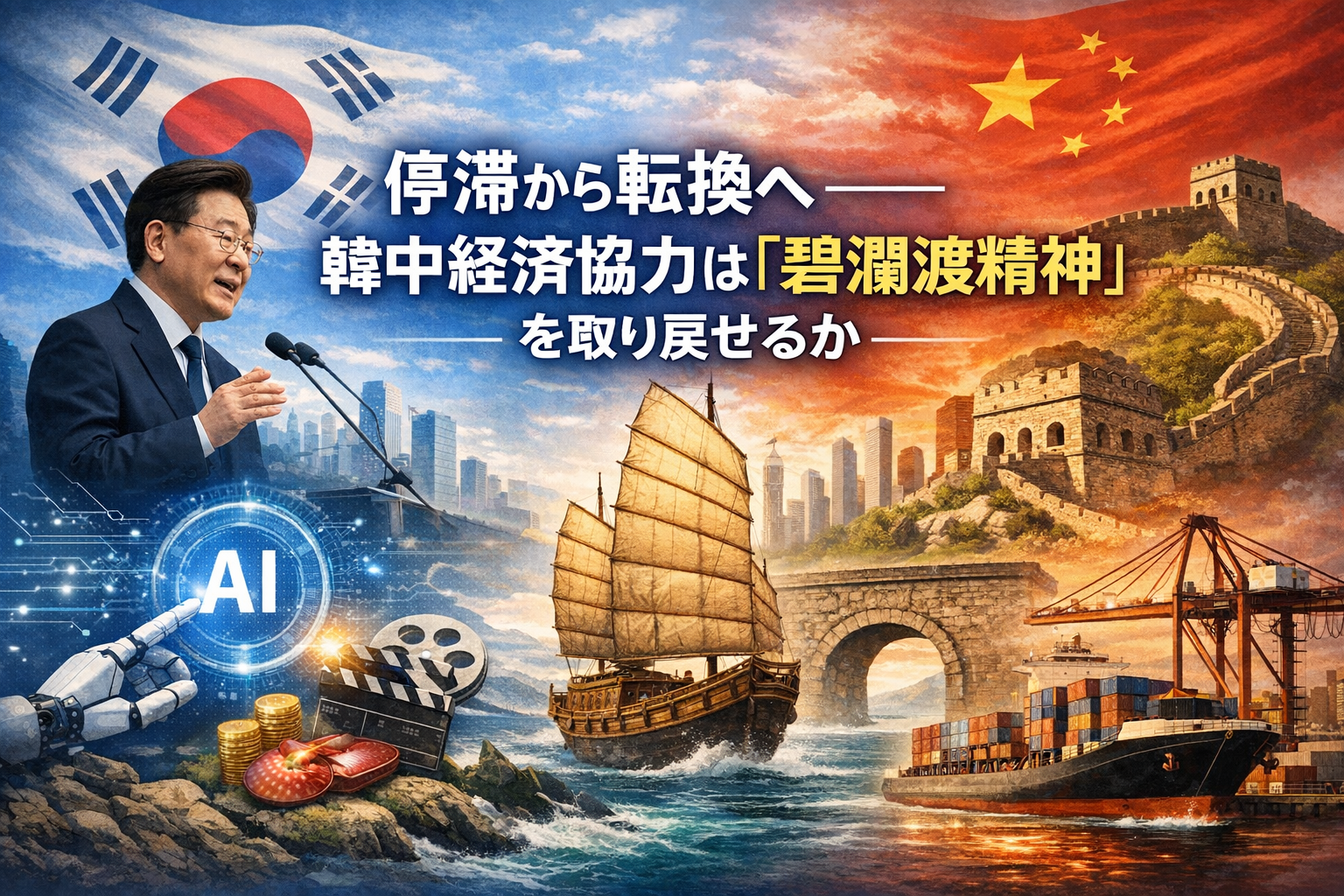
The message conveyed by South Korean President Lee Jae-myung during his state visit to China appears to succinctly capture both the challenges and possibilities currently facing South Korea–China economic relations. At a time when bilateral trade has stagnated at around USD 300 billion, his call for the development of “new shipping routes and new markets” goes beyond a mere discussion of economic policy and instead urges a fundamental shift in how the times themselves are understood.
A Warning Against Stagnant Trade and “Inertia”
What President Lee emphasized was the risk inherent in relying on past successes and inertia in an era where technological innovation and supply chains are changing at an unprecedented pace. This is a challenge shared across the global economy, but for neighboring major powers such as South Korea and China, its impact is particularly direct. As the manufacturing-centered cooperation model approaches its limits, the key question becomes how to envision new engines of growth.
AI and Cultural Content as New Pillars
One notable aspect of this visit was the proposal to position artificial intelligence (AI) and cultural content as new pillars of cooperation. AI is a foundational technology capable of transforming both manufacturing and service industries, offering wide-ranging opportunities for collaboration. Meanwhile, consumer goods such as cosmetics and food, as well as cultural content including films, music, and games, are sectors in which shared cultural values can be readily converted into economic value. The emphasis on building trust through areas close to everyday life and culture—while avoiding fields prone to political tension—reveals a strategic and pragmatic approach.
The Historical Metaphor of the “Bilan-du Spirit”
The metaphor of the “Bilan-du Spirit” used by President Lee in his keynote address was particularly striking. Referring to Bilan-du, an international trading port during the Goryeo Dynasty where trade and exchange continued despite diplomatic tensions, he underscored the importance of maintaining connection and communication amid change. The notion of layering new forms of value—such as services and content—on top of the solid foundation of manufacturing suggests not a simple extension of conventional cooperation, but rather its reconstruction.
Rebooting Through Business Forums and Institutional Frameworks
The South Korea–China Business Leaders Forum, held for the first time in nine years, brought together top executives from major South Korean companies such as Samsung Electronics, Hyundai Motor, and LG. Particularly symbolic was the move to regularize ministerial-level commerce meetings that had been suspended for seven years, along with indications that discussions on the second phase of the FTA could accelerate. In addition, the signing of memoranda of understanding on supply chain cooperation and intellectual property protection can be seen as concrete efforts to restore trust at the working level.
Where Is Cooperation Headed?
Taken together, this visit and the accompanying statements point to an attempt to shift South Korea–China relations from an emphasis on “quantitative expansion” to one of “qualitative transformation.” While stagnant trade volumes remain a challenge, emerging fields such as AI and cultural industries offer potential entry points for rebuilding the relationship. Whether these efforts will bear fruit, however, depends on how effectively the “Bilan-du Spirit” can be put into practice amid political tensions and a changing international environment.
Can both sides confront stagnation honestly, learn from history, and design new forms of cooperation for the future? This visit may well be remembered as a first step in testing that possibility.