
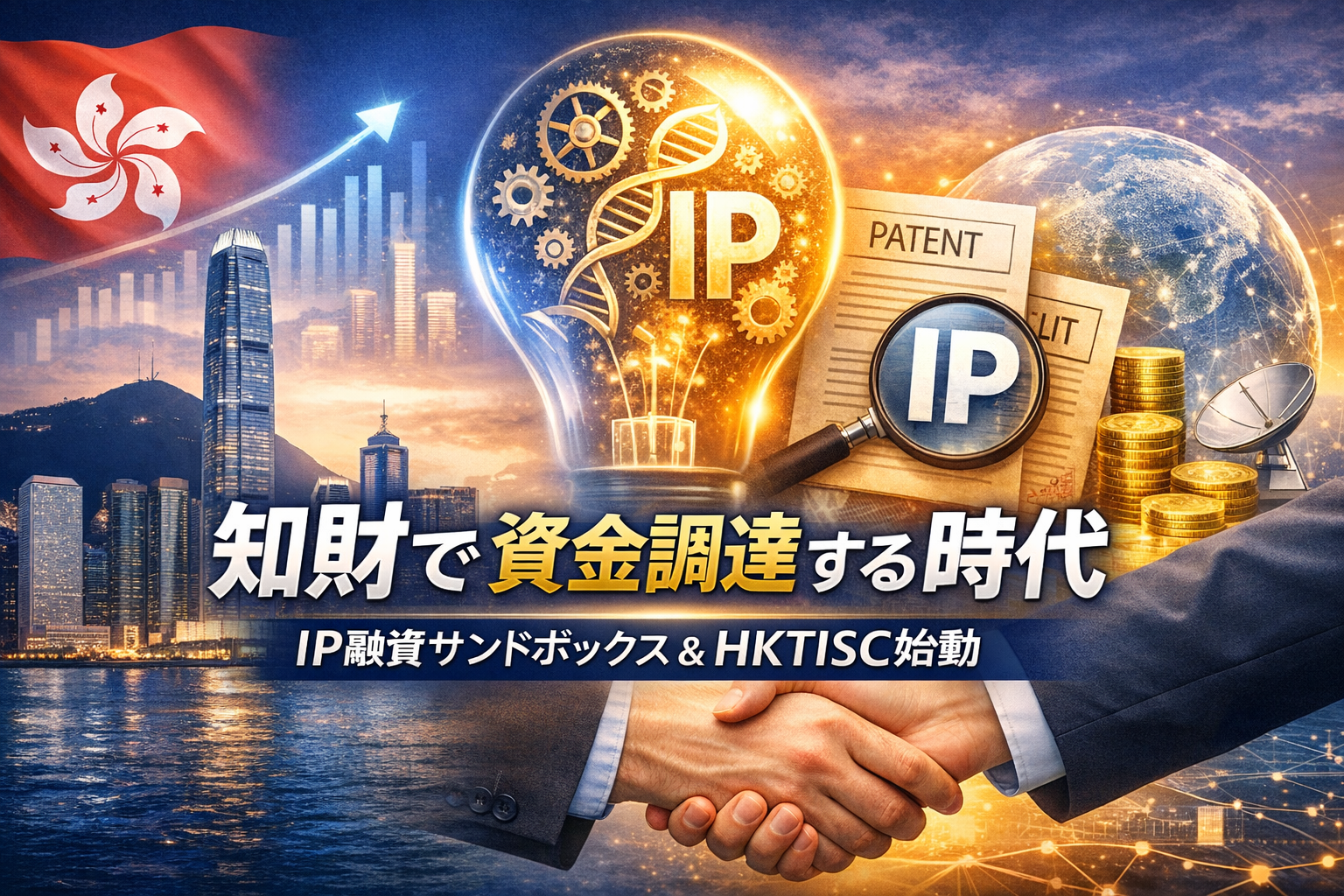
The Hong Kong government’s announcement of the launch of an IP financing sandbox, together with the official commencement of operations at the Hong Kong Technology & Innovation Support Centre (HKTISC), deserves close attention as a move that fundamentally repositions intellectual property from something merely “to be protected” to a financial asset “to be actively leveraged.” This initiative goes beyond the introduction of a new system and can be seen as a strong statement of Hong Kong’s ambition to become a regional hub for IP transactions and utilization.
A Paradigm Shift Toward Using IP as Collateral
The most distinctive feature of the IP financing sandbox lies in its approach of placing IP—such as patents—at the core of credit assessments and evaluating it head-on as collateral. For many companies, particularly startups and small and medium-sized enterprises, it has historically been difficult to directly link technological capabilities or patent holdings to financing, even when they possessed strong IP portfolios. This is largely because the value of IP, which is not easily reflected in financial statements, has often been insufficiently incorporated into traditional bank lending practices.
Under the new framework, IP is explicitly positioned as a key factor to be evaluated alongside a company’s creditworthiness and repayment capacity. This represents a potential turning point that could significantly expand financing opportunities for businesses whose core value lies in technology and intellectual property.
The Importance of Institutionalizing “Valuation” and “Risk Management”
The principal challenges of IP-based financing lie in valuation uncertainty and risk management. A notable characteristic of Hong Kong’s sandbox approach is that these issues are directly embedded into the institutional design. The adoption of internationally recognized valuation methodologies by independent expert bodies, as well as the use of qualitative patent evaluation reports, serves to enhance transparency and credibility in IP valuation.
At the same time, banks are required to comply with supervisory risk-management requirements, while companies are expected to assume responsibility for maintaining and enhancing the value of their IP. Rather than treating IP financing as a special exception, the framework reflects an effort to establish common rules that allow it to function as a viable form of finance.
HKTISC’s Role as a Central Hub
The role of HKTISC is another critical element supporting this initiative. In addition to providing foundational services such as patent searches, IP consultations, and training, HKTISC is expected to expand its offerings to include financial support for IP valuation and patent quality assessment services based on national standards. This can be seen as an attempt to build integrated infrastructure that supports the entire lifecycle of IP—from creation and valuation to financing and utilization.
For small and medium-sized enterprises in particular, the cost of valuation has been a major barrier to IP utilization. If support through HKTISC becomes fully operational, it may help overcome situations in which companies “have strong technology but hesitate to proceed with valuation.”
The Growing Realism of Hong Kong as a Regional IP Trading Center
As indicated by remarks from the Secretary for Commerce and Economic Development, these measures form part of a broader strategy to position Hong Kong as a regional IP trading center. The simultaneous advancement of legal frameworks, participation by financial institutions, and the construction of an ecosystem involving valuation and legal professionals suggests a clear intention not to let this remain a one-off experiment.
The fact that major banks have already expressed their participation and that numerous specialized service providers have shown interest demonstrates the existence of tangible market demand. Whether IP financing will become established as a standard financing option, rather than a rare exception, will depend on the accumulation of such practical, on-the-ground efforts.
Implications for Japanese Companies and Startups
These developments are not relevant only to Hong Kong. Financing through IP is also a critical issue for Japan, which positions itself as a technology-driven nation. Hong Kong’s initiatives offer many lessons, including the standardization of valuation methodologies and the importance of neutral support organizations that bridge finance and intellectual property.
The launch of Hong Kong’s IP financing sandbox and HKTISC represents a concerted effort to give concrete form—both institutionally and in practice—to the idea that “intellectual property is not a cost, but an asset.” Its success or failure will serve as a litmus test for the future direction of IP utilization models across Asia.