
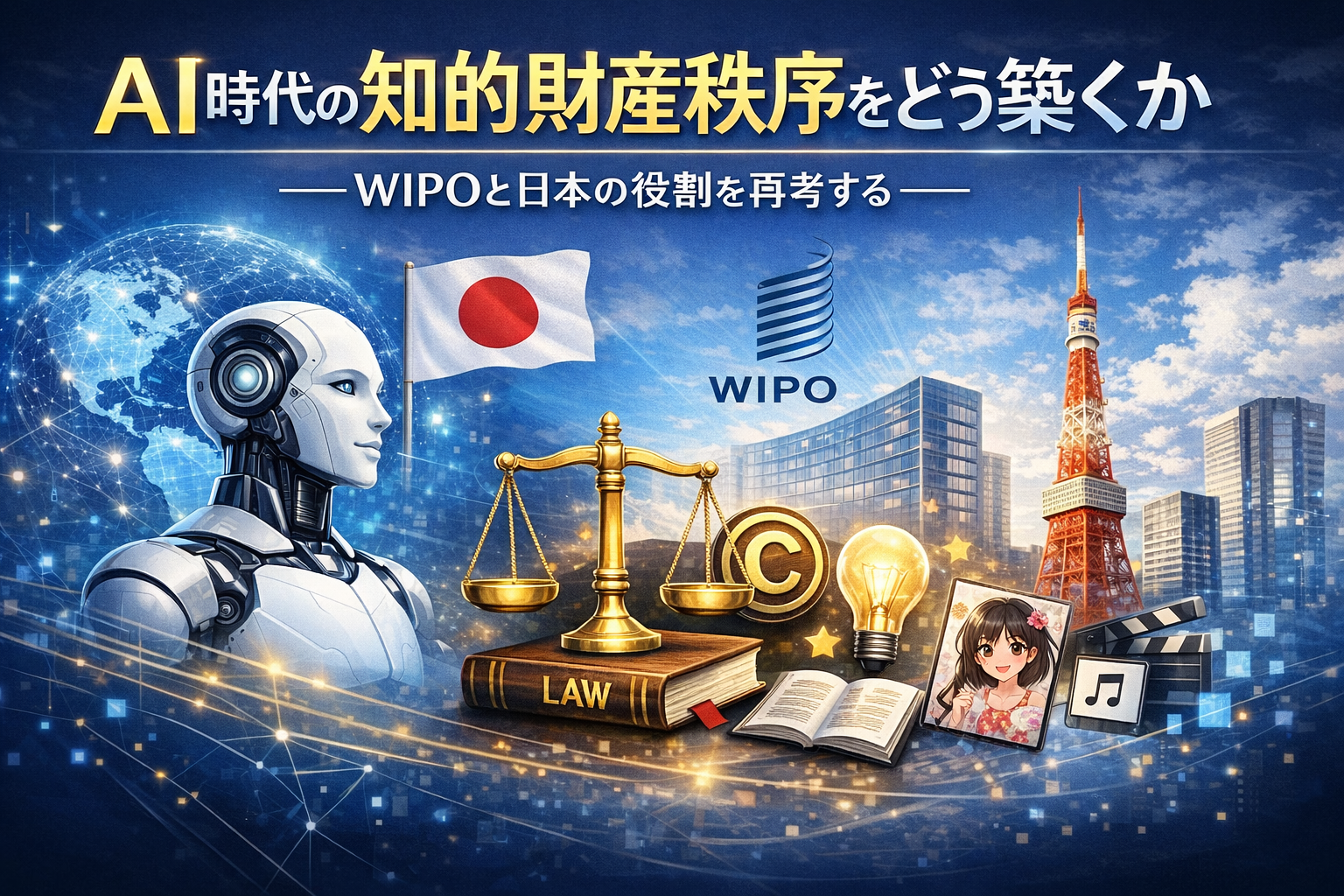
On January 30, 2026, Kimi Onoda, Minister of Economic Security in charge of intellectual property strategy, met at the Cabinet Office with Daren Tang, Director General of the World Intellectual Property Organization (WIPO). The remarks exchanged on this occasion went beyond a mere courtesy call and can be seen as suggesting the future direction of the intellectual property order in the age of AI.
The “Next Set of Issues” Surrounding AI and Intellectual Property
The “challenges surrounding AI and intellectual property” mentioned by Ms. Onoda have already become apparent in many countries. Issues such as the handling of training data used by generative AI, the attribution of authorship, and how to protect outputs created by AI are rapidly increasing—issues that cannot be fully addressed within traditional intellectual property frameworks.
These challenges cannot be resolved by any single country alone. As both AI technologies and digital content circulate across national borders, international common rules and at least a minimum level of global consensus are essential. In this sense, the statement expressing hope that “international discussions will progress further from here on” can be regarded as an extremely realistic and strategic message.
Combating Piracy and WIPO’s Role
Ms. Onoda also emphasized that WIPO should take international leadership in addressing intellectual property damage such as content piracy. This can be interpreted as signaling Japan’s intention to engage proactively not only in domestic measures but also in the design and operation of international systems.
Japan is particularly strong in content fields such as anime, manga, games, and music—areas where digitization and international distribution have advanced significantly. At the same time, Japan is also among those most vulnerable to the impacts of piracy. For this reason, the significance of leading rule-making efforts through a multilateral framework like WIPO is especially great.
“Japanese Content Enriches the World”
Director General Tang’s remark that “Japanese content enriches the world” is more than mere diplomatic courtesy. It reflects international recognition that content originating in Japan generates not only cultural value but also economic and social value.
At the same time, this assessment represents an expectation placed upon Japan. In other words, Japan is being called upon to contribute not only to its own national interests but also to the construction of a sustainable intellectual property system for the international community as a whole.
Japan’s Next Move
What emerges from this meeting is a picture of Japan seeking to move from being a “rule taker” to becoming a “rule maker.” The intersection of AI and intellectual property will only grow more complex in the future. In this context, it will be crucial for Japan to determine whether it can provide practical and institutional expertise while working in close cooperation with WIPO.
An intellectual property strategy for the age of AI is not merely a matter of protection policy. It concerns the broader design of society itself—how to promote innovation while maintaining a balance between creators and users. This news should be remembered as a milestone signaling that these discussions are now truly beginning in earnest.