
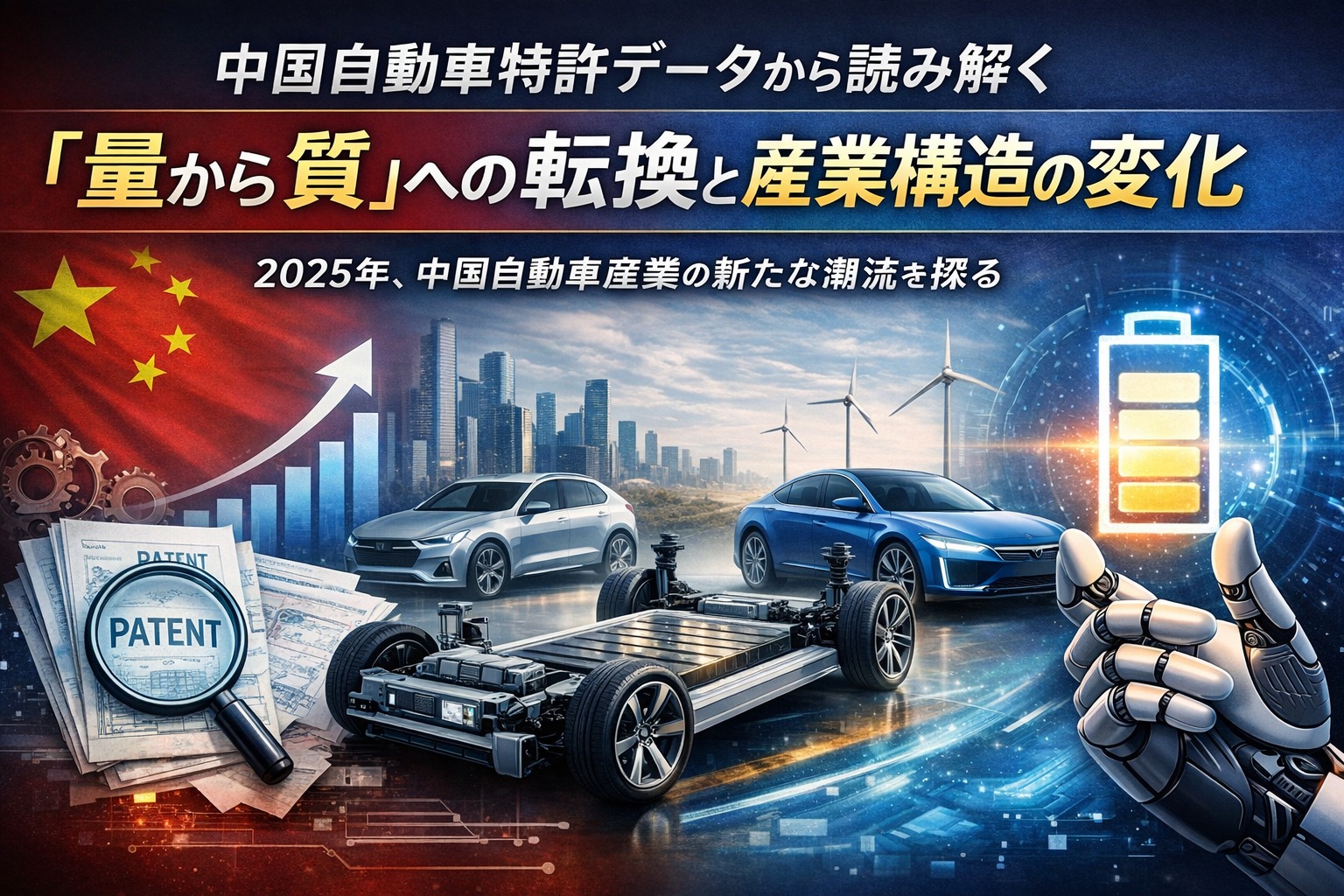
Patent trends in China’s automotive industry in 2025 reveal more than simple increases or decreases in numbers; they clearly reflect a strategic transformation across the entire industry. The latest analysis released by China Automotive Information Technology (CAITEC) highlights a distinct shift from “quantity to quality,” as well as changing roles between vehicle manufacturers and parts suppliers. This article examines the background to these trends and their implications going forward.
A Decline in Patent Numbers Does Not Mean “Retreat”
In 2025, the number of automotive patent publications in China decreased by approximately 4% year on year. At first glance, this may suggest a slowdown in research and development activity. However, a closer look reveals a different picture. The rising proportion of invention patents alongside a sharp decline in utility model patents indicates that companies are beginning to focus less on short-term or peripheral technologies and more on core technologies that will determine medium- to long-term competitiveness.
It is reasonable to interpret this as a transition from a phase of pursuing patent “volume” to one of accumulating “value.” This shift can also be seen as evidence that China’s automotive industry is entering a more mature stage of development.
Diverging Fortunes of Vehicle Manufacturers and Parts Suppliers
One of the most notable findings of the analysis is the contrast between vehicle manufacturers and parts suppliers. While patent publications by vehicle manufacturers declined, those by parts suppliers increased slightly. At the center of this trend lies the power battery sector.
Power battery manufacturers, which hold the key to the electrification race, position technological innovation as their primary growth driver and continue to expand R&D investment. Meanwhile, vehicle manufacturers face profit pressure from intense price competition—often referred to as “involution”—and are becoming more cautious in their R&D spending. As a result, parts suppliers, particularly battery-related companies, are strengthening their technological leadership.
This suggests a future in which vehicle manufacturers differentiate themselves through “integration capabilities” and “brand strength,” while the source of technological innovation increasingly shifts toward parts suppliers.
R&D Resources Concentrated in the New Energy Vehicle Domain
By technology field, new energy vehicles (NEVs) and intelligent connected vehicles together account for roughly half of all patents, reaffirming their status as the two strategic pillars of China’s automotive industry. Among them, the NEV sector continues to show steady growth in patent filings, with power battery systems accounting for more than half.
When charging systems and motor drive systems are included, technologies related to energy and propulsion represent over 70% of patents—a highly symbolic figure. In contrast, while foundational technologies such as power control units (PCUs) and EV chassis systems are critically important, their patent shares remain relatively low. This suggests that companies are taking a long-term view and steadily building intellectual property in these technically demanding areas.
Intelligentization Focused on Single-Vehicle Intelligence
In the intelligent connected vehicle field, overall patent numbers declined, but the content has become more sophisticated. Technologies related to single-vehicle intelligence—such as sensing, in-vehicle software, and integrated control—remain dominant. For the time being, competition is centered not on vehicle-to-vehicle or vehicle-to-infrastructure cooperation, but on how intelligent a single vehicle can become.
This reflects a pragmatic technology strategy: before autonomous driving can be fully implemented in society, the performance and completeness of individual vehicles must first be enhanced.
The Next Stage for China’s Automotive Industry
What the patent data ultimately shows is that China’s automotive industry has moved beyond an era of unidirectional growth and entered a phase of selective focus and concentration. In an excessively competitive environment, it is becoming increasingly difficult for all companies to continue investing in R&D at the same level. As a result, intellectual property and technological capabilities are likely to become more concentrated among companies with clear technological strategies and strong financial resources.
Going forward, corporate value will be determined less by the sheer number of patents and more by which technology domains companies focus on and the quality of the intellectual property portfolios they build. This analysis may well be seen as a milestone marking that turning point.