
Introduction
For years, a widely shared view has been that the United States holds the initiative in the global AI race, while China, though strong in application and implementation, is not the side shaping the cutting edge. In Washington and Silicon Valley in particular, that assumption has often been treated as almost common sense.
However, the emergence of DeepSeek has significantly shaken that picture. What this news reveals is not merely that another powerful AI company has appeared out of China. It points to a deeper reality: the competitive structure of AI itself is changing, and the pace of that change is faster than many had expected.
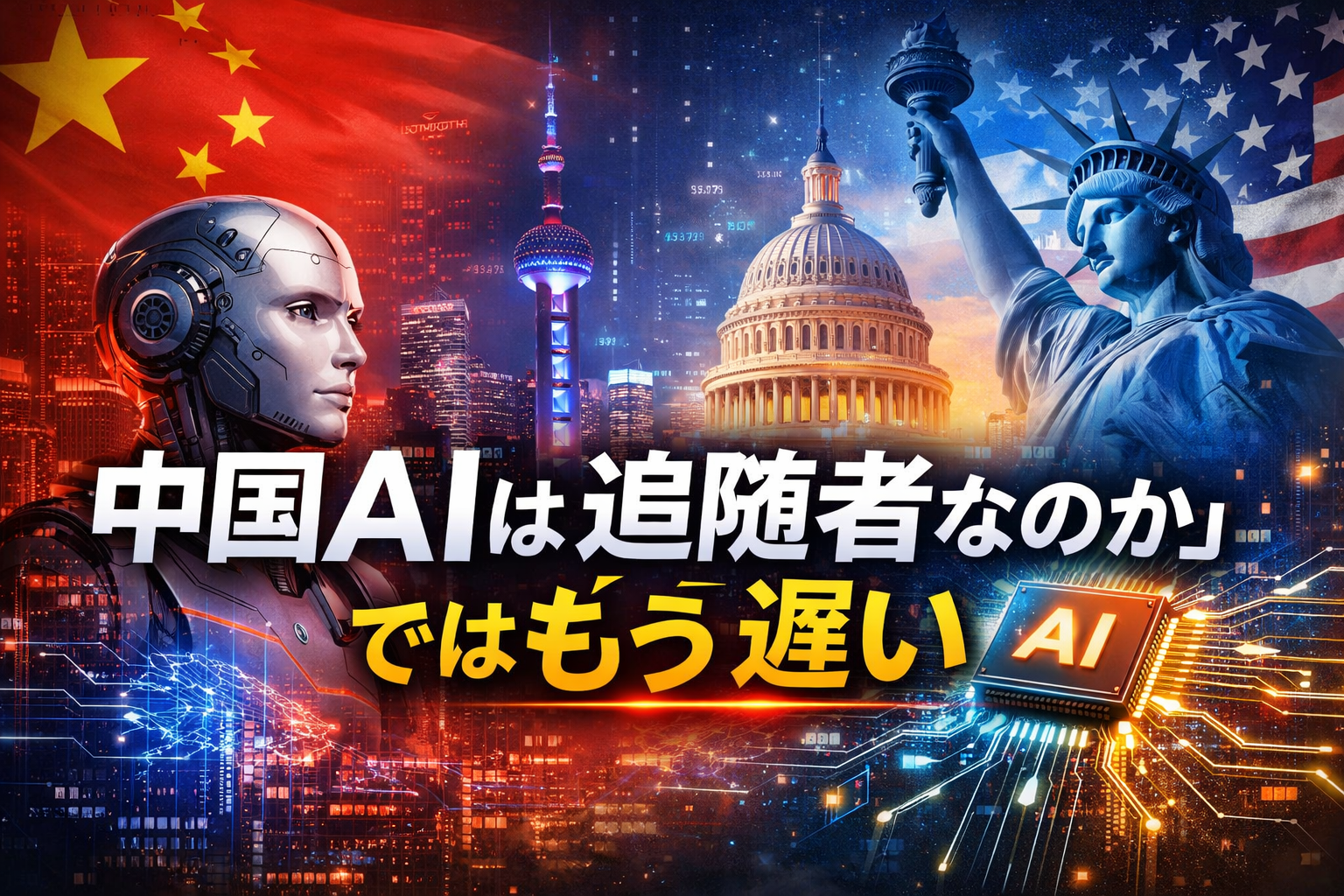
When we consider how this development should be understood, it becomes clear that continuing to assess Chinese AI using the old yardstick of “a player that follows behind the United States” is already no longer sufficient as a way of understanding the present situation.
What the Shock of DeepSeek Really Means
DeepSeek made such a strong impact not simply because of its performance. More fundamentally, it cast doubt on the assumption that only a handful of American companies—with massive capital and enormous computing resources—can reach the frontier of AI.
If it is truly possible to train high-performance models with fewer computational resources and at lower cost, then that changes the competitive conditions of the AI industry itself. Until now, it was generally believed that only a limited number of giant firms with deep financial resources, the ability to secure GPUs, and access to cloud infrastructure could develop frontier models. But when cases like DeepSeek emerge, the basis of competition shifts from simple “financial strength” to “design philosophy,” “efficiency,” and “how R&D is structured.”
Moreover, if such advances spread broadly in an open-source-like manner, the result will not be limited to the success of a single company. It will create the conditions for “the next DeepSeek” to emerge all over the world. This is not just a story about the rise of a Chinese company; it is also a change that could contribute to the democratization of the AI industry.
The Essence of Chinese AI Is Not “Imitation” but the Institutionalization of Implementation Capability
Until now, Chinese AI has often been seen as strong at quickly absorbing breakthroughs originating in the United States and implementing them at scale. There is some validity to that view. In areas such as facial recognition, smart cities, robotaxis, and industrial automation, China has demonstrated tremendous force in the social implementation of AI.
What deserves renewed attention now, however, is that this “implementation capability” is no longer merely an ability to apply existing technologies. It has been systematized into a distinct competitive advantage. By linking abundant data, a deep engineering talent pool, state funding, university research, rapid industry-wide deployment, and a massive domestic market, China has created a very fast pipeline from AI research to commercialization.
In other words, China’s strength does not lie in a simple either-or choice between basic research and application. It lies in its comprehensive ability to run the full cycle of research, development, deployment, and capital recovery in a short time. In the West, the relationship is often summarized as “innovation in America, application in China.” But the arrival of DeepSeek suggests that this boundary is beginning to break down.
What Has Changed Is Also the Cast of Companies
Another important point is that the main actors in Chinese AI are no longer limited to established tech giants such as Baidu, Alibaba, and Tencent. What makes DeepSeek especially symbolic is that it emerged not as a direct extension of one of the major platform companies, but as a startup rooted in a quantitative hedge fund.
This suggests that technological innovation in China is not concentrated solely in a few massive firms, but is emerging in a more distributed manner through regions, universities, and investment networks. In hubs such as Hangzhou and Beijing, talent, capital, technology, and entrepreneurial culture are clustering together to foster a new generation of companies. In that sense, China’s AI competitiveness is beginning to appear not just as “the strength of big companies,” but as “the depth of an ecosystem.”
This point should not be overlooked. If the competitive threat comes only from a small number of giant firms, it is relatively easier to formulate a response. But if the structure produces one promising startup after another, the competition becomes far more complex. The rival is no longer a specific company, but the very environment in which innovation is continuously generated.
U.S.-China AI Competition Is Shifting from a “Technology War” to an “Industrial War”
What struck me most strongly in reading this news is that AI competition is no longer simply a contest over model performance. It is becoming a comprehensive industrial competition that includes semiconductors, cloud infrastructure, researchers, universities, capital markets, open source, industrial deployment, and national strategy.
The United States still holds a powerful advantage in frontier research, semiconductor design, foundation models, and global platform dominance. China, by contrast, is trying to build a cycle in which it implements AI at scale in a huge domestic market, monetizes it, and then channels those returns into further research investment. In this structure, it is less accurate to say that one side is overwhelmingly dominant; rather, it is better to see two giant spheres with different strengths colliding head-on.
And that competition does not stop with AI alone. It is also closely tied to surrounding sectors such as EVs, batteries, drones, and robotics. AI is not a stand-alone industry. It is a foundational technology that is reorganizing almost every advanced industry. That is why the growth of Chinese AI should not be understood merely as the rise of software companies, but as part of a broader struggle for leadership over the industries of the next generation.
Why It Is Still Too Early to Declare Chinese Superiority
That said, it would also be premature to reduce this trend to a simple conclusion that “China will overtake the United States.” Leadership in AI is not determined merely by how many strong companies a country has. Many other conditions matter, including access to frontier semiconductors, the international mobility of talent, foundational software, the openness of the ecosystem, the regulatory environment, and the ability to penetrate global markets.
Chinese AI companies, moreover, benefit from the tailwind of state support, but they also face constraints such as geopolitical risk, export controls, and questions of trust and acceptance in overseas markets. Even if a technology is superior, that does not automatically mean it will become the global standard.
For that reason, what is happening now should not be understood as “America’s defeat,” but rather as “the end of the assumption of uncontested American dominance.” Global AI may be entering a stage in which it evolves not around a single pole, but around multiple poles.
What Japan Should Learn from This Shift
This news is by no means irrelevant to Japan. If anything, Japan is one of the countries that should take it most seriously. That is because, unlike the United States and China, Japan does not possess overwhelming levels of capital or platform dominance, and so it must think more strategically about where its openings for competition lie.
The lesson is not simply that Japan needs to spend massive amounts of money. The real issue is how to build pathways that connect research outcomes to social implementation, how universities, companies, investors, and policy can work in concert, and in which fields Japan can establish an international presence. China’s strength lies not only in the excellence of individual technologies, but in the fact that it is increasingly putting national-scale mechanisms in place to industrialize them.
What Japan is truly being challenged to rethink is not just its ability to develop AI itself, but how to rebuild industrial competitiveness with AI embedded within it. The key will likely be how deeply Japan can integrate AI into fields where it still has relative strengths—such as manufacturing, healthcare, mobility, robotics, government, and energy.
Conclusion
What DeepSeek’s emergence has shown is not merely that Chinese AI is “catching up,” but that global AI competition has entered a new phase. The starting point of the discussion is no longer whether China can catch up with the United States. The real questions are where the next innovation will come from, and how the conditions of competition themselves have changed.
And the answer to that question is probably not a single place. It is no longer only Silicon Valley, or only Beijing, or only Hangzhou. We are entering an era in which the next wave is likely to arrive simultaneously from multiple centers.
That is why this news should not be read merely as the success story of a single company. It should be read as a sign that leadership in the AI era is beginning to be redistributed in a more fluid and more open way. The shock of DeepSeek is, at once, a story about technology and a story about the moment when the world’s competitive map begins to be redrawn.