
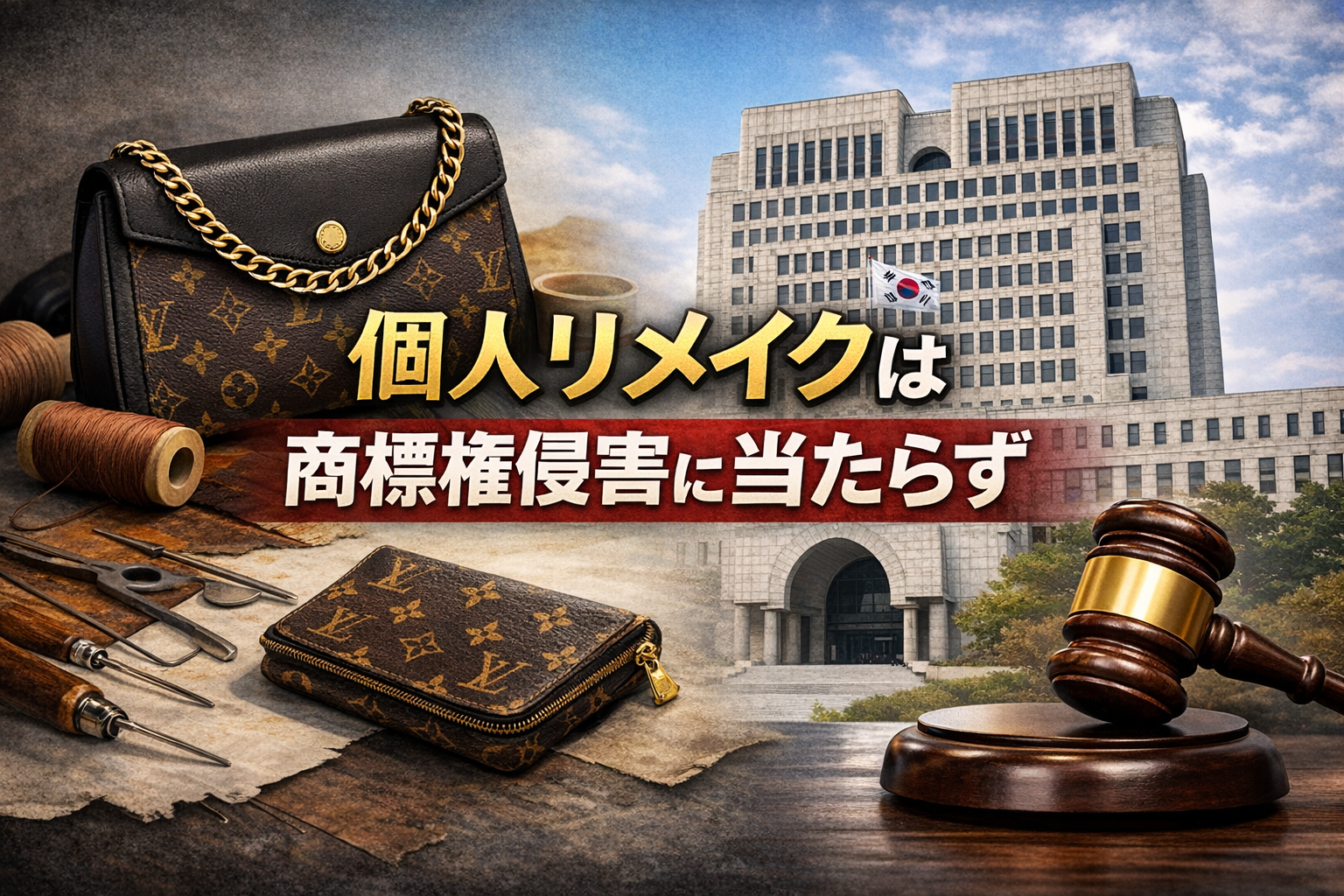
A New Boundary Between “Brand Protection” and “Owner Freedom” Drawn by the Supreme Court of Korea
A business in Gangnam, Seoul, engaged in the repair and remake of luxury brand products, prevailed in a trademark lawsuit against Louis Vuitton. The Supreme Court of Korea held that remaking luxury brand products for personal use does not constitute trademark infringement. This marks the first time the Court has clearly stated that a remodeling act itself does not amount to trademark infringement.
This case represents an important decision that encompasses not only the scope of brand protection, but also issues of consumer ownership rights, freedom of expression, and environmental sustainability. This article outlines the content of the ruling, analyzes its significance, and considers its potential future impact.
Overview of the Case
At issue were services provided between 2017 and 2021 by Mr. Lee Gyeong-han, the representative of a remodeling business known as “Gangnam Company.” He dismantled Louis Vuitton bags entrusted by customers and reused the fabric and metal components to create different bags and wallets. The production fees reportedly ranged from 100,000 to 700,000 won per item.
In 2022, Louis Vuitton filed suit, arguing that its logos remained on the remodeled products and that such conduct constituted trademark infringement.
Both the first and second instance courts found that the remodeled products qualified as “goods” with independent exchange value and ordered Mr. Lee to pay 15 million won in damages.
Key Points of the Supreme Court’s Decision
The Second Division of the Supreme Court reversed the lower court’s ruling and remanded the case to the Patent Court. The core aspects of its reasoning are as follows.
The Presence or Absence of “Market Circulation” as the Decisive Factor
The Supreme Court held that where remodeled products do not circulate in the market and are limited to personal use, trademark infringement does not arise.
Trademark rights are fundamentally intended to protect the source-identifying function of marks and to maintain fair competition. Accordingly, uses confined to the private sphere lack a close connection with the maintenance of fair competition. This reasoning reflects a purposive interpretation of trademark law.
Consideration of Ownership Rights and Freedom of Expression
The Court further stated that remodeling activities should also be evaluated from the perspectives of:
- The exercise of ownership rights
- Freedom of expression
- Environmental sustainability through resource circulation
The decision is notable for going beyond a purely technical interpretation of trademark law and incorporating constitutional values and social considerations into its analysis.
In particular, the Court’s explicit reference to “resource circulation” has drawn attention as an example of the judiciary embracing contemporary values that emphasize sustainability.
A Different Conclusion for Sale and Distribution
At the same time, the Supreme Court articulated an important limitation. If a business goes beyond mere repair or personal-use remodeling and sells or distributes the products as its own goods, trademark infringement may be established.
In other words:
- Within the scope of private use → In principle, no infringement
- Commercial distribution → Possible infringement
The Court thus drew a clear line between private and commercial spheres.
Significance of the Decision
Clarifying the Legal Status of the Aftermarket
Repair and customization of branded goods form part of the expanding global aftermarket. This decision provides a degree of legal certainty for activities falling within the private sphere.
For small-scale operators and consumers, this represents significant reassurance.
Balancing Brand Protection
On the other hand, concerns on the part of brand owners are understandable. Luxury brands build value through strict quality control and careful management of brand image. Unrestricted remakes and resale could undermine the source-identifying function and dilute brand value.
The decision appears to structure this balance around two axes:
- Whether the conduct affects market competition
- Whether it harms the brand’s source-identifying function
This framework is of practical importance for future cases.
Intellectual Property Law in the Age of Sustainability
Luxury goods are typically durable products intended for long-term use. Repairing and reusing them is rational from the standpoint of a circular economy.
If intellectual property rights are interpreted too expansively, repair and reuse may be discouraged, potentially promoting waste. This ruling may be viewed as signaling a restraint against excessive expansion of trademark rights.
Future Outlook
The case will proceed on remand, but the Supreme Court’s legal reasoning will serve as a guiding framework.
Key issues going forward may include:
- The concrete scope of “personal use”
- Whether social media postings could constitute “distribution”
- How to evaluate the continued presence of logos on remodeled items
It will also be important to observe how courts in other jurisdictions address similar issues. For global brands, divergent outcomes across countries remain a possibility.
Conclusion
This decision provides a response to the conflict between two values: the exclusive protection of brand rights and the owner’s freedom to use their own property. The Court has chosen to respect the private sphere.
Protection of brand value is undoubtedly important. At the same time, the freedom of consumers to use the items they own should also be respected.
The Supreme Court of Korea’s ruling represents an attempt to strike a balance between these competing values and is likely to have a meaningful impact on future intellectual property practice.