
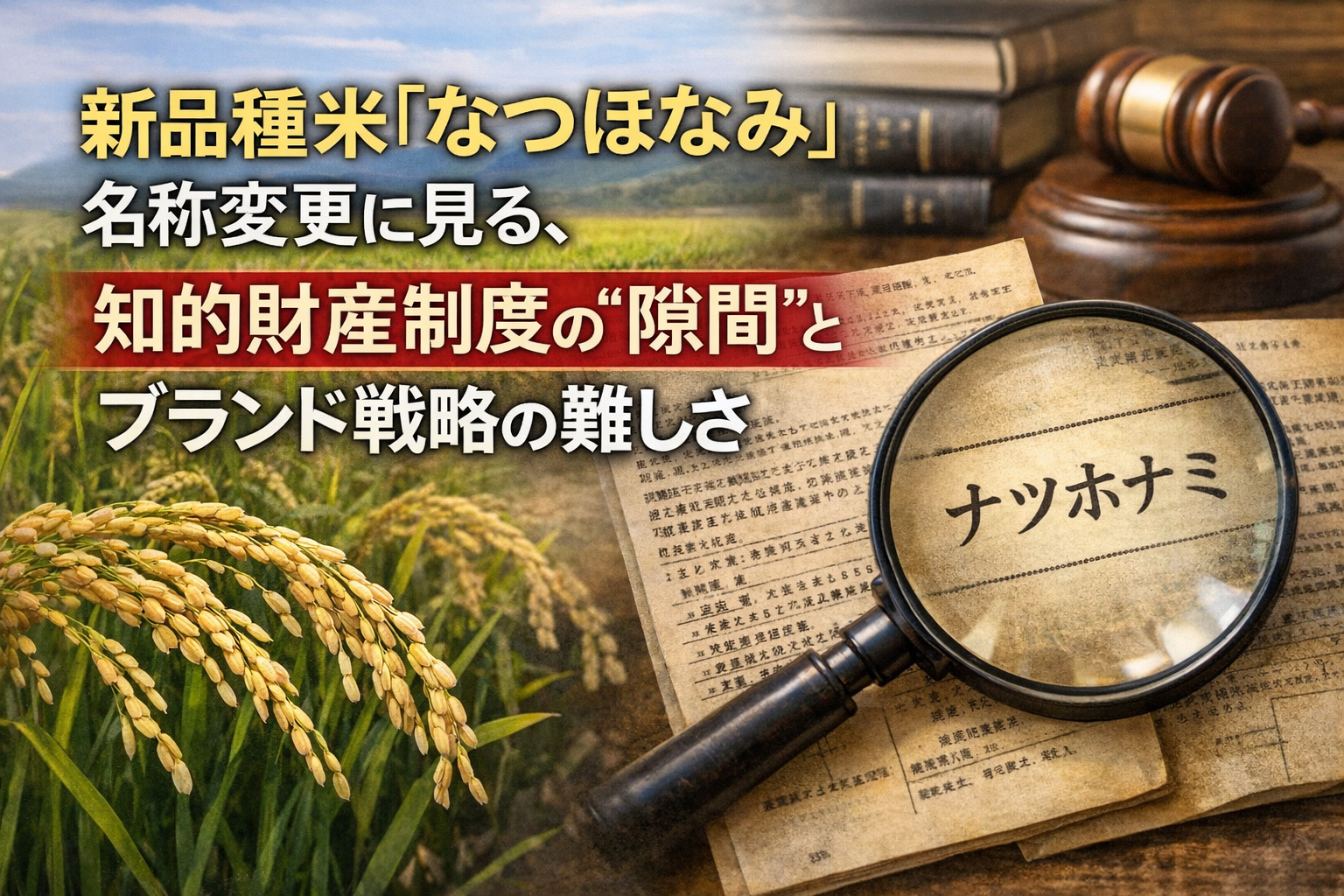
Niigata Prefecture has announced that it will change the name of its new rice variety “Natsuhonami,” which had been scheduled for market launch in 2026. The reason is that it was discovered that another variety with the same pronunciation, “Natsuhonami,” had already been registered in Fukui Prefecture in 1978. Under the guidelines based on the Plant Variety Protection and Seed Act, varieties with identical names cannot be registered, making this decision an unavoidable institutional response.
However, this news goes beyond a simple “renaming.” It brings into sharp relief the challenges of intellectual property management and brand strategy in Japan’s agricultural sector.
One point that deserves attention is that Niigata Prefecture did conduct advance checks. Before announcing the name, the prefecture confirmed—using the Ministry of Agriculture, Forestry and Fisheries’ plant variety registration database and the Japan Patent Office’s trademark search—that no identical name existed. Despite this, the later discovery of duplication with a variety registered in the past reflects historical limitations in how the system has been operated. Specifically, the MAFF database did not comprehensively cover information from before 1978, that is, prior to the implementation of the current Plant Variety Protection and Seed Act.
This case illustrates the danger of assuming that “having a database means everything is safe.” In administrative procedures and intellectual property management, unless one accurately understands the start dates and scope of a system, risks cannot be completely eliminated—even if all formal checks are carried out.
At the same time, this can also be seen as a case in which damage was kept to a minimum. As Governor Hanazumi noted, cultivation had not yet begun, and logo design and full-scale distribution had not started. As a result, the cost of rebuilding the brand is likely to be relatively small. In that sense, it may be considered fortunate that the issue came to light before general commercial release.
That said, a variety name is not merely an identifier. For consumers, it is an important brand element that evokes perceptions of quality and image; for producers and distributors, it is an asset that influences long-term value. The decision to select a new name—replacing one that had been chosen from 1,745 public submissions—demonstrates the prefecture’s commitment to brand building, while also underscoring how difficult that process can be.
The lesson from this incident is clear. When introducing new varieties or brands, it is necessary to conduct multilayered checks that go beyond current database searches to include the history of the system and information in non-digital domains. At the same time, it poses a challenge for administrative bodies and research institutions: how to make past intellectual assets visible and integrate them into modern digital infrastructures.
As Niigata Prefecture’s new rice variety sets out anew under a different name, the question is whether it can leverage this experience to grow into a stronger brand. Its trajectory may well become a touchstone for considering agricultural brand strategy in Japan as a whole.