
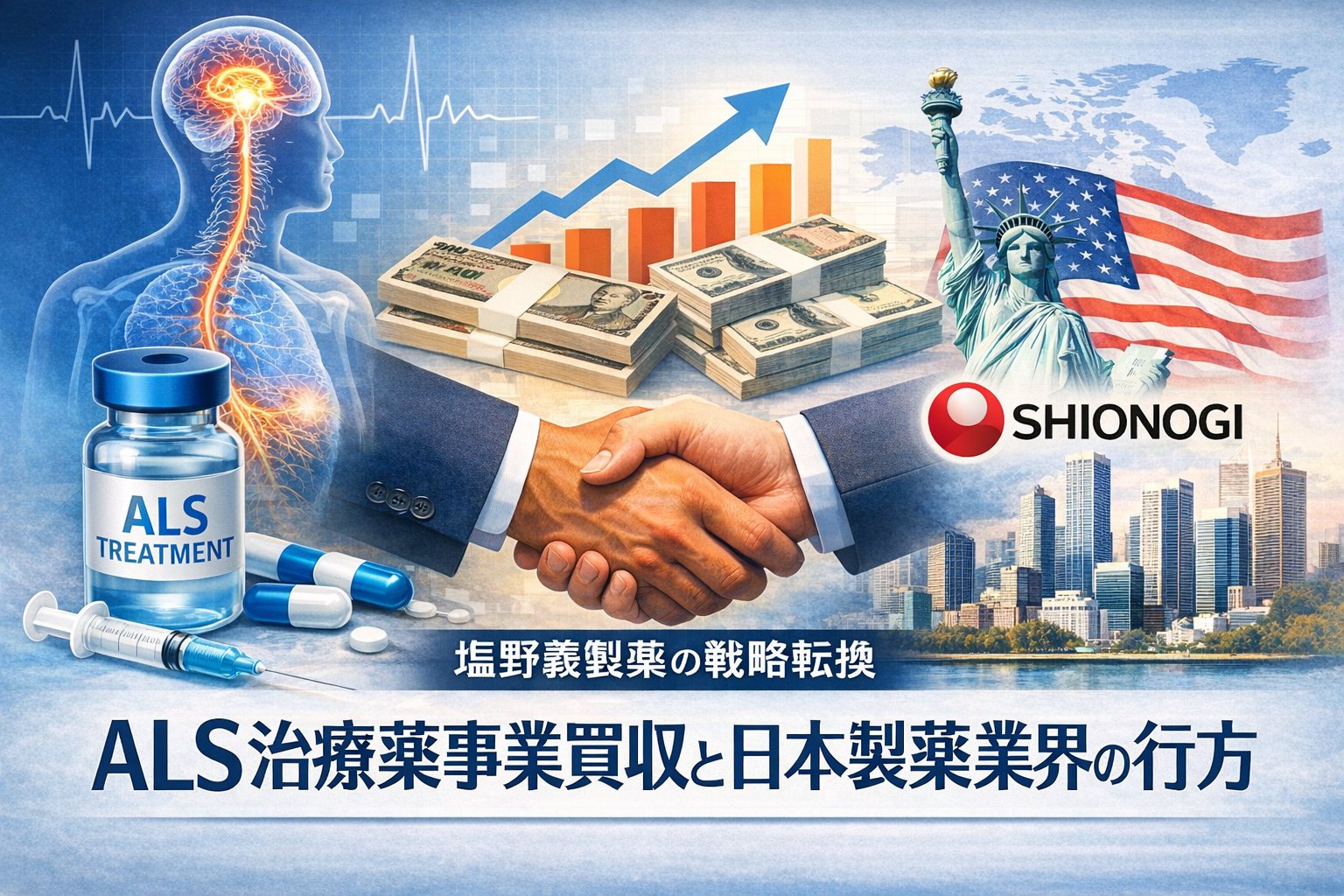
Shionogi & Co., Ltd. has announced that it will acquire the amyotrophic lateral sclerosis (ALS) therapeutics business from Tanabe Pharma. The deal, valued at a total of USD 2.5 billion (approximately JPY 400 billion), represents a highly impactful decision for a Japanese pharmaceutical company. This move goes beyond simple business expansion and strongly suggests a strategic shift with a clear focus on the global market.
The Significance of the ALS Therapeutics Field
ALS is a progressive and highly fatal disease for which no definitive cure has yet been established. As a result, the development of treatments carries immense medical and social significance, while also involving substantial research and development risk. Against this backdrop, the decision to acquire existing intellectual property rights and an established business platform as a package can be seen as an effort to shorten timelines and increase certainty compared with in-house development alone.
A Strong Emphasis on the U.S. Market
One particularly noteworthy aspect of the announcement is the explicit emphasis on strengthening the sales infrastructure in the United States. The U.S. represents the largest pharmaceutical market in the world, and in the field of rare diseases such as ALS, pricing and post-approval market development have a direct impact on corporate value. By acquiring global intellectual property rights centered on Japan and the United States, Shionogi is effectively positioning itself to seize leadership in global commercialization.
A Changing Growth Model for Japanese Pharmaceutical Companies
Traditionally, Japanese pharmaceutical companies have relied on the domestic market as their foundation and expanded overseas in a gradual manner. However, with the maturation of the domestic market and ongoing drug price controls, growth opportunities at home have become increasingly limited. This acquisition symbolizes a more aggressive growth model—one that rapidly builds an overseas revenue base by incorporating entire businesses, in addition to leveraging research and development capabilities.
The Commitment Reflected in the Size of the Investment
An investment of approximately JPY 400 billion is by no means a light burden for any company. Shionogi’s decision to proceed nonetheless suggests a strong conviction that the ALS therapeutics business can become a stable source of revenue in the future. At the same time, the company’s commitment to delivering medicines with high social value on a global scale should not be overlooked.
Key Points to Watch Going Forward
Looking ahead, attention will focus on how quickly Shionogi can establish a robust sales structure, particularly in the United States, and on what kind of synergies can be created with its existing research and development pipeline. In addition, this move may influence other Japanese pharmaceutical companies, potentially accelerating investment in overseas businesses and in the rare disease space.
This acquisition represents a major turning point for Shionogi and may also serve as a touchstone for the Japanese pharmaceutical industry as a whole as it moves toward its next stage of growth.