
Introduction
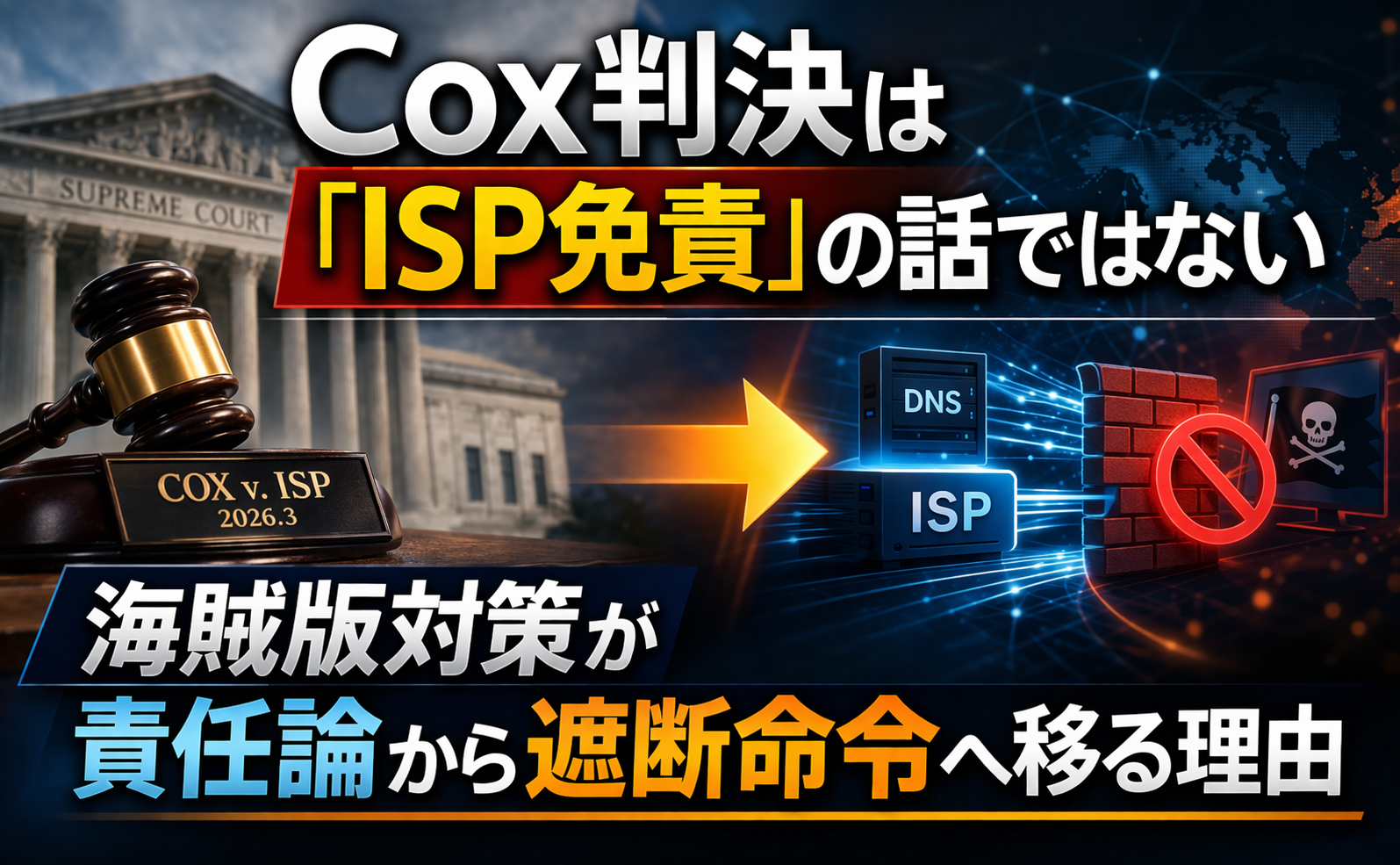
It is not sufficient to read the Cox ruling of March 2026 simply as “the ISP won” or “anti-piracy enforcement has retreated.” Rather, what this ruling shows is that the center of gravity in copyright enforcement is shifting away from “imposing ex post damages liability on service providers” and toward “having the infrastructure layer carry out blocking pursuant to court orders.” In fact, even immediately after the Supreme Court ruled in Cox’s favor, efforts continued around Congress to advance a blocking regime targeting foreign pirate sites, centered on FADPA and the Block BEARD Act.
What the Cox ruling actually changed
What the Supreme Court made clear is that contributory infringement liability cannot be established merely by showing that a party “knew of suspected infringement and still did not terminate access.” The Court explained that it is necessary to show that the service provider intended to facilitate infringing use, and that such intent is shown only where the provider actively induced infringement or where the service was configured for infringing use. The Court further stated that the DMCA safe harbor does not create liability; it is merely a framework for immunity, and liability cannot be inferred simply from the fact that a party does not qualify for it.
The significance of this clarification is substantial. From the perspective of rightsholders, the traditional pressure tactic of “suing an ISP for not doing enough to stop infringement” becomes much harder to use. As a result, if the goal is to seriously strengthen enforcement, the natural path is not to expand civil liability, but to move toward legislation that explicitly authorizes blocking orders. The increased attention to site-blocking bills following this ruling is therefore not a coincidence, but a fairly coherent institutional response.
Why site-blocking legislation is the next step
FADPA in the House of Representatives, introduced in January 2025, would make it possible to issue blocking orders against certain foreign infringing sites or online services. What is noteworthy is that it covers not only major broadband providers, but also public DNS resolution services above a certain size. At the same time, however, it excludes providers that offer only encrypted DNS and businesses dedicated to VPN services, and it also provides that an order may not require conduct that interferes with the use of VPNs as such. In addition, if a target site moves to a different domain or IP address, the bill provides a mechanism to add that new location to the order. In other words, it is aiming not merely at blocking authority in the abstract, but at an operable blocking regime designed on the assumption that circumvention will occur.
The Senate discussion draft of the Block BEARD Act likewise adopts a structure under which courts designate foreign digital piracy sites and then order service providers to take reasonable measures. It too includes a mechanism for modifying orders when a target site reappears under a different domain or IP address, or when it employs circumvention technology, and it also contains provisions excluding small broadband providers. Moreover, according to press reports, since the first half of 2026, Senator Tillis and Representative Lofgren have been working on a bipartisan, bicameral draft that would integrate the two bills, although the integrated text itself has not yet been released. Accordingly, while the overall direction is increasingly visible, the final shape remains fluid.
The significance of the Lofgren shift
What symbolizes this trend is the change in Zoe Lofgren’s position. In her own 2025 statement, Lofgren acknowledged that she had once been one of the central figures blocking the enactment of SOPA, but this time she frames FADPA as a proposal that would “target foreign infringers without breaking the open Internet.” What this reveals is that the political environment of 2011—when “site blocking” itself was treated as politically untouchable—has already broken down. Today, the central disputes are no longer about whether blocking is categorically acceptable, but about the details of institutional design: how narrowly the targets should be defined, how much procedural protection should be built in, and how DNS and VPN services should be treated.
Concerns that still remain
That said, a shift toward legislation is not necessarily desirable in itself. In her concurring opinion, Justice Sotomayor expressed concern that under the majority’s rule, the DMCA safe harbor would be effectively hollowed out, making it difficult to hold ISPs liable even if they do nothing to prevent infringement. On the other hand, the EFF has strongly criticized FADPA-type regimes as a revival of SOPA/PIPA, warning that they would lead to overblocking, lack of due process, and broad effects on speech. In addition, the Library Copyright Alliance, in its comments on the ACPA discussion draft, pointed to problems involving default judgments, overblocking, insufficient user protections, and constitutional concerns. In other words, those who criticize the ruling and those who criticize blocking legislation are moving in opposite directions, but they agree on one point: the status quo is problematic.
The essence of the matter is that the point of enforcement is moving downward, from moderation within platforms to the infrastructure layer of connectivity and name resolution. This may offer rightsholders a powerful enforcement tool, but at the same time it brings in deeper institutional issues such as network neutrality, overblocking, harm to third parties, and future expansion of the scope of regulation. FADPA and the Block BEARD Act are framed with limiting concepts such as “foreign,” “piracy,” and “court order,” and this should be read as evidence that lawmakers themselves are aware of the risks involved. Conversely, the real issue is whether those limitations will be preserved in the future.
Conclusion
In my view, the Cox ruling is likely to be remembered not only as “the ruling that saved ISPs,” but also as “the ruling that pushed copyright enforcement toward more explicit infrastructure regulation.” For service providers, it may be a short-term victory, but in the medium to long term, it could become the entry point to more direct and structural blocking obligations. What rightsholders lost was one particular litigation theory, not the will to strengthen enforcement itself. The real issue going forward will no longer be whether ISPs are liable, but how far the state and the courts should be allowed to intervene in the network layer.