
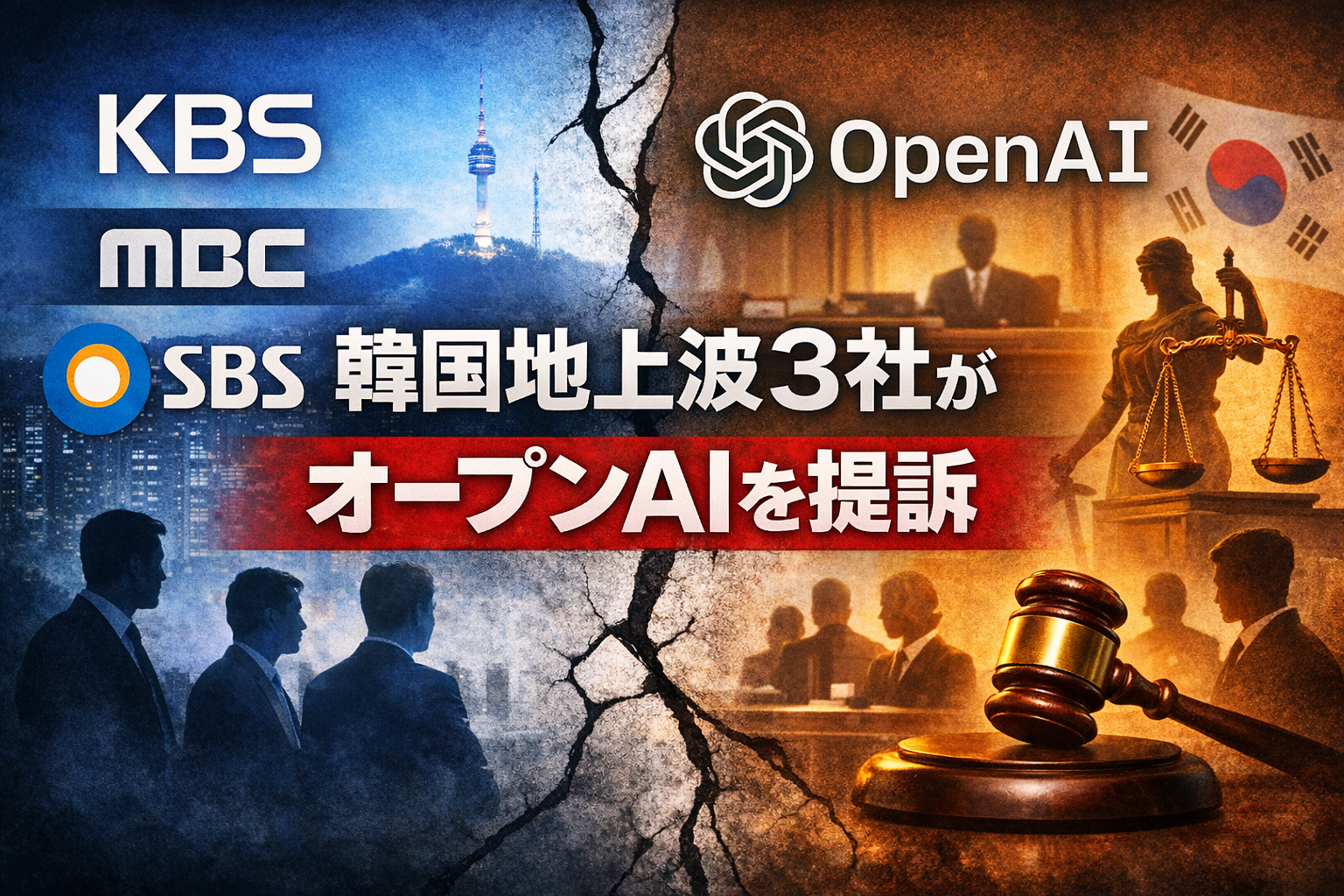
Three major South Korean terrestrial broadcasters—KBS, MBC, and SBS—have filed a lawsuit with the Seoul Central District Court against OpenAI, the developer of the conversational generative AI “ChatGPT,” seeking an injunction for copyright infringement and damages.
According to the Korea Broadcasters Association, the three companies allege that their news content was used without authorization in the training of generative AI developed and operated by OpenAI. This marks the first time that South Korean terrestrial broadcasters have taken legal action against a major overseas AI company.
The case is noteworthy not only as a copyright dispute but also as one framed within the broader concept of “data sovereignty.” In this article, I would like to examine the background and key issues surrounding this development.
The Core Issue — Does AI “Training” Constitute Copyright Infringement?
The central question in this lawsuit is whether the use of content in the training process of generative AI constitutes copyright infringement.
Generative AI systems acquire language patterns and contextual understanding by training on vast amounts of textual data. If news articles or broadcast scripts were incorporated as training data, the issue becomes whether such use amounts to “reproduction” or “adaptation,” or whether it is merely statistical processing.
Traditional copyright law was designed on the premise of human reproduction and distribution. However, machine learning by AI represents a new form of use that creates gray areas not originally anticipated by existing legal frameworks.
The South Korean broadcasters emphasize the element of “unauthorized use.” Their position is that permission was not obtained for the use of their content as training data. On the other hand, AI companies generally argue that collecting publicly available information and conducting statistical analysis fall within the scope of fair use or data mining exceptions.
In the upcoming litigation, the legal characterization of “use as training data” will be a key point of contention.
“Overwhelming Capital” and News Organizations — Asymmetry of Power
The Korea Broadcasters Association has criticized large IT companies for using, without authorization, intellectual property accumulated over many years by foreign news organizations and converting it into profit.
Underlying this claim is a clear asymmetry of power.
AI companies operate on a global scale with enormous capital resources.
Meanwhile, news organizations in various countries face declining advertising revenues and the financial burden of digital transformation.
In this context, news content is being used as AI training data without direct compensation.
For news organizations, journalism is the result of significant investment—reporting, editing, and verification. If such content becomes a free resource for AI training, contributing to the enhancement of AI services and corporate profits, a sense of unfairness is understandable.
This issue goes beyond legal interpretation and calls into question how value is distributed within the information industry.
The Emergence of “Data Sovereignty” as a New Framework
What is particularly interesting in this lawsuit is the prominence of the concept of “data sovereignty.”
Data sovereignty concerns the extent to which a country can assert control or governance over data generated within its territory. In recent years, this issue has rapidly gained attention in areas such as cloud services, cross-border data transfers, and AI development.
The South Korean side frames the unauthorized use of content accumulated over many years by domestic media organizations as a matter of national sovereignty.
This perspective may spread to other countries. Particularly in nations with strong linguistic and cultural distinctiveness, how to protect and utilize domestic data assets is likely to become a significant policy issue.
Future Outlook — From Confrontation to Rule-Making
While the lawsuit highlights a confrontational structure, it may also serve as a catalyst for new rule-making.
Possible future directions include:
- Institutionalizing licensing agreements
AI companies could formally contract with news organizations and pay compensation for the use of training data.
- Clarification through legal reform
There may be accelerated efforts to explicitly define the scope of rights related to AI training within copyright law.
- Technical countermeasures
Content providers may introduce mechanisms to control scraping and AI training uses of their materials.
The critical issue is achieving a balance between innovation and the protection of rights. While generative AI offers significant social benefits, it must not undermine the sustainability of content creators and news organizations that form its foundation.
Implications for Japan
In Japan as well, newspapers and publishers have begun reassessing their relationships with generative AI. The outcome of the South Korean lawsuit is likely to influence Japan’s media industry and policy discussions.
Japan has historically permitted relatively broad data analysis uses under its copyright law. How this framework aligns with international developments will become an important issue going forward.
Conclusion — Redesigning “Value” in the Generative AI Era
This lawsuit is not merely a corporate dispute.
It represents a symbolic event concerning the redesign of “the value of information,” “compensation for creative work,” and “national sovereignty” in the age of generative AI.
Technological progress will not stop. However, we cannot ignore the question of whose burdens underlie that progress.
The courtroom battle between South Korea’s three major broadcasters and OpenAI compels us to establish rules for the next era. Its outcome may significantly shape the future relationship between the global media industry and the AI sector.