
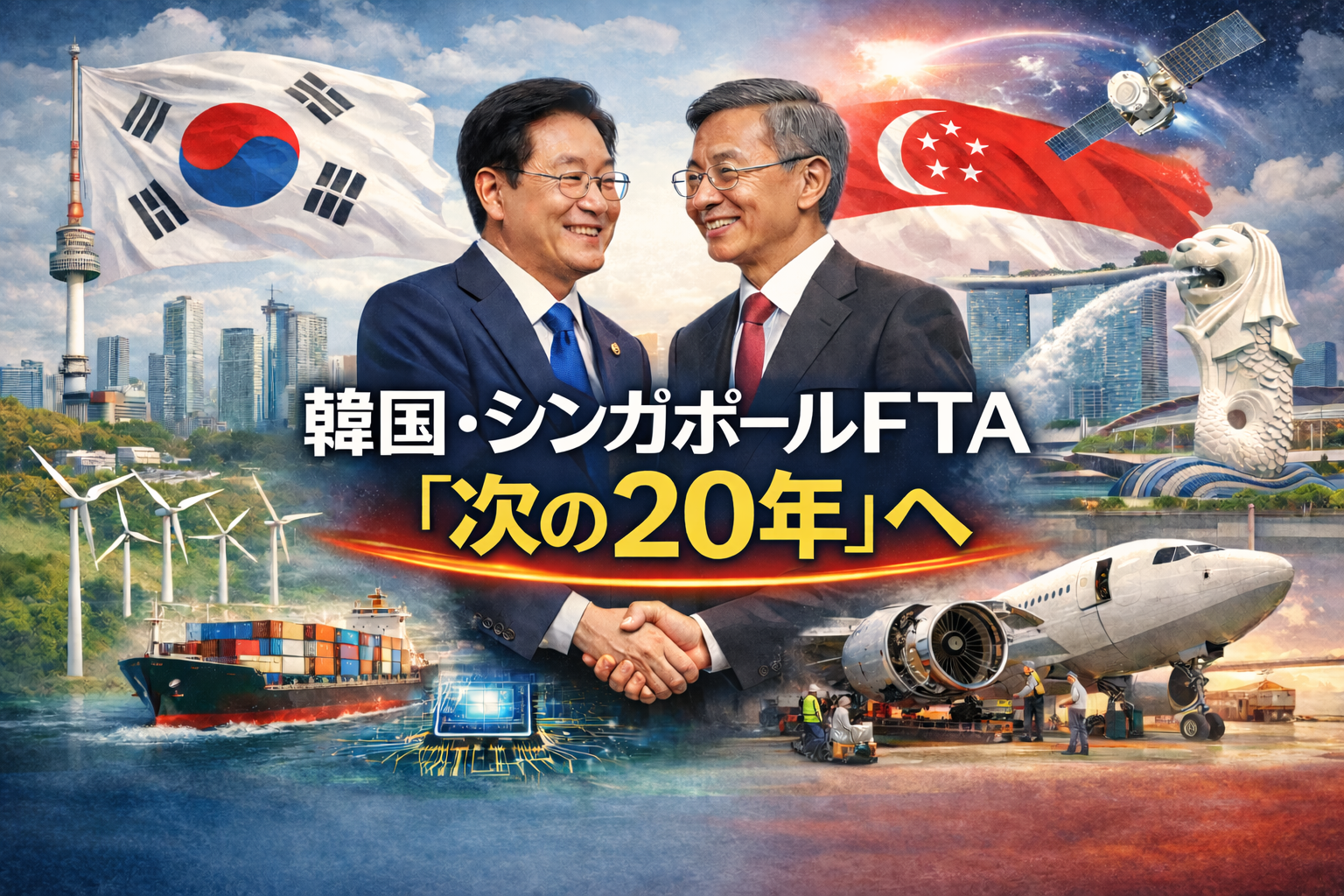
In March 2026, during a state visit to Singapore, South Korean President Lee Jae-myung held a summit meeting with Prime Minister Lawrence Wong and agreed to launch negotiations to upgrade the Korea–Singapore Free Trade Agreement (FTA). The agreement, which entered into force in 2006, marks its 20th anniversary this year. At this milestone, the two countries have chosen not merely to revise tariff arrangements, but to pursue a comprehensive upgrade centered on “economic security” and “strategic investment cooperation.” This move symbolizes the evolving nature of the international economic order.
This article organizes the background and significance of the agreement and examines its potential impact on the economies of East Asia and ASEAN.
Twenty Years Since Entry into Force — A Shift from Quantity to Quality
The Korea–Singapore FTA was South Korea’s second FTA, following the Korea–Chile FTA. At the time, it was positioned as “the beginning of the FTA era with major East Asian trading partners.” In other words, it served as a starting point for quantitative expansion.
Over the past two decades, however, the trade environment has changed dramatically:
- Risks of supply chain fragmentation
- Institutionalization of economic security
- Rapid expansion of digital trade
- Acceleration of decarbonization and green transition
- Intensifying competition over advanced technologies
The current upgrade negotiations can be characterized as a process of “qualitative advancement” that reflects these structural changes in institutional frameworks. FTAs are no longer merely mechanisms for tariff elimination; they have become infrastructure for designing the economic order itself.
Strategic Intent Reflected in Four Priority Areas
The joint statement identified four areas for improvement:
- Supply chains
- Green economy
- Trade facilitation
- Aviation MRO (Maintenance, Repair, and Overhaul)
Particularly noteworthy is the aviation MRO sector. Singapore is one of the world’s leading aviation hubs and a major center for the MRO industry. South Korea, meanwhile, is advancing the sophistication of its aerospace industry. The two countries’ industrial structures are complementary. If institutional support through FTA enhancement materializes, aviation-related business expansion within ASEAN could accelerate significantly.
Strengthening cooperation in supply chains can also be interpreted as a response to geopolitical risks, including U.S.–China tensions. By deepening ties with trusted partners, both countries aim to enhance the resilience of their supply networks.
MOUs Indicating Deepening “Technology-State Cooperation”
Beyond the FTA upgrade, five Memoranda of Understanding (MOUs) were concluded during the visit, revealing longer-term strategic intentions.
- Small Modular Reactors (SMRs)
Singapore faces challenges in diversifying its energy sources due to its limited land area. South Korea has earned international recognition for its nuclear technology. SMRs are attracting attention as next-generation power sources capable of reconciling decarbonization with energy security. The significance of this cooperation lies not only in joint technological development but also in the potential co-design of business models.
- AI in Public Policy and Intellectual Property
Cooperation will also advance in the areas of AI-driven public safety policy and AI transformation in intellectual property. This goes beyond simple technological exchange; it represents joint engagement in shaping the rules of the AI era.
- Environmental Satellites, Quantum, and Space Technologies
The two countries agreed to strengthen cooperation in atmospheric research using environmental satellites, as well as in quantum, space, and satellite technologies. These are foundational technology domains underpinning national competitiveness. The collaboration suggests an effort to explore a model of partnership between mid-sized technology powers.
The ASEAN Strategy Context
Prime Minister Wong noted that Korean companies such as Hyundai, Lotte, and Hanwha Ocean use Singapore as a hub to expand into Southeast Asian markets.
Although geographically small, Singapore serves as ASEAN’s gateway in terms of finance, logistics, and legal infrastructure. Upgrading the FTA therefore signifies not merely bilateral strengthening but enhanced access to the ASEAN region as a whole.
Moreover, Singapore will assume the ASEAN Chairmanship next year. South Korea’s expressed support underscores its strategic commitment to deepening ties with ASEAN.
Partnership in an Era of “Hyper-Uncertainty”
Both leaders emphasized the theme of “uncertainty.”
The current international order faces multiple overlapping transformations:
- Geopolitical confrontation
- Institutionalization of economic security
- Energy transition
- Competition for technological supremacy
In such an environment, cooperation with partners that share values and institutional stability carries significance beyond mere economic rationality. The FTA upgrade can be viewed as a process of redesigning that institutional foundation.
Conclusion: From a “Trade Agreement” to a “Strategic Agreement”
The launch of negotiations to upgrade the Korea–Singapore FTA is not simply a review of trade arrangements.
It represents an evolution toward a comprehensive strategic agreement encompassing:
- Institutionalization of economic security
- Frameworks for advanced technology cooperation
- Strengthening of ASEAN strategy
- Redesign of supply chains
If the FTA of 20 years ago symbolized “openness,” this upgrade symbolizes the deepening of “trusted partnership.”
Depending on how the negotiations unfold, this initiative could become a pioneering example of a new model of mid-sized power cooperation in East Asia. It will be important to closely monitor how concretely this institutional design for the next 20 years takes shape.