
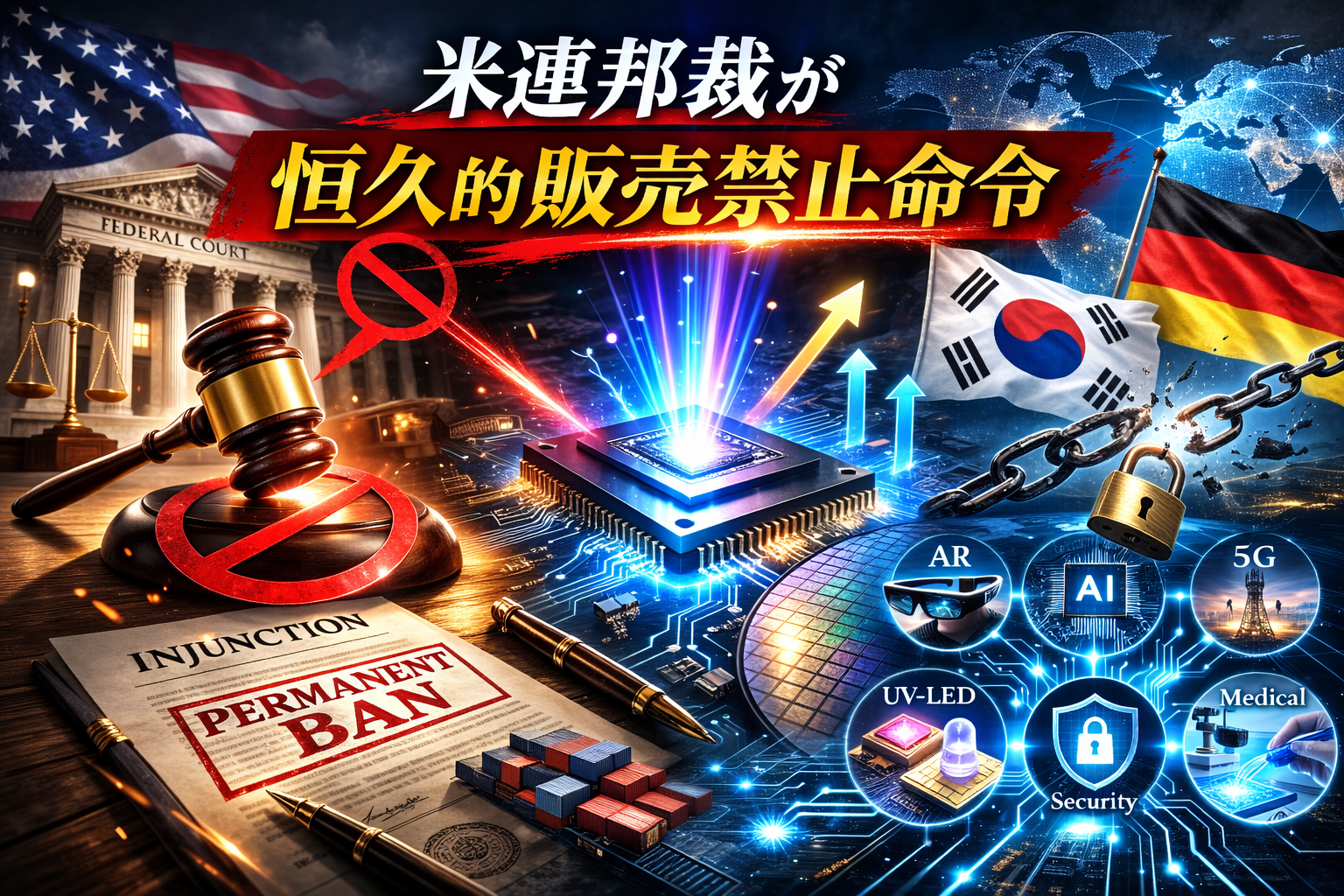
It has been reported that a United States federal court has issued a permanent injunction prohibiting sales by Laser Components, a German company specializing in optoelectronic semiconductors, after finding that it infringed patents held by Sensor Electronic Technology, Inc. (SETi), a subsidiary of Korea’s Seoul Semiconductor.
This case goes beyond a mere patent infringement lawsuit. It represents a highly instructive matter intersecting with technological sovereignty in the strategic field of optoelectronic semiconductors, and even with issues of national security. This article examines the legal, technological, and industrial policy implications of the ruling.
Key Points of the Decision — “Permanent Injunction” and the Scope of Its Effect
In this case, the U.S. federal court ordered a permanent prohibition on the manufacture, sale, and importation of products using the infringing technology. Notably, the court made clear that the injunction extends not only to the company itself, but also to its officers and employees, as well as third parties who assisted or participated in the infringement.
Under U.S. patent law, an injunction is granted only when certain requirements are satisfied. The ruling suggests that both the validity of the patent and the finding of infringement were strongly affirmed. The fact that a permanent injunction was granted underscores the technological value of the patent and its significant impact on the market.
The Patent Technology at Issue — Optimization of Photon Generation Efficiency
At the core of SETi’s patent is a performance-enhancing technology that maximizes photon generation and minimizes internal losses by optimizing current control and layer structures within the semiconductor.
What Are Optoelectronic Semiconductors?
Optoelectronic semiconductors are devices that convert electrical energy into light energy, with LEDs and laser diodes being representative examples. SETi is particularly known for its development and commercialization of deep ultraviolet (Deep UV) LEDs.
Such technologies are expected to be applied in advanced fields including:
- AR glasses (augmented reality devices)
- High-bandwidth memory (HBM)-related technologies
- High-precision sensor applications
- Sterilization and medical applications (Deep UV LEDs)
Improvements in photon generation efficiency are not merely incremental performance upgrades; they directly affect fundamental aspects of device design, including power consumption, heat generation, miniaturization, and operational lifespan. In that sense, the patent at issue can be positioned as one of the core technologies of the future.
The Underlying Issues of “Investment” and “Capacity Utilization”
SETi’s CEO has disclosed a challenging situation: despite having invested hundreds of millions of dollars over the past 25 years, the company’s current capacity utilization rate is reportedly below 10 percent.
In technology-intensive industries, both R&D investment and capital expenditures for manufacturing facilities are enormous. If the results of such investments are not adequately protected by patents, low-cost imitations can flood the market, potentially undermining the business foundations of R&D-driven companies.
What emerges here is the recognition that intellectual property is not merely a legal right, but an institutional infrastructure that supports the industrial base.
National Security and Technological Sovereignty
It is also noteworthy that the CEO referred to national security considerations.
In recent years, semiconductors have clearly been designated as strategic materials. Optoelectronic semiconductors in particular are essential foundational technologies for communications, military systems, space, defense, and advanced computing.
If core patents are not properly protected, or if they are ultimately sold to foreign entities, this could lead to the erosion of technological sovereignty. This case can thus be viewed not only as a dispute between companies, but also as a reflection of the industrial competition structure between nations.
IP Risks in the Era of Global Supply Chains
The structure of this case involves:
- A Korean corporate group
- A U.S. subsidiary (SETi)
- A German company (Laser Components)
- A U.S. federal court
In an era of highly specialized and globally distributed supply chains, patent infringement frequently crosses national borders. For companies supplying products to the U.S. market, the risk of infringing U.S. patents is particularly significant. A permanent sales ban may, in practice, amount to a de facto withdrawal from the market.
Going forward, in the field of optoelectronic semiconductors, the following will likely become increasingly important:
- Active cross-licensing negotiations
- Defensive construction of patent portfolios
- Thorough Freedom to Operate (FTO) analyses with a focus on the U.S. market
What This Case Suggests
This ruling appears to highlight three key points:
- Optoelectronic semiconductors are strategic core technologies.
- Robust patent protection is indispensable for recouping R&D investments.
- Injunctions can have decisive impacts on corporate operations.
Patents are not merely legal rights; they function as both offensive and defensive pillars in technological competition. Particularly in high-value-added sectors such as semiconductors, patent strategy itself can determine a company’s very survival.
Conclusion
The optoelectronic semiconductor market is likely to expand rapidly in connection with AR, AI, next-generation memory, and quantum-related technologies. In this context, the issuance of a powerful injunction in this case once again highlights the importance of intellectual property strategy.
In an era of accelerating technological innovation, it is no longer sufficient to ask merely, “Who possesses the technology?” The more critical question is:
“Who can successfully protect that technology?”
We appear to be entering a phase in which the answer to that question will shape the competitiveness of both companies and nations.