
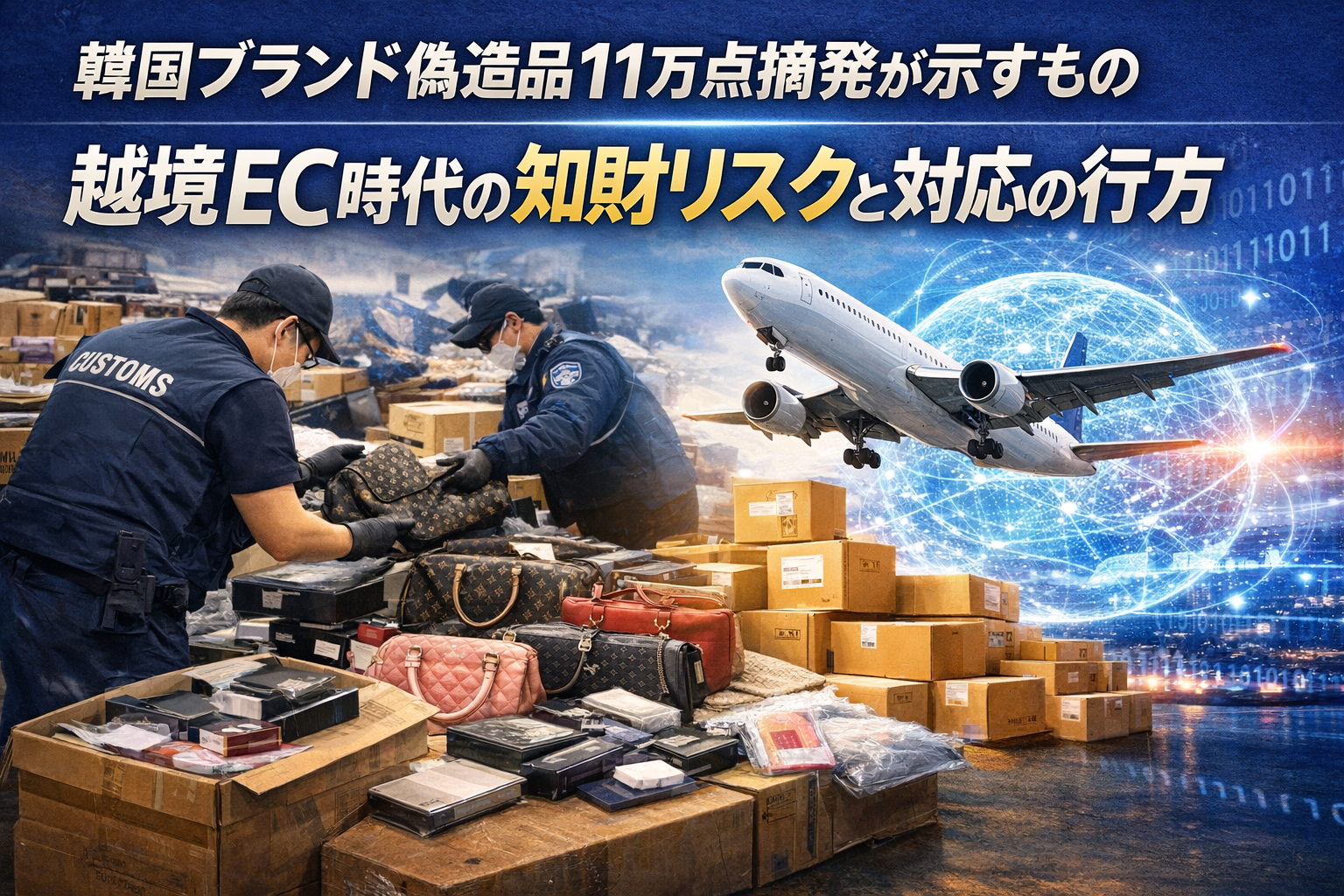
The news released by the Korea Customs Service announcing the seizure of approximately 117,000 counterfeit Korean-branded products over the course of last year goes beyond a simple report of enforcement results. It brings into sharp focus the structural challenges currently confronting international trade and intellectual property protection. This article examines the background and implications of this development, as well as the outlook going forward.
The Rise of “Small-Volume, Dispersed” Counterfeit Distribution Driven by Cross-Border E-Commerce
One notable feature of this enforcement outcome is that counterfeit goods were discovered almost evenly across both general cargo and express shipments. This clearly reflects the rapid increase in small-volume shipments disguised as personal imports, driven by the expansion of e-commerce.
Traditionally, anti-counterfeiting measures focused on large-scale shipments and enforcement against commercial operators. However, with the widespread adoption of cross-border e-commerce, a “hard-to-detect distribution structure” has become the norm, characterized by:
- Small quantities per shipment
- An enormous number of shipments
- Frequent claims of personal use
The latest statistics indicate that customs authorities have accurately recognized this shift and are strengthening monitoring at the customs clearance stage.
China as an Overwhelming Source Country—and the Flip Side of Brand Power
The fact that 97.7% of shipments originated from China may be less surprising than expected—it feels more like a confirmation of existing assumptions. Given China’s role as a global manufacturing hub and the persistence of counterfeit operations, this figure is, in a sense, inevitable.
What deserves closer attention, however, is the range of brands targeted by counterfeiters.
In cosmetics, brands such as Sulwhasoo, Beauty of Joseon, and 3CE were affected.
In fashion and lifestyle goods, Mardi Mercredi, Gentle Monster, and MARITHÉ FRANÇOIS GIRBAUD appeared.
In character and entertainment-related products, Kakao Friends and BTS-related merchandise were among the targets.
All of these brands exemplify Korean-origin brands that have secured strong global recognition and demand. The increase in counterfeits represents not only damage but also the flip side of brand strength.
The Seriousness of Counterfeiting Extending into the Hardware Sector
Another point that cannot be overlooked is that electronic products and components from Samsung Electronics and LG Electronics were also subject to counterfeiting.
Unlike cosmetics or character goods, counterfeit electronic products pose direct risks to safety and quality. This goes beyond mere brand value erosion and may lead to consumer harm and a loss of international trust.
The Significance and Limitations of the MOU with China
The “Memorandum of Understanding on Cooperation for Intellectual Property Protection at the Border Stage” concluded this month between the Korea Customs Service and China can be seen as a pragmatic response to these realities. Anti-counterfeiting efforts have clear limits when undertaken by importing countries alone, making deterrence at the manufacturing and shipping stages essential.
That said, an MOU is ultimately only a framework. Its effectiveness will depend on operational factors such as:
- The specificity of information sharing
- Enforcement incentives for local authorities
- Ongoing joint investigations
How deeply this cooperation can be implemented will be closely watched.
The Next Stage Indicated by Stronger Public–Private Collaboration
Particularly significant in this announcement is the plan to establish a public–private consultative body involving Korean companies. Counterfeit countermeasures cannot rely solely on government leadership; they require the integration of:
- Damage information from brand owners
- On-the-ground market distribution realities
- Technical expertise in authenticity verification
Institutionalizing public–private collaboration may also symbolize Korea’s entry into a mature phase as a “brand-exporting nation.”
Conclusion: Implications for Japan
This news is far from irrelevant to Japanese companies or Japan’s intellectual property administration. The conditions of cross-border e-commerce, small-volume shipments, and global brand expansion apply equally to Japanese brands.
Korea’s approach deserves attention as a model case for the shared challenges faced by Asian brands after achieving global success. Counterfeit countermeasures are not merely defensive—they are strategic infrastructure essential for the sustainable growth of brand value. How effective Korea’s initiatives will prove to be remains to be seen, and their future development warrants continued observation.