
Introduction
In March of this year, the school lunch recipe YouTube channel Aoi no Kyushoku-shitsu announced that it would stop releasing new videos. According to the announcement, the background to this decision was the alleged unauthorized use of its recipes by a certain company, which reportedly caused the channel’s operator, Aoi, severe emotional distress.
That said, there are currently said to be discrepancies between the claims of the two parties, and legal proceedings are still ongoing. For that reason, it is not possible to determine with certainty what is true in this individual case.
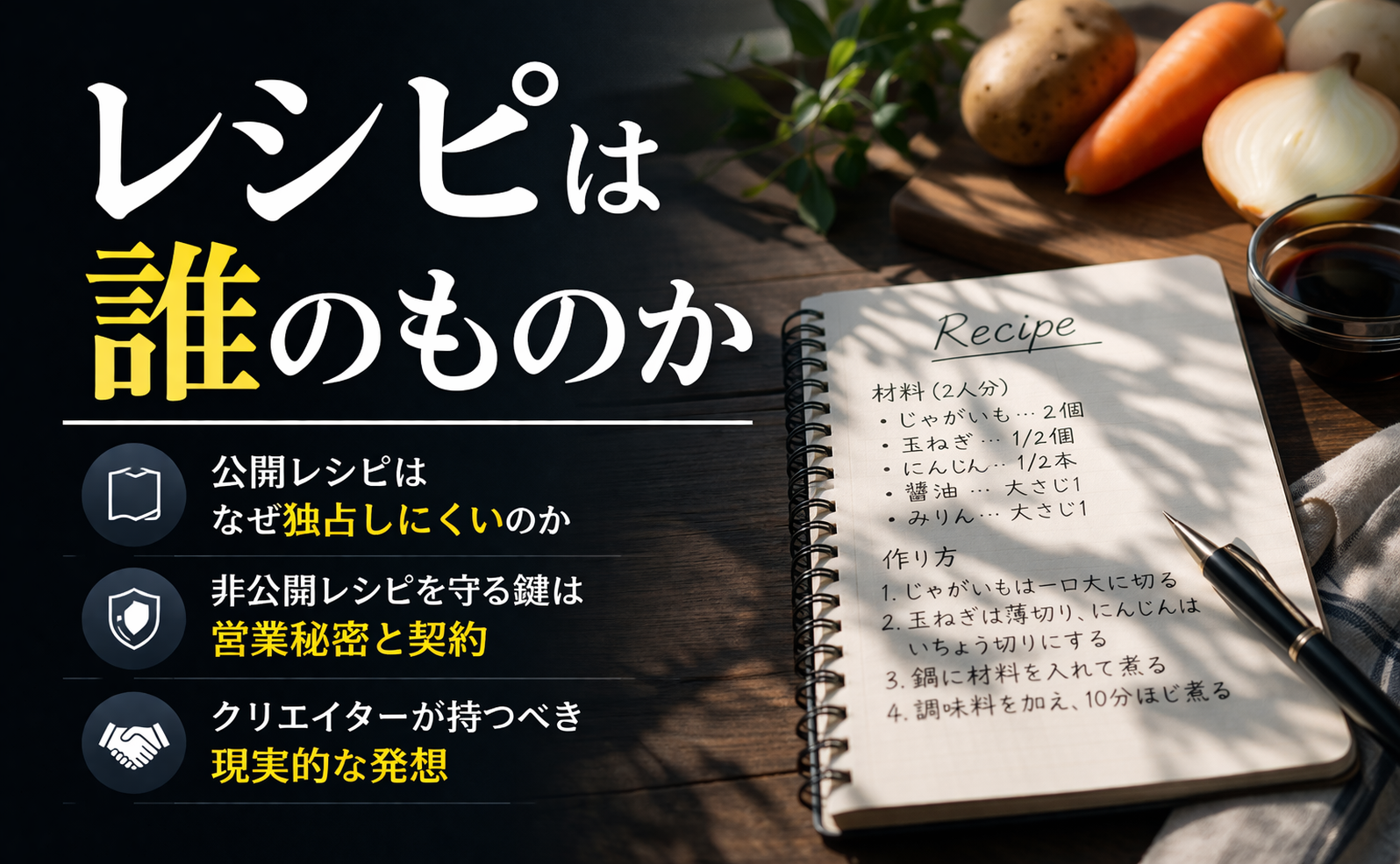
Still, the question this matter raises for society is a weighty one: how can recipes be protected, and can they be monopolized in the first place? In this article, I will examine these issues and consider practical ways of protecting recipes as intellectual creations.
Why Public Recipes Are Difficult to Exclusively Control
The first point to understand is that it is generally difficult to monopolize a recipe once it has been made public.
People often say that “recipes cannot be protected by copyright,” and this is broadly correct. Copyright protects “expression,” such as text, video, photographs, and design, rather than methods themselves, such as how to prepare a dish or the steps involved in cooking it.
For example, the wording of explanatory text in a cookbook, the structure of a video, its narration, and its visual presentation may all be protected by copyright. However, cooking methods themselves—such as “cut the potatoes and simmer them” or “add the seasonings in this order”—tend to fall outside the scope of copyright protection.
Moreover, in the culinary world, the more popular a recipe becomes, the more likely it is that its ingredients and steps will resemble those of other recipes to some extent. When people are working within the limits of available ingredients, flavoring methods, and cooking objectives, it is not uncommon for them to arrive at similar conclusions independently. In other words, the mere fact that two recipes are “similar” does not automatically mean that anything improper has occurred.
This is also something that many food creators intuitively understand. Regardless of who came first and who came later, similar recipes appear all the time, and the reality is that it is difficult to treat that alone as an infringement of rights.
Patents Are More Suitable Than Copyright
Does that mean recipes cannot be protected at all? Not necessarily. At least in theory, patents are better suited to protecting recipes than copyright.
Whereas copyright protects “expression,” patents are a system for granting exclusive rights over “technical inventions” that satisfy certain requirements. If a cooking process or combination of ingredients can be formulated as a technical idea and meets conditions such as novelty and inventive step, then even something close to a recipe may potentially be patented.
In fact, there have been cases in the past where food-related companies obtained patents for things that, to the average person, looked very much like recipes—for example, curry or fried rice. In this sense, while a “method of preparation” may not be protectable by copyright, there is still room for protection through patents.
However, there is a significant practical problem here. Today, it is rare for an ordinary home-style recipe to qualify for a patent as-is. To obtain a patent, details such as ingredient ratios, temperatures, time, and process order often need to be defined quite specifically and technically, and there are also filing and attorney costs to consider.
Furthermore, even if a patent is obtained, merely introducing or describing the recipe does not necessarily constitute infringement. In many cases, a problem arises only when the patented method is actually used in business and the product is manufactured or provided in a way that satisfies the patent’s claim requirements. In other words, patents are not a universal shield, and there are only limited situations in which they are cost-effective.
For food manufacturers with mass-production technology, or restaurants building their business around specific menu items, patents may be worth considering. But for chefs or video creators who continuously publish large numbers of recipes, the cost-effectiveness is often poor.
The Real Issue This Time May Not Be the “Public Recipe,” but the “Private Data”
What is important in the Aoi no Kyushoku-shitsu matter is the possibility that the target of concern is not simply imitation of publicly available recipes.
Based on media reports and explanations from the party involved, the issue does not seem to be that “the recipes visible on YouTube looked similar.” Rather, the apparent point of contention is whether unpublished recipe data that had been provided for a fee was somehow obtained and then used without authorization.
This is a very important distinction. While it is difficult to exclusively control recipes that have been made public, unpublished recipe information may give rise to entirely different forms of legal protection.
In other words, the essence of this issue may lie less in the simple question of whether recipes are protected by copyright, and more in how non-public business information was handled—making it closer in substance to a matter of unfair competition law and contractual obligations.
The Keys to Protecting Private Recipes: Trade Secrets and Limited Shared Data
One possible way to protect private recipes is through trade secret protection.
To qualify as a trade secret, the information must not be publicly known, must be useful for business, and must be managed as confidential. Simply refraining from making it public is not enough. What matters is the actual operation supporting confidentiality, such as access restrictions, controls on removal, confidentiality labels, and rules governing how the information is handled both inside and outside the organization.
If recipe data was properly managed in this way, it may be possible to seek remedies under the Unfair Competition Prevention Act against unauthorized acquisition or use.
Even if the information does not rise to the level of a trade secret, there may still be room for protection as “limited shared data.” This is a framework for protecting valuable information that is provided only to a limited group under certain conditions. A continuously accumulated recipe database, for example, may in some circumstances fall within the scope of this protection.
Even here, however, the decisive issue is ultimately the management system. To whom was the data provided, to what extent, and under what conditions? Were viewing and copying restricted? Was the permitted purpose of use clearly defined? The accumulation of this kind of day-to-day management is what often determines the outcome when a dispute actually arises.
Contracts Are the Most Practical Breakwater
Public recipes are difficult to monopolize, and patents are not a universal solution because of their cost and requirements. Given that, the most important practical tool is the contract.
For example, when recipes are provided for a fee, it is worth clearly specifying clauses that limit the purpose of use and prohibit disclosure to third parties, copying, resale, use outside the contract, and use for competitive purposes. If confidentiality obligations are imposed and the measures and damages applicable in the event of breach are also defined, the legal footing in the event of a dispute becomes considerably stronger.
This is not a right that can be asserted uniformly against the entire world in the way copyright can, but at least in the relationship with a contractual counterparty, it carries very significant force. Particularly for businesses that engage in recipe development or menu provision as part of their operations, it may be fair to say that contract design is even more important than intellectual property rights.
In this case as well, one of the future issues is likely to be what the contractual relationship with the other party looked like, and how the permitted scope of use of the provided data had been defined.
A Practical Mindset for Creators
What this issue makes clear is that when thinking about how to protect recipes, it is necessary to distinguish between what is made public and what is kept confidential.
As for recipes that are intended for public release, it is necessary to accept to some extent that similarity is unavoidable. Even if one asserts rights too aggressively in that context, such claims are often difficult to sustain legally and may instead lead to a draining war of attrition.
By contrast, unpublished recipes that form the core of a business, data sold to customers, and accumulated know-how must be treated as something different from public content. Careful measures such as confidentiality management, access restrictions, contracts, and thoughtful design of the method of provision are precisely what make it possible to protect the value that truly matters.
In the culinary world, creativity and practicality are closely intertwined. For that reason, it is difficult to organize everything solely through copyright as one might with a work of art. In reality, it often makes more sense to think in terms of business information management.
Conclusion
The issue surrounding Aoi no Kyushoku-shitsu is not merely a case of online controversy, nor is it simply an emotional conflict between creators. It includes a distinctly modern question: where should we draw the line between recipes as widely shared knowledge and know-how accumulated as part of a business?
As a general rule, publicly disclosed recipes are difficult to monopolize. However, unpublished recipe data and know-how accumulated over time may be protectable depending on how they are managed and what contracts are in place. What matters is neither giving up and assuming that “recipes cannot be protected,” nor expecting that “everything can become a legal right.”
The key is to carefully design, in ordinary times, what will be made public, what will be kept confidential, and what will be governed by contract. I believe this case should be understood as a powerful reminder of how important that line-drawing really is.