
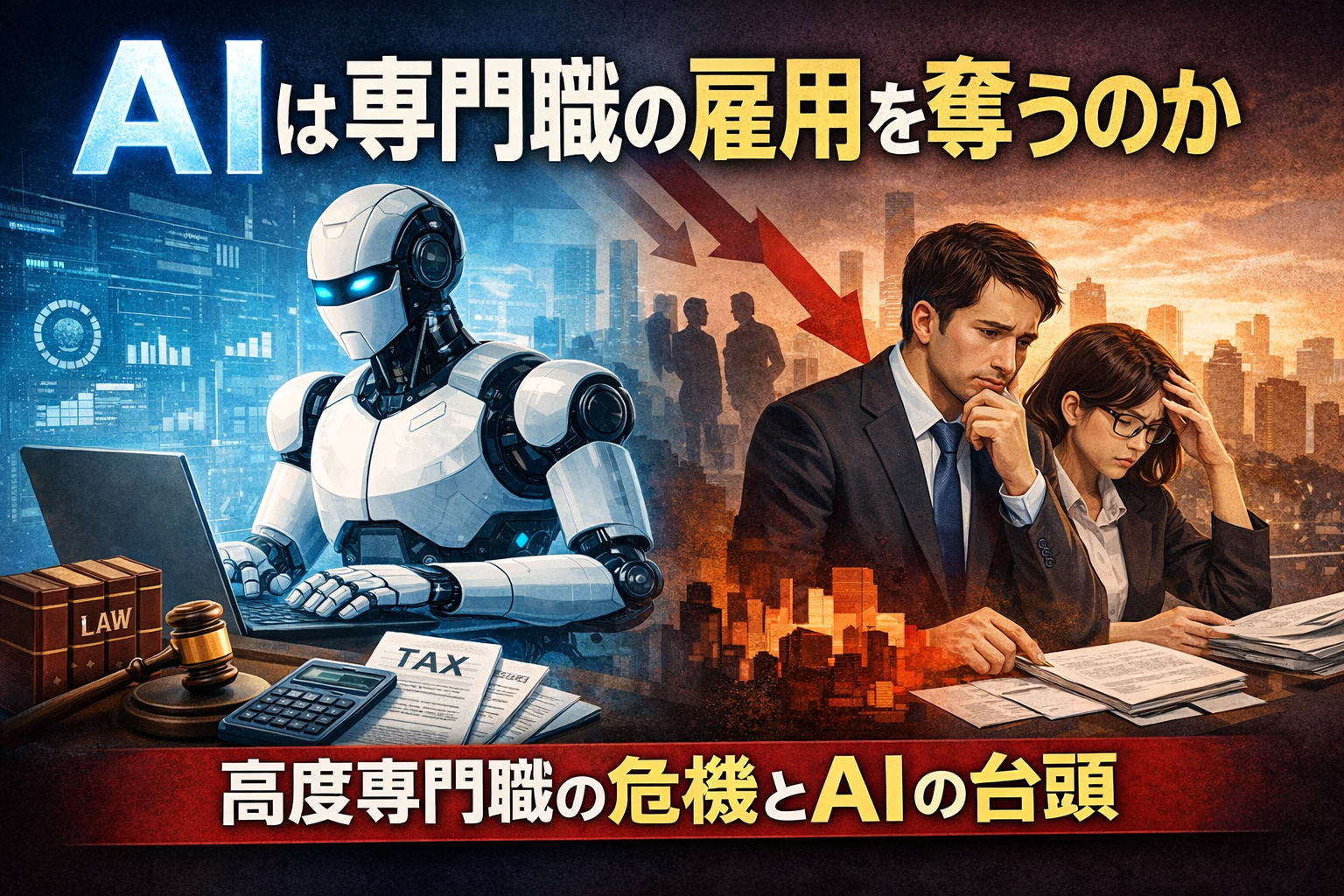
The employment trends announced in South Korea for January contain significant implications. Employment in the professional, scientific, and technical services sector declined by 98,000 compared to the same month last year—the largest decrease since the industrial classification revision in 2013. Notably, high value-added professional service fields such as accounting, legal services, taxation, and patents experienced pronounced declines.
These sectors include highly skilled professionals such as lawyers, certified public accountants, patent attorneys, and tax accountants. Traditionally regarded as stable and high-income professions, the fact that employment is decreasing in these areas suggests the possibility of structural change rather than a mere cyclical economic downturn.
Is “AI-Driven Job Substitution” Becoming Reality?
Officials at Statistics Korea have suggested the possibility of a “technical adjustment” following employment growth since 2023, while also noting that the advancement of AI may be contributing to slower hiring. Although it cannot yet be conclusively stated that AI is directly causing job losses, developments in the field appear to have reached a stage that can no longer be ignored.
Following the release of ChatGPT in November 2022, demand for software developers temporarily surged. However, as generative AI has advanced, certain tasks—such as code generation, review, and documentation—have increasingly become automated, and signs of adjustment are now visible in developer demand. In professional services as well, tasks such as contract drafting, case law research, tax calculations, and patent specification drafting are becoming partially replaceable or augmentable by AI.
The critical issue is not whether jobs will disappear entirely, but whether the nature of work itself is changing. Even in professional occupations, routine, repetitive, and information-intensive tasks are being automated at an accelerating pace. A reduction in new hiring often begins with the contraction of entry-level work. This trend could lead to a more serious long-term issue: a disruption in the professional talent pipeline.
Irreversible Change in Manufacturing as Well
Production jobs are not exempt. Hyundai Motor’s plan to deploy the humanoid robot “Atlas” in manufacturing facilities starting in 2028 symbolizes that automation is not a temporary trend but an irreversible structural transformation.
Just as the 19th-century Luddite movement in Britain failed to halt the Industrial Revolution, the AI revolution cannot be stopped. The central question is not whether technological progress can be prevented, but how society can absorb and manage its impact.
Impact on Youth Employment and Structural Risks
January’s youth employment rate stood at 43.6%, the lowest level since 2021. Moreover, the fact that the number of people who have stopped seeking employment and are categorized as “inactive” exceeds 2.78 million indicates a severity that cannot be explained solely by economic slowdown.
As AI diffusion outpaces expectations, younger generations may be struggling to adapt. Particularly concerning is the situation in which young people who have invested heavily in long-term education to enter professional fields are unable to secure opportunities at the entry level. This represents not only an individual challenge but also a substantial social cost.
What Is Truly Being Tested: Institutional Adaptability
This issue is not merely a fluctuation in employment statistics. It calls into question the adaptability of labor market institutions, professional certification systems, educational curricula, and industrial policy.
First, strengthening retraining and transition programs is urgent. Skill transformation is essential for individuals to position themselves on the side that leverages AI rather than being replaced by it. Even within professional fields, disparities may emerge between “AI-enabled professionals” and “AI-replaced professionals.”
Second, workforce supply-demand planning must be reassessed. If there is a mismatch between the traditional scale of professional training and the actual absorptive capacity of the market, institutional design itself requires reconsideration.
Third, regulatory reform and the acceleration of new industry creation are critical. Without generating new employment domains commensurate with technological innovation, the substitution effect will dominate. The government’s role lies less in protecting legacy industries and more in building the foundation for emerging sectors.
Conclusion: Neither Pessimism nor Optimism, but a Clear-Eyed Response to Structural Change
The latest statistics from South Korea should be viewed as a signal that AI-driven job substitution may be materializing. However, interpreting the situation through the simplistic narrative that “AI takes jobs” is insufficient.
Technological innovation has always reshaped employment structures. The core challenge is minimizing friction and social pain during the transition period. The most significant message in this development may be that even professional occupations are not exempt.
The AI revolution is irreversible. Precisely for that reason, the adaptive strategies of institutions, educational systems, corporations, and individuals are being tested more than ever before. We may now be standing at a critical juncture.