
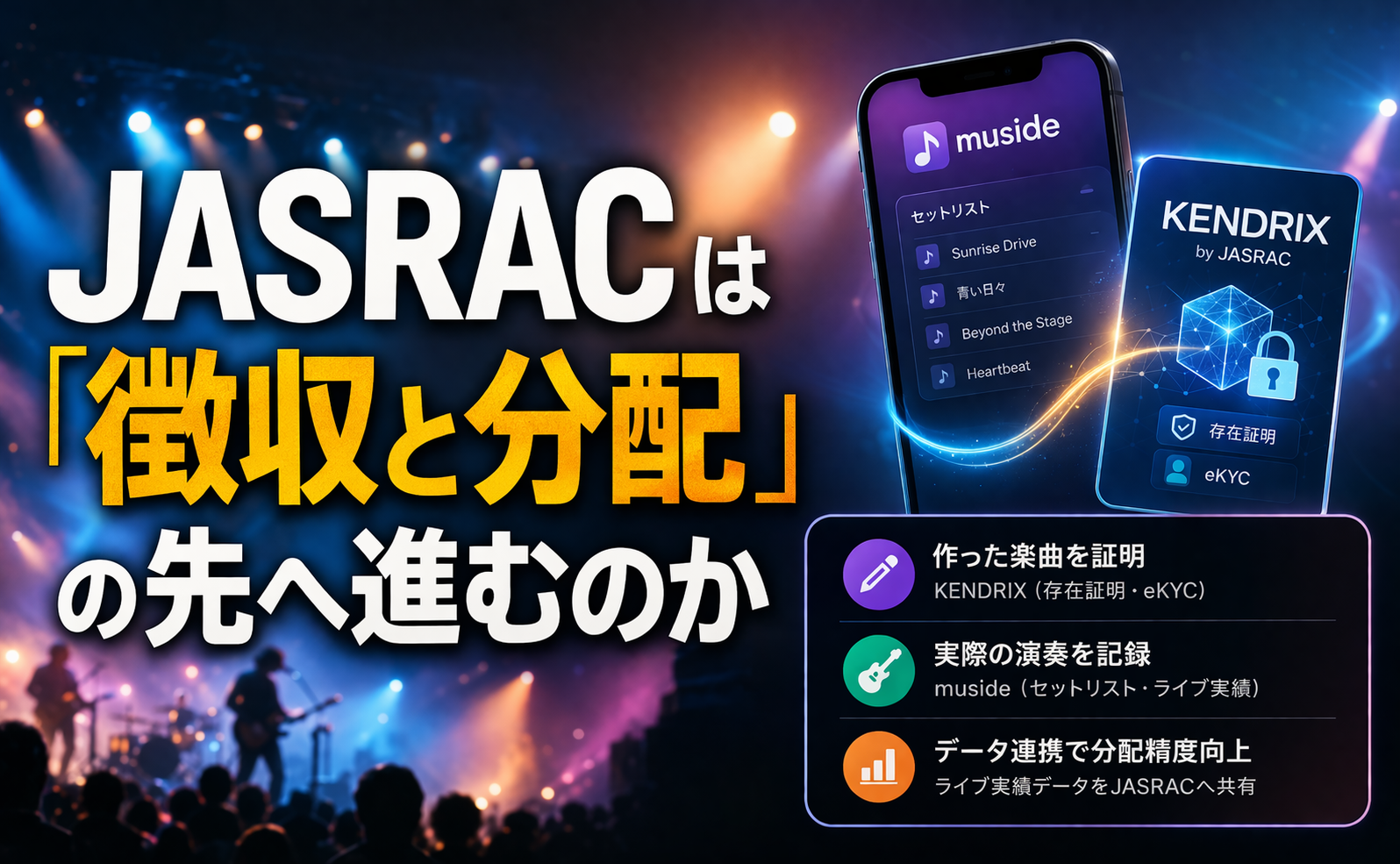
The partnership between JASRAC and “muside,” a music activity support app operated by Nishi-Nippon Railroad and announced by JASRAC on March 31, 2026, should be seen not merely as a collaboration between two services, but as a development that brings the mechanisms of music copyright management closer to the realities of activity in the field. Under this partnership, JASRAC will not only promote KENDRIX to muside users, but will also collect data on songs performed at live music venues through muside’s setlist function and conduct verification aimed at using that data in the future as part of JASRAC’s royalty distribution data. In addition, a live event hosted by muside and sponsored by KENDRIX is planned in Fukuoka City around the fall of 2026.
The essence of this news is that the entry point of creation and the exit point of usage records are gradually beginning to connect in a single line. KENDRIX officially launched in October 2022 as a music information management system equipped with a blockchain-based proof-of-existence function and an eKYC function. As of March 2026, it has been used by more than 2,500 creators in total, with over 14,000 sound recordings registered. Muside, on the other hand, is a music activity support platform launched in February 2024, offering functions closely tied to the on-the-ground activities of amateur and indie musicians, including live show announcements, performance records, ticket management, setlist viewing, and audition features. In other words, this partnership connects KENDRIX, which is strong in proving that a song was “created,” with muside, which is strong in recording that it was “actually performed.”
What makes this important is that improving the accuracy of copyright management requires not only rights information, but also data on actual usage. According to the announcements by JASRAC and Nishi-Nippon Railroad, the goal is to share with JASRAC the song lists registered through muside’s setlist function, collect data on songs performed at live events and elsewhere, and build a platform that enables centralized management of such information. Muside also plans to make it possible to register JASRAC work codes and ISRCs, while revising its terms of use and proceeding with verification. This can be seen as an attempt to more accurately visualize usage records from small-scale live events and indie music venues that have previously been difficult to capture.
For JASRAC, this partnership may also lead to a shift in its public image. JASRAC is generally perceived as an organization for licensing and royalty distribution, but KENDRIX was originally designed as a creator DX platform aimed at lowering the procedural barriers that music creators face in publishing their works with confidence and receiving fair compensation. By linking up with a field-oriented service like muside, JASRAC may begin to strengthen its role not only as a rights management organization, but also as an infrastructure provider that supports the practical side of creative activity.
For Nishi-Nippon Railroad as well, this partnership is more than a simple effort to increase awareness of its app. Muside has already been expanding in ways that create more opportunities for artists to perform, through event collaboration and audition functions. Now, with JASRAC’s rights management infrastructure layered onto that, muside can broaden its positioning from being simply “an app that supports live performances” to “an app in which live performance records can also lead to future compensation and rights management.” It is particularly interesting that a service originating from a regional railway company is trying to move beyond supporting the local music scene and become part of the broader infrastructure of the creator economy.
That said, the success or failure of this initiative will depend less on technology than on operations. The key implementation issues will include whether setlists are entered properly, how accurately performed songs can be matched with registered works in practice, and whether performers, live houses, and organizers can avoid excessive input burdens. The planned enhancement allowing registration of JASRAC work codes and ISRCs is one step toward improving accuracy, but unless the system can operate smoothly in real-world settings, its practical value as royalty distribution data will remain limited. On the other hand, if these hurdles can be overcome, the data on actual usage surrounding live houses should become far richer than it has ever been before.
Another point worth noting is that this partnership originates in Fukuoka. A live event is scheduled in Fukuoka City around the fall of 2026, and auditions are expected to begin around the end of May. There is significance in the fact that JASRAC and Nishi-Nippon Railroad, a regional transportation company rather than a major platform operator, are working together to build a mechanism for data collection and rights-based compensation starting from local live music venues. It suggests that DX in the music industry will not advance only through centralized mega-platforms, but also through small, locally rooted points of contact in actual performance settings.
If this announcement were to be summed up in a single phrase, it would be: an attempt to bring the downstream process of copyright management closer to the real sites of creation and live performance. By connecting the proof-of-existence and identity verification functions handled by KENDRIX with the live activity support and setlist recording functions provided by muside, the process for music creators—from “creating,” “performing,” and “proving,” to “being evaluated” and “receiving compensation”—could become smoother than before. At present, this remains in the verification stage, but if this model proves effective, JASRAC may evolve one step further: from being simply an organization that collects and distributes copyright royalties to becoming an entity that supports the very data infrastructure of musical activity itself.