
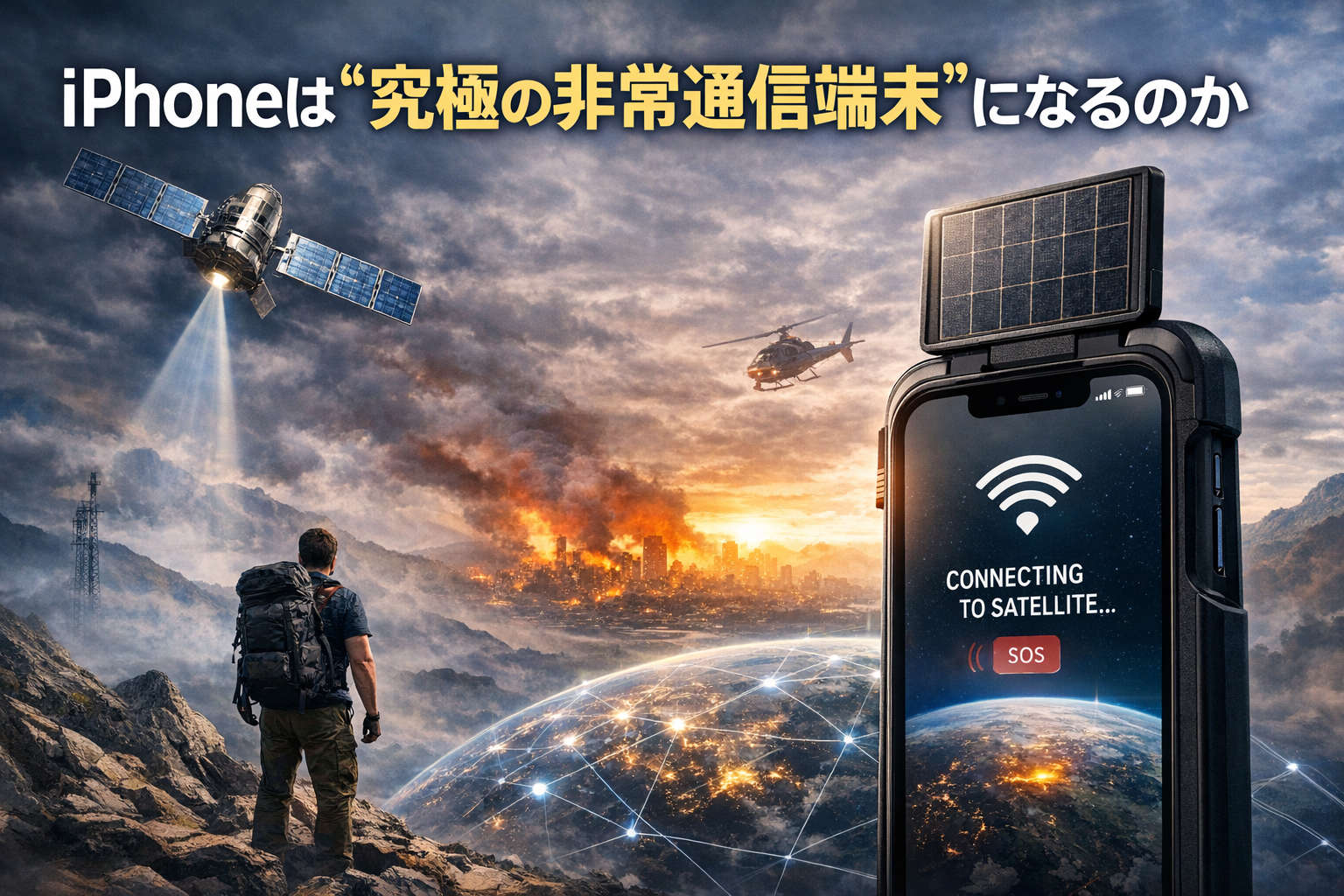
According to overseas media reports, Apple is developing a detachable case equipped with a “phased array antenna.” This is not merely an accessory. It represents a move that could redefine the relationship between smartphones and satellite communications.
In this article, we examine the implications of this technology and its potential impact on society and daily life.
The Current Limitations of iPhone Satellite Communication
Current iPhones are equipped with a satellite SOS function, but practical use comes with constraints:
- The device must be manually and precisely pointed toward the satellite
- Only short text messages can be transmitted
- Connections are easily interrupted due to satellite movement
These limitations stem from the physical constraints on antenna size and power that can be integrated inside a smartphone. Built-in antennas have limited surface area, which restricts transmission power and reception performance.
In other words, while satellite communication is possible with a standalone smartphone, inherent constraints remain in terms of stability and communication quality.
A Phased Array Antenna as the Solution
The reported case is said to incorporate a “phased array antenna,” which coordinates multiple antenna elements.
Key characteristics of phased array technology include:
- Electronic control of directionality through phase control of multiple elements
- Beamforming without physically changing orientation
- Improved transmission and reception efficiency
This reduces the burden of continuously pointing the device toward a satellite and enables more stable communication.
Equally important is the “detachable” design philosophy. Rather than assuming constant attachment, this modular approach expands functionality only when needed—an approach that reflects Apple’s distinctive product strategy.
Alignment with Industry Trends
The telecommunications industry is currently striving to enable direct satellite communication from standalone smartphones. However, the laws of physics cannot be altered.
Even as built-in antennas become smaller and more advanced, constraints on antenna surface area and power remain. There is therefore a clear performance gap between what a standalone device can achieve and what is possible with an additional dedicated antenna.
Apple’s case appears to present not merely an extension of standalone satellite communication, but an alternative solution: “expandable satellite communication.”
Enhanced Safety in Outdoor Activities
If realized, this case could significantly enhance safety in outdoor activities such as mountaineering and sea fishing.
In mountainous or coastal areas, users often fall outside the coverage of terrestrial base stations. Loss of communication directly increases risk.
With more stable satellite communication enabled by a phased array antenna, the following become realistically achievable:
- Real-time access to weather information
- Continuous sharing of location data
- Rapid distress signaling in emergencies
This is not merely a matter of convenience—it is technology directly linked to survival rates.
Disaster Preparedness and Child Safety
In disaster-prone countries such as Japan, the significance of this technology becomes even greater.
If terrestrial communication networks fail during major earthquakes or typhoons, satellite connectivity would allow:
- Confirmation of family members’ safety
- Location tracking
- Reception of emergency information
One of the most common reasons parents provide smartphones to their children is to ensure communication during emergencies. If a case equipped with a phased array antenna becomes practical, the reliability of that communication would increase substantially.
This could fundamentally shift the evaluation criteria for devices given to children.
Is Apple Aiming to Brand “Peace of Mind”?
Apple has consistently positioned privacy protection and safety features at the core of its brand value. This initiative can likewise be interpreted as strengthening the added value of “security and reassurance.”
As smartphone performance competition approaches saturation, new differentiation may lie in areas such as:
- Life-saving communication
- Devices that function during disasters
- Connectivity even outside cellular coverage
If this case becomes a reality, the iPhone may establish itself not merely as an information device, but as “the most reliable emergency communication terminal.”
Conclusion
A detachable case with an integrated phased array antenna is not just an accessory. It represents an attempt to evolve the smartphone’s role from a “convenient device” to “reliable infrastructure in emergencies.”
Technical challenges undoubtedly remain. However, if this approach is successfully implemented, it may fundamentally change the way we think about safety.
Can the iPhone become the ultimate emergency communication device?
Future developments will be closely watched.