
Introduction
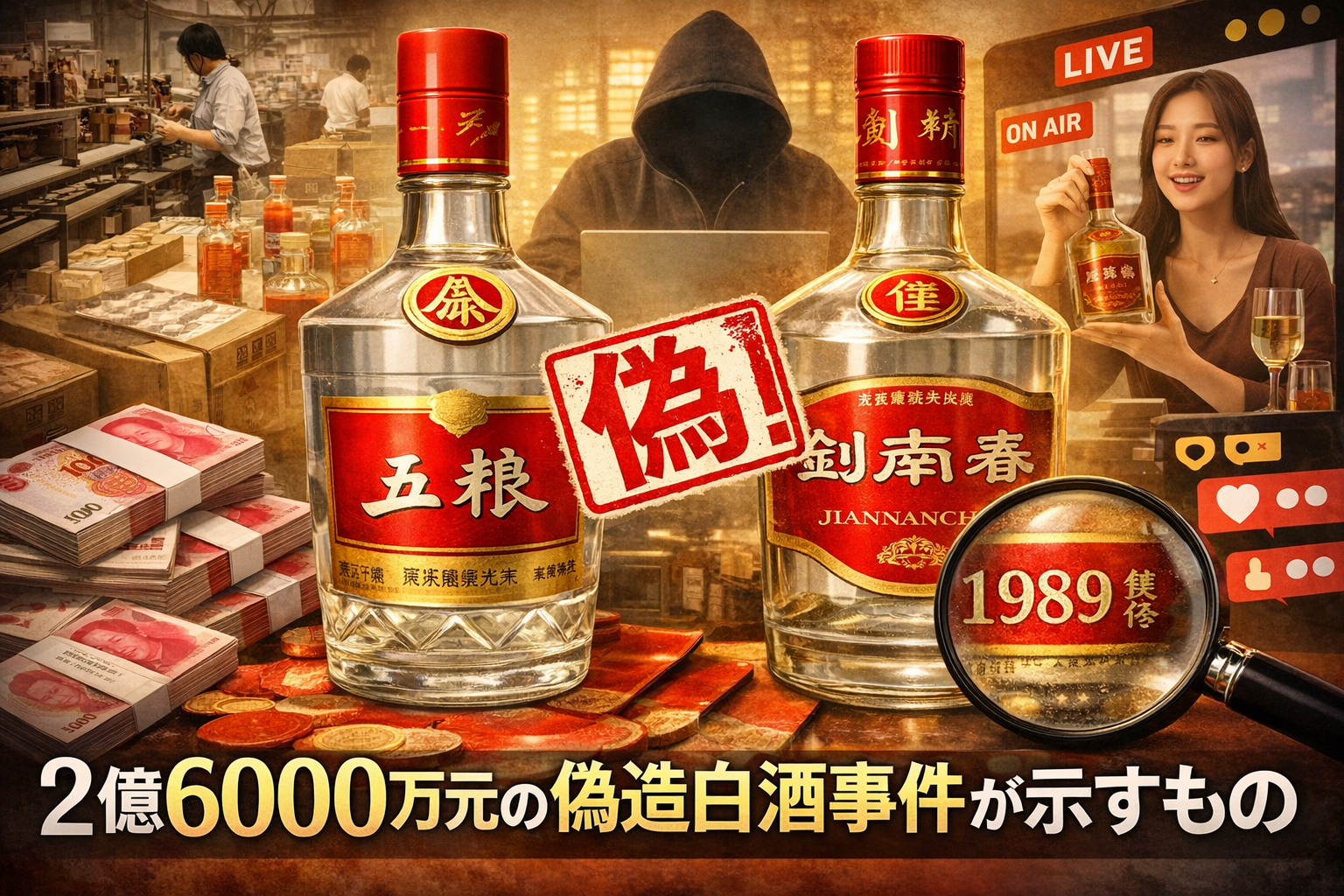
On April 19, 2026, Hong Kong media outlet HK01 reported that Chinese authorities had busted an extraordinarily large counterfeit baijiu manufacturing and sales network involving damages on the scale of 260 million yuan. What was uncovered was not merely a group producing low-quality imitation liquor. Rather, it was a large, integrated network encompassing manufacturing, storage, packaging, trademark printing, distribution, and even live-commerce sales. A notable feature of the case was that the group had skillfully imitated famous Chinese baijiu brands such as Jiannanchun and Wuliangye.
What is particularly striking about this case is that not only the contents of the counterfeit products, but also the brand labeling, production-year labeling, and sales methods had been elaborately constructed. It is said that the group used trademarks featuring variant Chinese characters that made them difficult to distinguish from the genuine ones, falsified production years to present the liquor as aged vintage baijiu, and sold the products via livestreams while emphasizing their rarity. This shows that counterfeiting has evolved beyond merely “making products that look similar” into the “falsification of value itself, including the story behind the product.”
This case is highly suggestive when considering the structure of China’s premium liquor market, consumer protection in the age of live commerce, and the new dimensions of intellectual property infringement.
Why It Matters That the Targets Were “Premium Brands” and “Aged Vintage Liquor”
It is no coincidence that the targets of counterfeiting in this case were baijiu products with high brand recognition and brand value in China. Premium baijiu is not simply a consumer indulgence; it is a product that carries multiple forms of value, including gift-giving, business entertainment, investment, and collection. In particular, “aged vintage liquor” is an area where the passage of time itself becomes a source of value, making it easier for such products to command premium prices in the market.
In other words, for counterfeiters, this is not merely about selling liquor. It is about illicitly appropriating the dual values of “brand” and “time.” The contents do not even need to be authentic in any strong sense, because what consumers are purchasing is less the taste itself than the symbolic value attached to the brand name, provenance, age, and rarity. The method used in this case—labeling the products as having been made between 1990 and 2010, or even in the 1980s—can be seen as an attempt to exploit that symbolic value to the fullest.
What is important here is that counterfeiting occurs in the premium market not only because demand is high. It is also because purchasing decisions in premium markets depend heavily on trust. Since consumers often find it difficult to judge product quality on the spot, brand, appearance, narrative, and distribution channel carry tremendous influence. And it is precisely this mechanism of trust that modern sophisticated counterfeit businesses exploit.
From “Trademark Disguise” to “Staged Value Creation”
According to the reports, the product labels used look-alike characters that were almost indistinguishable from the genuine ones at first glance. This is a classic trademark infringement tactic, but the seriousness of this case goes beyond that. The more fundamental problem lies in the fact that the products were sold with falsified production dates and accompanied by the story that they were “rare aged liquors matured over several decades.”
This structure indicates that modern counterfeiting is shifting from simple imitation to a more sophisticated, “value-staging” model precisely engineered around consumer psychology. It is no longer just about making the product itself look similar. It also involves constructing the explanation for “why this is expensive” and “why you should buy it now.”
Its connection with live commerce is especially symbolic. In livestream sales, the seller’s rhetoric, the sense of exclusivity, real-time urgency, and the reactions of other viewers all encourage purchases. Rather than calmly comparing options, consumers become more likely to make decisions within the atmosphere and story created in the moment. As a result, live commerce is an extremely powerful device for giving counterfeit products an aura of authenticity.
This means that in the e-commerce era, anti-counterfeiting measures cannot rely solely on monitoring product images and written descriptions. Going forward, surveillance and record-keeping of the dynamic sales environment of livestreaming itself, as well as discussion of platform responsibility, will become increasingly important.
The Structural Problems in the Chinese Market Revealed by This Case
The network uncovered in this case had divided functions for manufacturing, storage, packaging, trademark printing, logistics, and sales. Moreover, it is said that unlicensed operators produced blended liquor made from edible alcohol and food additives. What this reveals is the reality that counterfeiting is no longer a sporadic underground activity, but has become highly organized and industrialized.
In other words, this is not merely a problem of “a malicious individual merchant.” It is a problem of counterfeit business as a supply chain. As long as raw material procurement, bottle and packaging production, label printing, logistics, and sales channel operations are all interconnected, cracking down on just one point in the chain will be insufficient. There is a strong possibility that such networks are structured in a way that allows them to regenerate through alternative routes even after a bust.
In addition, data cited from the State Administration for Market Regulation indicate that, nationwide in 2024–2025, there were more than 30 trademark infringement cases involving illegal sales exceeding 10 million yuan, and 11 major cases involving more than 100 million yuan. This suggests that the present case should be viewed not as an extraordinary outlier, but as part of a market environment in which large-scale infringement continues to occur.
What these figures show is not only that Chinese authorities are strengthening enforcement, but also that infringement businesses remain substantial in scale. Strict enforcement does not mean the problem is small. On the contrary, the fact that major cases continue to emerge despite such crackdowns indicates that the underlying profit structure remains extremely strong.
The Risks from a Consumer Protection Perspective
The problem of counterfeit baijiu is not limited to intellectual property infringement. If liquor made by blending edible alcohol and food additives was falsely sold as authentic, then the issue is also a serious one from the standpoint of quality control, safety, and potential health harm.
Counterfeiting of premium liquor is often discussed in terms of economic damage—namely, that consumers were deceived into paying high prices. But since baijiu is a consumable product, there is also the possibility of direct bodily harm. In particular, if it is true, as reported, that unlicensed operators were involved in manufacturing, then it would hardly be surprising if there were deficiencies in hygiene control and ingredient management.
What makes the matter even more troublesome is that in the aged-liquor market, there may be cases where products are “kept unopened” or “circulated as gifts.” In that case, once counterfeit products enter the market, they may remain mixed with genuine products for a long period of time. This is not merely a temporary fraud problem; it is one that can erode trust in the market as a whole.
What Is Required of Brand Owners and Platforms
In light of incidents like this, what will become increasingly important is not only administrative enforcement, but also preventive responses by brand owners and distribution platforms.
For brand owners, legal action against trademark infringement is of course essential. But beyond that, the more pressing question is how to establish systems that make authenticity easier to verify. Measures such as serial number control, visualization of distribution routes, clarification of authorized sales channels, and the provision of authenticity verification tools are needed to create an environment in which consumers can confirm authenticity for themselves. In products like premium liquor, where appearance and narrative form the core of value, proving authenticity itself becomes part of brand strategy.
At the same time, responsibility must also be demanded of live-commerce and e-commerce platforms. Anti-counterfeiting measures cannot stop at seller review and ex post deletion. More robust controls are needed, including identity verification of streamers, confirmation of sellers’ authorization to sell branded goods, detection of abnormal pricing and promotional language, and cross-checking against past violation records.
Livestream sales, in particular, tend to drive purchases through one-time momentum, and there are inherent difficulties in preserving evidence and conducting post hoc tracing. For that reason, making recording retention mandatory and establishing mechanisms that allow brand rights holders to report and stop infringing streams quickly will likely become important practical countermeasures going forward.
The Essential Point We Should Take from This News
It is not enough to regard this crackdown merely as “yet another counterfeiting incident in China.” The essence of this case lies in the fact that the counterfeit business has evolved into a sophisticated commercial model combining brand imitation, age falsification, distribution design, and livestream selling.
What is being infringed here is not just trademarks. What is being appropriated is the accumulated trust, history, rarity, and even the sales experience associated with the product. Put differently, modern counterfeiting is no longer simply “copying goods”; it is becoming something closer to “copying value.”
That is why simple intensification of crackdowns alone will not be enough. What is needed is a comprehensive response that includes proof of authenticity for genuine goods, ensuring the reliability of sales channels, monitoring sales staging on platforms, and improving consumer literacy.
Conclusion
This counterfeit baijiu case, involving 260 million yuan, is significant not only as a matter of intellectual property protection and food safety in China, but also because it highlights the vulnerabilities inherent in the premium goods market in the digital age. The greater the brand value becomes, the stronger the incentive to imitate it. And new sales methods such as live commerce, while offering opportunities for legitimate distribution, can also become powerful weapons for counterfeiters.
This case suggests that the era of viewing anti-counterfeiting simply as a two-party conflict between rights holders and infringers is coming to an end. Going forward, this issue must be considered as one of market design involving all participants: government authorities, brand owners, platforms, and consumers. The recent crackdown in the premium baijiu market seems to illustrate that point with remarkable clarity.