
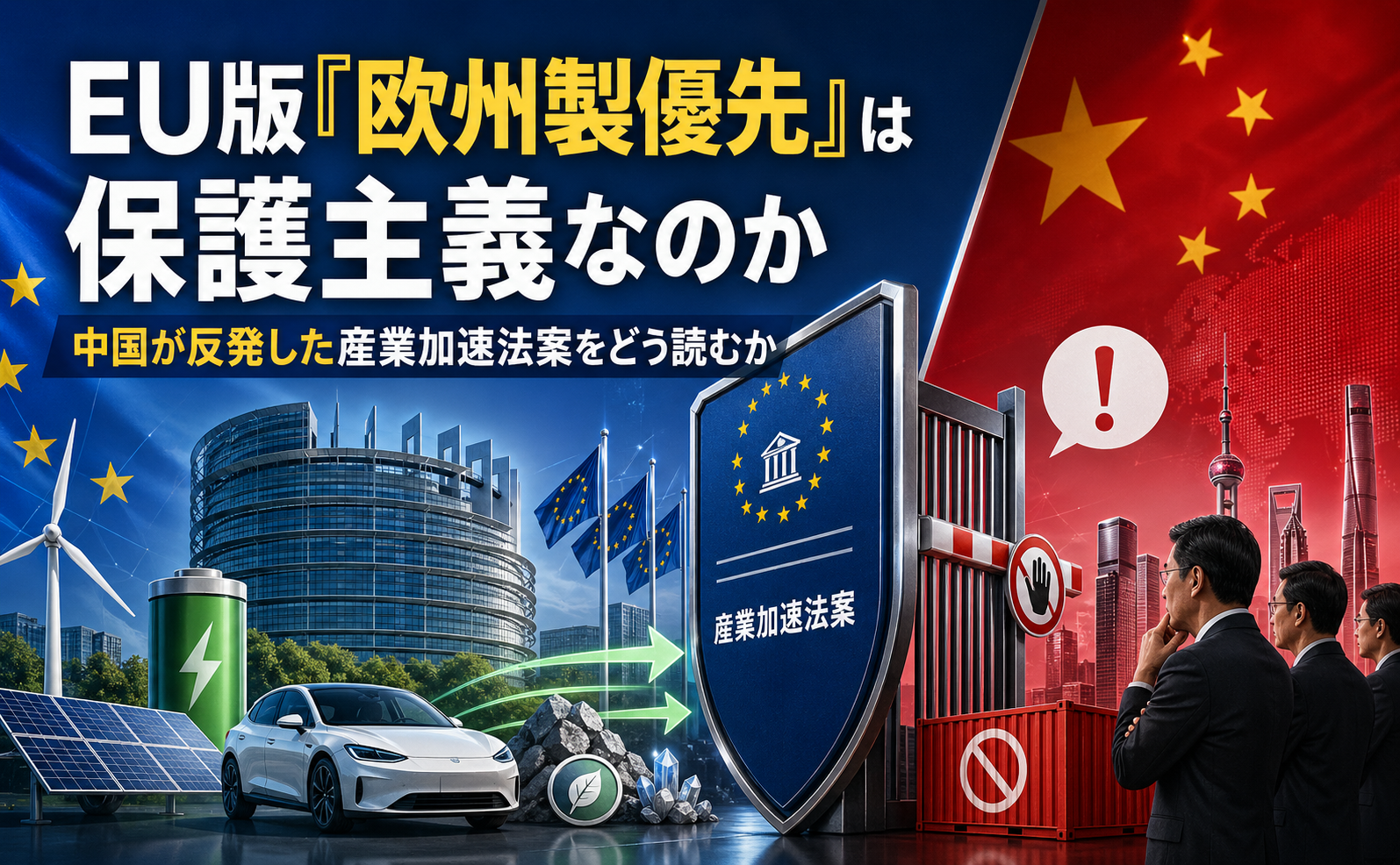
On April 27, 2026, China’s Ministry of Commerce revealed that it had submitted a formal opinion on the European Union’s “Industrial Acceleration Act” to the European Commission on April 24. China argues that the bill imposes strict conditions on foreign investment in sectors such as batteries, electric vehicles (EVs), solar power, and critical raw materials, and that it also favors “EU-origin” goods in public procurement and public support measures. Beijing criticizes the proposal as a “serious investment barrier” and a form of “institutional discrimination.” The EU, on the other hand, positions the bill as a framework for simultaneously strengthening decarbonization and industrial competitiveness, and has already referred it to the European Parliament and the Council of the EU for deliberation. This news is not merely another exchange of blows between China and the EU; it reflects a new era of trade rules in which green policy and economic security have become tightly intertwined.
What China Finds Problematic
China’s position is quite clear. The Ministry of Commerce states that the bill may violate basic principles such as most-favored-nation treatment and national treatment, and that it would not only lead to discrimination against Chinese investors, but also slow the EU’s green transition and undermine fair competition. China has therefore demanded that the bill remove discriminatory requirements against foreign investors, local content requirements, coercive requirements relating to intellectual property rights and technology transfer, and restrictions on public procurement. It has also indicated that it is prepared to take countermeasures if its demands are not accepted. In other words, China sees this bill not merely as an industrial promotion policy, but as a structural change designed in practice to shut Chinese companies out.
The Essence of the EU Bill
That said, if one looks at the EU’s own explanation, this is not simply an “anti-China bill.” Regarding the Industrial Acceleration Act published on March 4, the European Commission explains that it is intended to boost demand for low-carbon, European-made technologies and products, strengthen manufacturing, create jobs, and accelerate decarbonization. Its scope also extends to sectors the EU considers strategic industries, including steel, cement, aluminum, automobiles, and net-zero technologies. Behind it lies not only a clean industrial policy, but also an economic security logic centered on reducing dependence on non-EU countries and strengthening supply-chain resilience.
What matters here is that the EU is no longer merely “a market that buys the cheapest goods from around the world.” It is increasingly becoming a market that asks far more strictly what market access will bring to Europe in return. The European Commission itself has stated that one of its aims regarding foreign direct investment is to ensure that it “brings concrete value to the EU,” and the philosophy behind the bill shifts the center of gravity away from liberalization and toward conditional openness. This should be seen as a message not only to China, but to non-EU companies in general.
What the “EU-Origin” Clause Means
The “EU-origin” clause, which has triggered strong opposition from China, is in fact quite carefully designed. In the text of the bill, “Union origin requirements” are imposed in public procurement and certain forms of public support for specific net-zero technologies. For example, in areas such as batteries, solar power, heat pumps, and wind power, the scheme would require EU-origin finished products or key components after a certain point in time. Therefore, China’s characterization of the measure as “Europe-made first” is not an exaggeration; it is written into a core part of the bill itself.
That said, the system is not a complete closure. The bill provides room, in certain cases, for procurement from countries that have free trade agreements or customs unions with the EU, or that are parties to the WTO Agreement on Government Procurement (GPA), to be treated as equivalent to “EU-origin.” At the same time, however, the European Commission would also have the power to exclude such treatment where the partner country does not grant national treatment to EU companies, or where there is a need to avoid dependency. Moreover, under WTO rules, China is not a party to the GPA; it is only an observer on the committee. As a result, from the perspective of Chinese companies, this bill is likely to appear as a regime that formally contains exceptions, but in practice could still operate to their disadvantage. This shows that China’s opposition is not merely political theater; it has a reasonable basis as an interpretation of the institutional design.
What China Is Most Wary Of: The Investment Restrictions
The most noteworthy part of this bill is arguably not public procurement, but rather the chapter on foreign investment restrictions. Under the bill, if a direct investment into the EU exceeds €100 million and the investing third country accounts for more than 40% of global production capacity in the relevant field, investment in the manufacturing of batteries, EVs, solar power, and critical raw materials cannot proceed without explicit approval from the authorities. Given that the list of sectors matches the statement by China’s Ministry of Commerce almost exactly, it is perfectly natural that Beijing sees this as the core regulatory provision.
The approval requirements are also heavy. In principle, the bill allows approval only for investments that satisfy at least four of six conditions. These include limiting the foreign investor’s equity stake to 49% or less, structuring the investment as a joint venture with an EU company, licensing intellectual property rights or know-how, spending at least 1% of EU turnover on research and development, ensuring that at least 50% of workers are EU workers, and making efforts to source at least 30% of inputs from within the EU. Moreover, the requirement that 50% of workers be EU workers is a mandatory condition for approval. These provisions are the background to China’s claims of “forced technology transfer” and “local content requirements.” The EU side will likely explain this as a way of securing added value for Europe, but from China’s perspective it will look like a system that demands management control, technology, employment, and procurement commitments in exchange for investment access.
The Real Issue Is Not Simply “Illegal or Not,” but “How Far Is Permissible”
The key issue surrounding this bill is not simply whether it violates WTO rules. Of course, China argues that it is inconsistent with most-favored-nation treatment and national treatment. But the EU is also constructing the system by combining reciprocity, supply-chain security, dependency avoidance, and climate policy. The text of the bill itself carefully incorporates treatment based on FTAs and the GPA, exception clauses, and considerations related to dependency avoidance, suggesting that the EU has been conscious of its legal defensive line from the outset. In other words, what is happening now is not a crude tariff hike, but a more modern and more difficult dispute: how far market access can be conditioned in the name of economic security.
The Real Change This News Reveals
What this news truly shows is that green policy is no longer just environmental policy. It is now also industrial policy, trade policy, and security policy. The EU is trying to advance decarbonization while at the same time promoting the return of manufacturing and reducing dependence on China. China calls this discrimination, but for the EU it is also a strategic shift away from what it sees as defenseless openness. The positions of the two sides clash head-on, yet they are also quite similar in one respect: both are trying to protect their domestic industrial base and technological sovereignty.
In that sense, this issue is not just about China and the EU. Going forward, for companies seeking to enter overseas markets, the competitive conditions will no longer be limited to price and performance. They will also include local employment, technological cooperation, the location of supply chains, and compliance with public procurement rules. In the era of free trade, the central question was “what do you sell?” From now on, the question will increasingly be “where do you make it, whom do you employ, and how much value do you leave locally?” This bill seems to symbolize the beginning of those new rules.