
Introduction
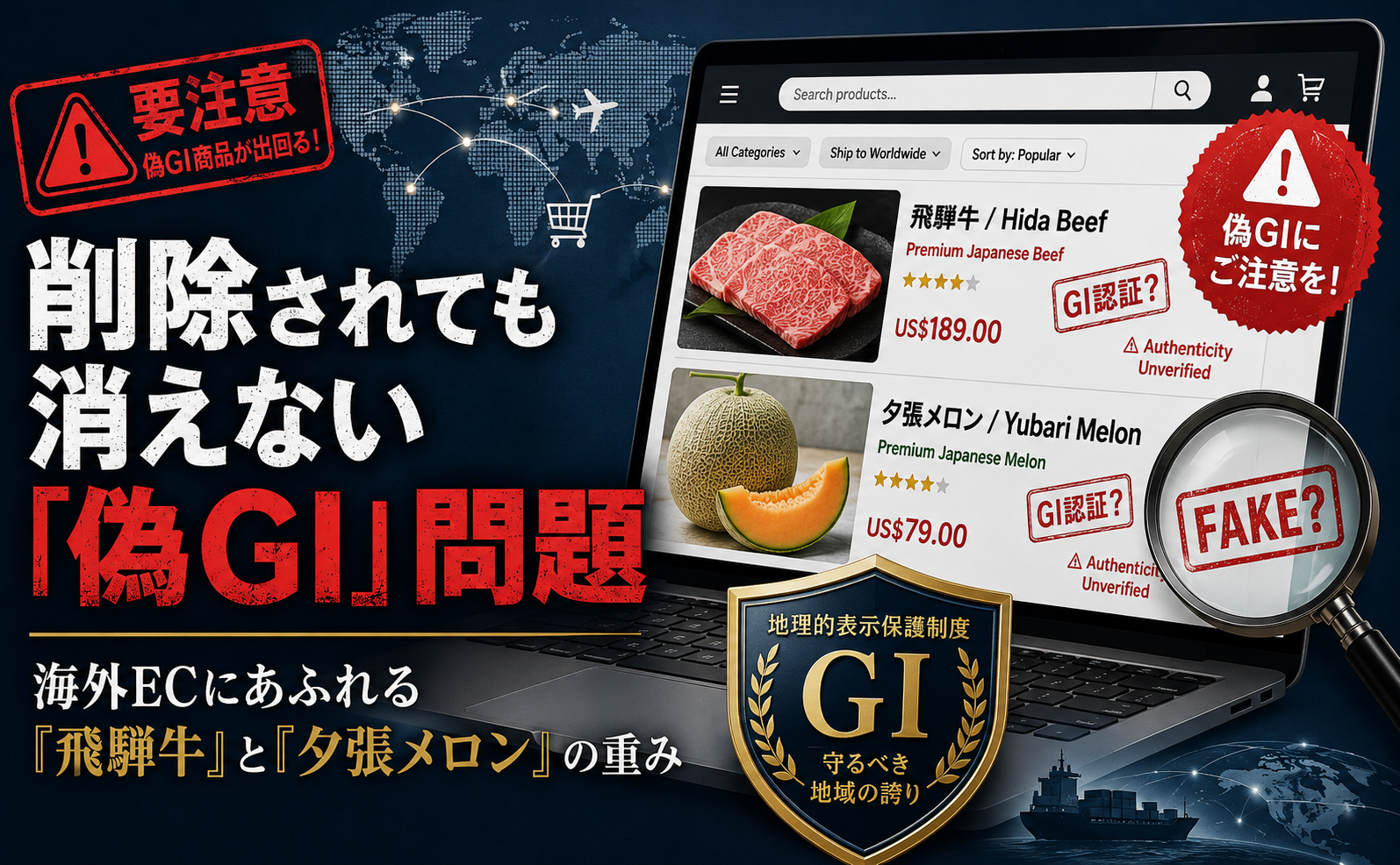
A total of 1,197 products using the names of Japan’s geographical indications (GIs), which represent regional brands, without authorization were found in a fiscal 2024 survey of overseas e-commerce sites. The findings included cases such as beef from the Philippines being sold as “Hida Beef” and melons from Australia being labeled as “Yubari Melon,” showing that Japanese place names and brand names were being used on products that were not actually from those origins. Japan’s Ministry of Agriculture, Forestry and Fisheries requested the removal of these listings and confirmed that 73% were taken down, but some listings still remain. This news is not simply about combating counterfeits. It highlights the challenge of how Japan can protect the regional brands it has cultivated over many years in overseas markets, from the perspectives of both export strategy and intellectual property protection.
GI Is Not Just a “Name,” but Trust Itself
The GI protection system is a framework under which the government protects the names of region-specific agricultural, forestry, fishery, and food products. In other words, a GI-registered name is not merely a product name or a common designation. It is a mark of trust indicating that the product was produced in that region, by that method, and in compliance with specific quality standards.
For example, names such as “Hida Beef” and “Yubari Melon” embody the natural conditions of the production area, the efforts of producers, the reputation built up over many years, and the trust of consumers. That is precisely why it is more serious than it may appear when products made in other countries or regions use the same names. It is not simply a matter of borrowing a name. It is nothing less than free-riding on the trust that others have painstakingly built.
What the Figure of 1,197 Tells Us
In this survey, 184 major e-commerce sites around the world were examined, and GI product names and place names were searched in Japanese, English, and Chinese. As a result, 1,197 suspected cases of unauthorized use were identified. Of these, 697 were said to be products that clearly imitated GI products such as “Kobe Beef.”
What this figure reveals is the reality that Japanese regional brands have that much appeal in overseas markets. Put differently, the fact that merely using the name helps products sell shows how highly the value of Japanese GI products is regarded.
However, that reputation originally arose because legitimate producers and exporters have worked hard on quality control and market development. If unrelated sellers exploit that reputation, legitimate businesses are placed at a disadvantage in price competition, and consumers also find it harder to distinguish genuine products from fake ones. The higher the brand value, the greater the damage caused by imitation. That is the structure we are seeing here.
A 73% Takedown Rate Is Progress, but It Is Not Enough
Japan’s Ministry of Agriculture, Forestry and Fisheries reportedly requested the removal of all 1,197 listings identified, and confirmed that 877 of them, or 73%, had been taken down. It is fair to recognize that the government has taken concrete action against overseas e-commerce sites and achieved a certain degree of success.
At the same time, that also means that about one quarter of the listings remain. In particular, the fact that there are cases in countries and regions that do not have mutual GI protection agreements with Japan where takedown requests are not complied with should be taken seriously. Even if the system is well established domestically, it cannot fully protect these products in an age of expanding cross-border e-commerce unless adequate protection is also secured overseas.
In other words, current measures are centered on ex post responses of “finding listings and requesting their removal,” and there are limits to this approach when it comes to fundamentally preventing the spread of harm. The next challenge is not simply how to delete listings after they are discovered, but how to create rules and cooperative frameworks that make fraudulent listings less likely to appear in the first place.
This Is Not Just a Problem for Producers
This issue is not only a concern for producers and exporters of GI products. It is also a major loss for consumers if indications of origin and brand labeling can no longer be trusted.
If overseas consumers purchase low-quality products under the names “Hida Beef” or “Yubari Melon,” they may come away with the impression that “that Japanese brand is nothing special.” That impression can damage the reputation of genuine GI products as well. Once a brand image has been undermined, restoring it takes a long time and a great deal of cost.
Damage to a brand tends to be underestimated because it is difficult to see. In reality, however, it is extremely troublesome. It threatens not only current sales, but also future market opportunities.
The Ominous Reality of a Flat Trend in the Numbers
Similar surveys found 1,135 cases in fiscal 2022, 1,242 in fiscal 2023, and 1,197 in fiscal 2024. Although the numbers have gone up and down, they have remained at a high level overall. This indicates that the issue is not something that can be resolved through temporary crackdowns, but a structural problem that occurs continuously.
Moreover, the e-commerce market continues to expand across borders. Sellers can use multiple sites, and even if one listing is removed, they can relist the product under a different name or on a different sales page. Seen in that light, the actual damage may be more extensive than the confirmed number of cases suggests.
The fact that the number has not dropped dramatically does not mean that countermeasures are meaningless. On the contrary, without continued efforts, the situation might have become even worse. Still, maintaining the status quo is not enough. More far-reaching international institutional arrangements and stronger coordination with private-sector platforms are needed.
What Must Be Protected Is the “Intellectual Property of Regional Economies”
GIs differ somewhat from the trademarks of large corporations. They are intellectual property cultivated by entire regions. For that reason, the damage caused by infringement does not stop at the losses of individual companies. It also affects the reputation of the production area, the sustainability of local industries, and the surrounding economy, including tourism and exports.
In Japan, increasing added value through the use of regional resources is regarded as important. But the premise for that is a market in which authenticity is properly recognized and rewarded. No matter how high the quality of a product may be, if only its name is abused overseas, the efforts behind it are less likely to be rewarded.
That is why protecting GIs is not simply about protecting producers. It is also about safeguarding the foundation of regional revitalization and export expansion policies. If the value of Japanese products is to be accurately conveyed overseas and chosen on its merits, protection of the name is indispensable.
Conclusion
The 1,197 cases of unauthorized GI use found on overseas e-commerce sites are proof that Japanese regional brands are attracting attention around the world, while also showing the reality that their value is being exploited without permission. A takedown rate of 73% is certainly an achievement, but the fact that listings still remain shows that this issue is only at the beginning.
What is truly being tested is not only the ability to build brands, but also the ability to protect them. Names such as Hida Beef and Yubari Melon are crystallizations of trust built up by local communities over a long period of time. Whether that value can be properly protected in overseas markets will surely become a crucial issue that shapes the future of Japan’s agricultural, forestry, and fishery exports.