
Introduction
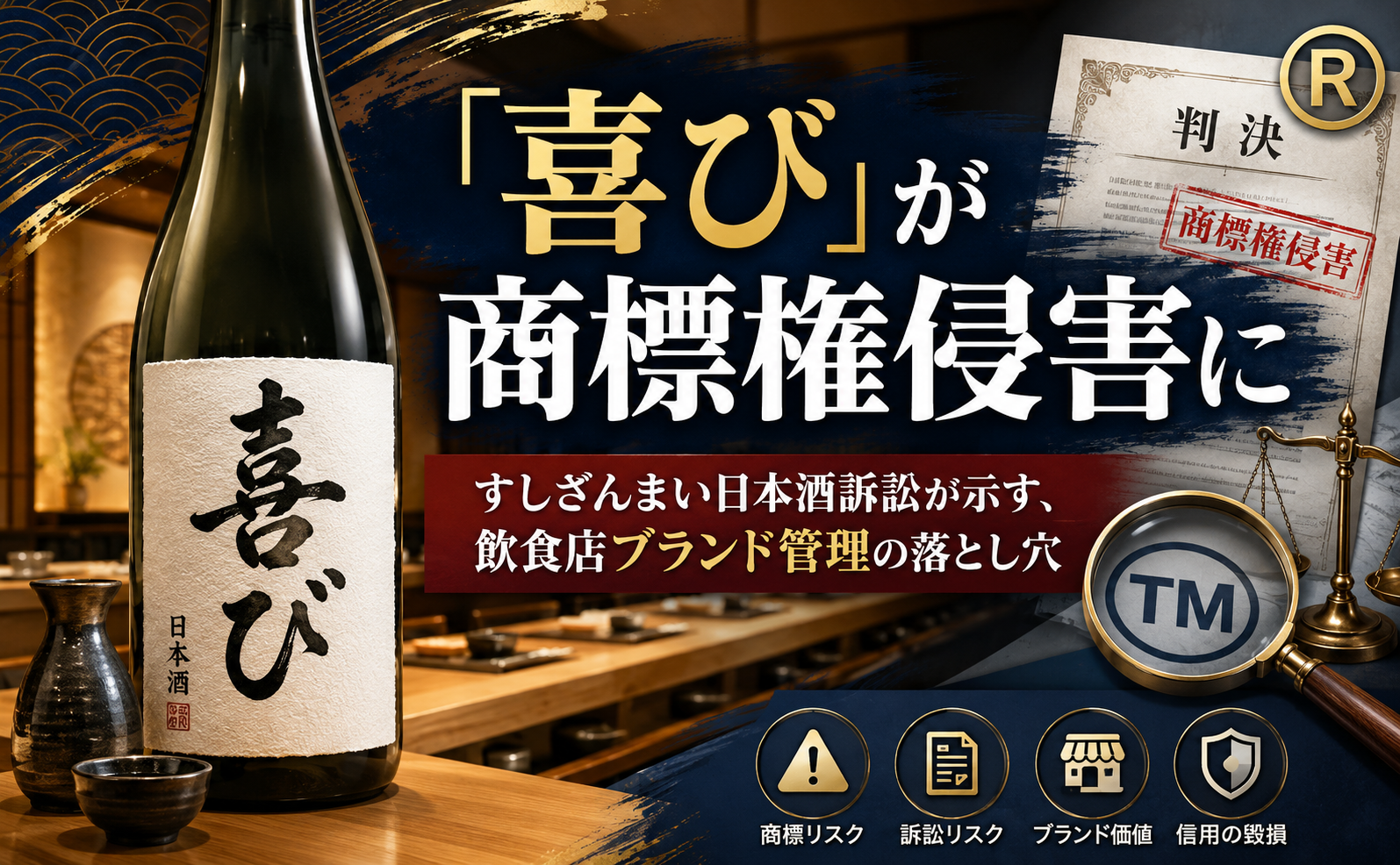
A judgment finding trademark infringement was handed down by the Osaka District Court in a lawsuit concerning the sake “Yorokobi,” which had been served at the sushi restaurant chain “Sushizanmai.” According to reports, Kiyomura, the company that operates Sushizanmai, had since 2004 served at its restaurants a sake called “Yorokobi,” which it had commissioned a sake brewery in Akita Prefecture to produce. In response, the representative of a sake brewery in Wakayama Prefecture sought damages and an injunction, alleging that the use infringed trademark rights in registered trademarks such as “Yorokobi” and “Kiyorokobi,” which had been registered for sake and other goods.
The judgment found that, even though there were some differences such as the presence or absence of okurigana or furigana on the label, those differences were only minor and there was a likelihood of confusion. As a result, Kiyomura and the manufacturer were ordered to jointly pay approximately 31 million yen.
This news is not merely a story about the danger of selling sake under a similar name. It highlights a practical issue for restaurants: how far they should go in checking trademarks when they plan products under their own brand, outsource manufacturing to an external manufacturer, and serve those products in their stores.
The Central Issue Is Not “Exact Match,” but “Likelihood of Confusion”
In determining trademark infringement, the issue is not limited to whether the names are exactly the same. What matters is whether ordinary consumers who come into contact with the goods or services are likely to mistake the source of one for the other.
What is particularly noteworthy in this report is that the court regarded differences such as the presence or absence of okurigana or furigana as “minor differences.” In other words, “喜び,” “よろこび,” and “喜よろこび” are not identical in written form. Even so, where they are used for the same type of goods, namely sake, and are considered close in pronunciation or concept, it may be found that consumers could misunderstand them as related products.
In trademark practice, similarity is examined from three perspectives: appearance, pronunciation, and meaning. As in this case, even if a name differs in its use of kanji and hiragana, it cannot be considered safe if the pronunciation or meaning is close. Rather, auspicious words and generally favorable expressions are more likely to be adopted by many businesses as product names, making trademark conflicts more likely to arise.
Trademark Risk Can Arise Even When Products Are Served Inside a Restaurant
A key point in this case is that the sake was served at Sushizanmai restaurants. Regardless of whether bottles were sold over the counter or the product was served inside a restaurant, if the product name or label is shown to consumers, its use may become an issue from a trademark perspective.
For restaurants, exclusive sake, original menu items, collaborative products, and commemorative products are effective ways to enhance brand value. However, once a product name or label is attached to them, trademark risk arises in the same way as with ordinary product sales.
Sake, wine, craft beer, sweets, seasonings, and similar products are areas in which restaurants can easily create original products in collaboration with external manufacturers. It is dangerous to assume that there is no issue because the product is served only in-store, that a limited-edition product is safe, or that an internal project of a well-known chain is unlikely to create problems.
Not Only the Manufacturer but Also the Provider May Bear Responsibility
In this case, the parties ordered to pay were not only the manufacturer, but also Kiyomura, the company operating Sushizanmai. This point is especially important in the practice of contract manufacturing and OEM products.
From the restaurant’s perspective, there may be situations in which it is tempting to think, “We left the manufacturing to the sake brewery,” or “We assumed the manufacturer had checked the label and product name.” However, if the restaurant actually serves the product in its own stores and displays the product name to customers, the provider may also be held responsible for trademark infringement.
This issue is not limited to restaurants. The same problem can arise in retail, hospitality, tourism, food brands, e-commerce businesses, and other industries. Even when a company does not manufacture a product itself, if it sells or provides the product under its own brand, it needs a system that does not leave trademark checks entirely to external parties.
Common Words Require Particular Caution
Words such as “Yorokobi,” meaning “joy,” are familiar expressions and are also attractive as product names. Words such as celebration, gratitude, happiness, dream, harmony, color, ultimate, and craftsmanship are similarly likely to be adopted as names for food and alcoholic beverages.
However, words that are easy to adopt are also more likely to have already been registered as trademarks by someone else. The fact that a word is common does not immediately mean that it is free to use. If it is protected as a registered trademark in a particular field of goods, restrictions may arise on its use in that field.
In the fields of alcoholic beverages and food in particular, product names often use auspicious words, words that evoke flavor, and words that convey a Japanese aesthetic. For this reason, businesses should not intuitively conclude that a word is safe because it is ordinary. Instead, they need to conduct trademark searches for each relevant product field.
Label Design Is Also Considered Together with the Name
Trademark risk is not determined by the words alone. It is also important which characters stand out on the label, whether furigana is attached, how kanji and hiragana are arranged, and which part consumers will recognize as the product name.
In this judgment as well, the presence or absence of okurigana and furigana became an issue. This shows that, when determining the product name, the overall impression of the label is important.
In practice, it is advisable to conduct checks not only when the product name is decided, but also when the label design has been finalized. This is because the trademark recognized by consumers may change depending on the size, arrangement, decoration, and reading aids attached to the characters.
Measures Restaurants and Manufacturers Should Take
The practical lesson from this news is clear. First, before deciding on a product name, businesses need to check prior trademarks at least in the same or similar product fields. For alcoholic beverages, trademarks relating to alcoholic beverages should be checked, and the relationship with food products and restaurant services should also be considered where necessary.
Next, in contract manufacturing agreements and joint planning agreements, it is important to clearly allocate responsibility for trademark checks. If it is unclear who proposed the name, who conducts the trademark search, and who responds if a warning is received from a third party, responsibility may become ambiguous when a dispute arises.
In addition, product names that have been used for a long period of time also require periodic review. According to reports, the sake in question had been served since 2004. The longer a name has been used, the more likely it is to be treated internally as a given and to fall outside the scope of risk checks. However, the longer the period of use, the greater the potential impact if a problem is discovered.
Trademark Management to Protect Brand Value
Trademark management is not merely a legal department checklist. It is a management issue for protecting brand value. Product names and labels are important points of contact through which customers remember products, reorder them, and recommend them to others. If there is a trademark problem at that point of contact, multiple risks may arise at the same time, including suspension of sales, label changes, disposal of inventory, damages, and loss of trust.
On the other hand, if trademark checks are conducted at an early stage, risks can often be avoided by changing the name or filing a trademark application. If a problem is discovered near the end of product planning, the cost of correction becomes significant. At the initial planning stage, however, switching to another name is comparatively easier.
This judgment once again demonstrates to restaurants and food manufacturers the importance of confirming not only whether a product name is attractive, but also whether that name can continue to be used safely.
Conclusion
The word “Yorokobi,” meaning “joy,” is positive as a product name and fits well with alcoholic beverages. In the world of trademarks, however, whether a word is appealing and whether it is free to use are separate issues.
The judgment concerning Sushizanmai’s sake shows that trademark infringement is not only an issue for large corporations or specialized manufacturers, but can also occur in familiar settings such as restaurant menus and original products. Even when manufacturing is outsourced, a business that actually provides the product cannot remain unrelated to trademark risk.
Original products and limited-edition menu items are important initiatives for enhancing the appeal of a brand. Precisely for that reason, it is necessary to conduct trademark checks at the stage of deciding names and labels, and to develop them into brand assets that can be used with confidence over the long term.