
Introduction
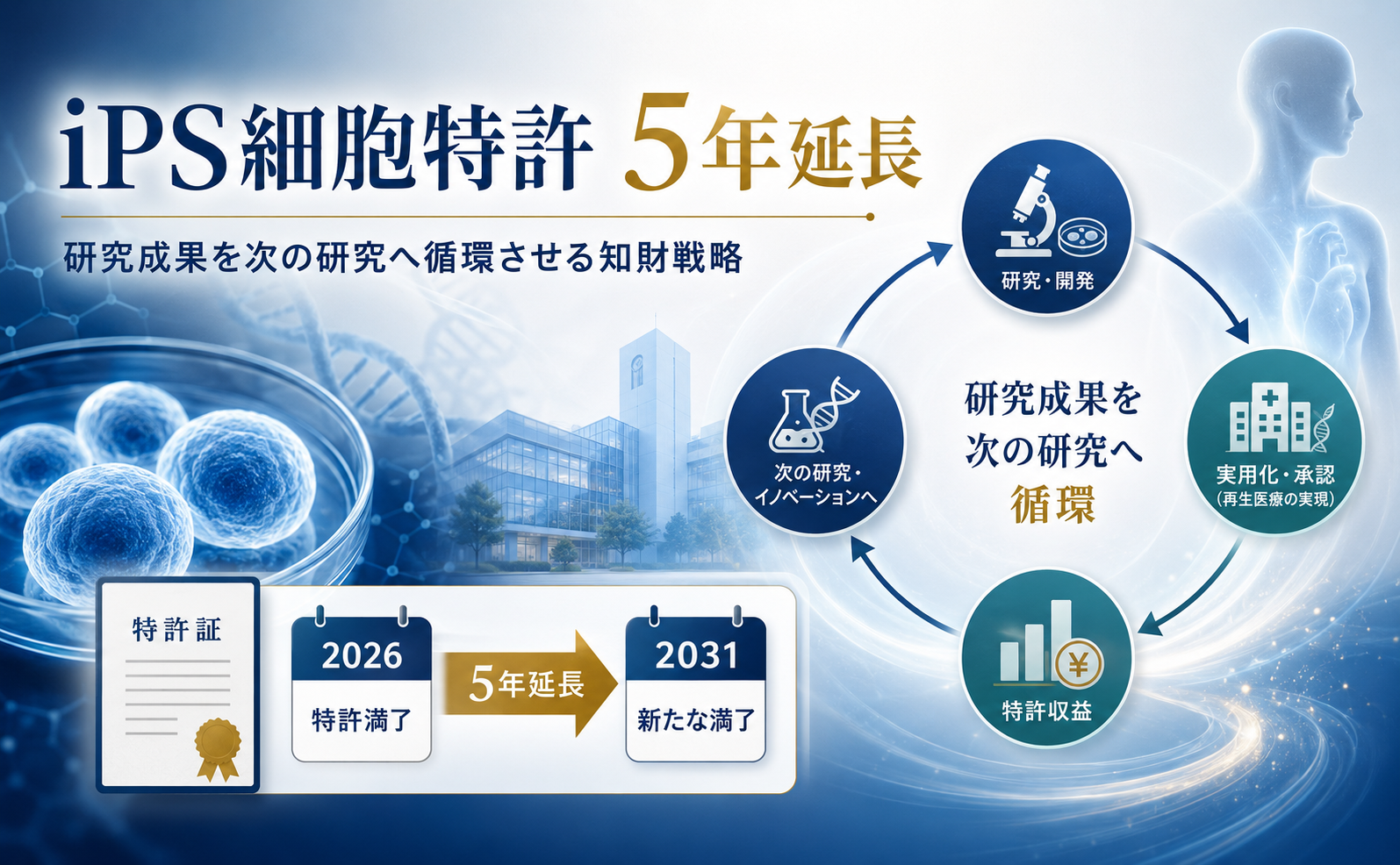
Kyoto University has filed an application with the Japan Patent Office to extend the term of its domestic patents relating to the technology for producing iPS cells developed by Professor Shinya Yamanaka and others until 2031. These patents were internationally filed in 2006, when the production of iPS cells was announced, and under the ordinary rule, their 20-year patent term would expire in December 2026.
The background to this extension application is that, in March 2026, two products were approved: a myocardial cell sheet using iPS cells and cells to be transplanted into patients with Parkinson’s disease. For pharmaceuticals, regenerative medicine products, and similar products, there is a system under which the patent term can be extended by up to five years if certain conditions are met, because it takes a long time to obtain national approval. Kyoto University has applied for an extension of the domestic patents on the basis that these conditions have been satisfied.
This news is not simply a story about “a famous patent being extended by five years.” It is a highly suggestive development when considering basic research, medical implementation, university research funding, and the role of intellectual property.
Research Outcomes Have Moved Closer to Medicine Over 20 Years
iPS cells have attracted great expectations since they were first announced. This is because they were expected to be applied to regenerative medicine and drug discovery research as a technology with the potential to differentiate into various types of cells.
However, discoveries in basic research are not immediately used in clinical settings. There are many stages before medical application, including confirming cell safety, quality control, manufacturing methods, post-transplantation effects, and therapeutic efficacy. Regenerative medicine, in particular, requires careful verification because it involves transplanting cells into the human body.
The approval of products using iPS cells at a time when the patents are approaching expiration is symbolic. It can be said that, 20 years after the 2006 announcement, the technology has finally reached the entrance to practical application. This once again shows that it takes a long time for advanced medicine to be implemented in society.
Patent Term Extension Is Not Merely “Prolonging Monopoly”
When people hear about patent term extension, some may feel that it is a way to lock up technology. Indeed, a patent is a right that allows the exclusive working of an invention for a certain period. Therefore, if the right continues for a longer time, it may affect use by third parties.
However, in the fields of pharmaceuticals and regenerative medicine, a somewhat different perspective is also necessary. Because research and development and approval review take a long time, by the time a product is actually approved, much of the patent term may already have passed. If the patent were to expire as it is, the period for recovering development investment would become extremely short, and as a result, companies and research institutions may become less willing to invest in high-risk medical technologies.
In that sense, the patent term extension system is not merely a system for protecting rights holders. It is also a system for encouraging the development of medical technologies that take time and for increasing future treatment options.
An Era in Which University Patents Generate Research Funds
Another point worth noting in this news is the revenue generated by Kyoto University’s iPS cell-related patents. According to reports, patent revenue in fiscal 2024 was more than one billion yen, and this revenue is being used for research expenses and other purposes.
The cycle in which revenue obtained from university research outcomes is used for further research is extremely important. In particular, long-term and foundational research, such as iPS cell research, is difficult to evaluate based only on short-term results. Without stable research funding, it becomes difficult to continuously support the path from basic research to clinical application.
Of course, the mission of a university is not to maximize patent revenue. Its original role is to generate knowledge that benefits society and to return that knowledge broadly to the public. However, a system for properly managing intellectual property and reinvesting the resulting revenue into research has become indispensable for sustaining university-originated innovation.
The Importance of an IP Strategy That Allows Broad Use
For foundational technologies such as iPS cells, what matters is not merely owning patents, but how those patents are made available for use. Excessively strong exclusivity may hinder the expansion of research and development. On the other hand, if no rights are held and everything is left entirely unmanaged, it may become difficult to maintain quality control and order in commercialization.
In other words, balance is important. It is necessary to enable research institutions and companies to participate in development with confidence, while also preventing any particular entity from enclosing the technology. Foundational patents can become barriers to entry if used incorrectly, but if operated properly, they can also become a common platform for promoting industry-academia collaboration.
This extension application should also be viewed from that perspective. The purpose is not simply to extend the rights themselves, but to maintain a mechanism that connects iPS cell technology to social implementation and returns the resulting revenue to the next stage of research.
Overseas Patents Will Also Become a Focus
Kyoto University has stated that it will consider how to respond to its overseas patents going forward. iPS cell technology is not something that can be completed within Japan alone. Regenerative medicine and drug discovery exist within an international competition in research and development, and relationships with overseas companies and research institutions are also important.
The question is not only whether domestic patents are extended, but also how rights will be maintained overseas, how they will be licensed, and how Japan-originated technology will be developed internationally. In particular, regenerative medicine involves complex manufacturing, quality control, clinical data, and regulatory responses. Simply owning patents does not by itself create competitiveness.
Going forward, patents, clinical development, manufacturing systems, regulatory approval, insurance systems, and international collaboration will need to be considered in an integrated manner. The IP strategy for iPS cells should evolve into a comprehensive strategy for connecting research outcomes to medicine around the world.
Conclusion
Kyoto University’s application to extend the iPS cell patents is symbolic news showing that a groundbreaking research outcome born in 2006 has, after 20 years, moved closer to the stage of medical implementation.
Patents are sometimes discussed as tools of “monopoly.” However, for foundational technologies originating from universities, they are also mechanisms for protecting research outcomes, encouraging corporate investment in development, and returning the resulting revenue to the next stage of research.
The extension of the iPS cell patents is not merely an issue of the duration of rights. It is an event that prompts us to think about the long period required to deliver basic research to society, the institutional design needed for the practical application of regenerative medicine, and how universities should make use of intellectual property.
For Japan-originated iPS cell technology to develop not merely as a research achievement in the laboratory but as medicine that reaches patients, not only scientific progress but also the IP strategy and funding circulation mechanism that support it will become increasingly important.