
Introduction
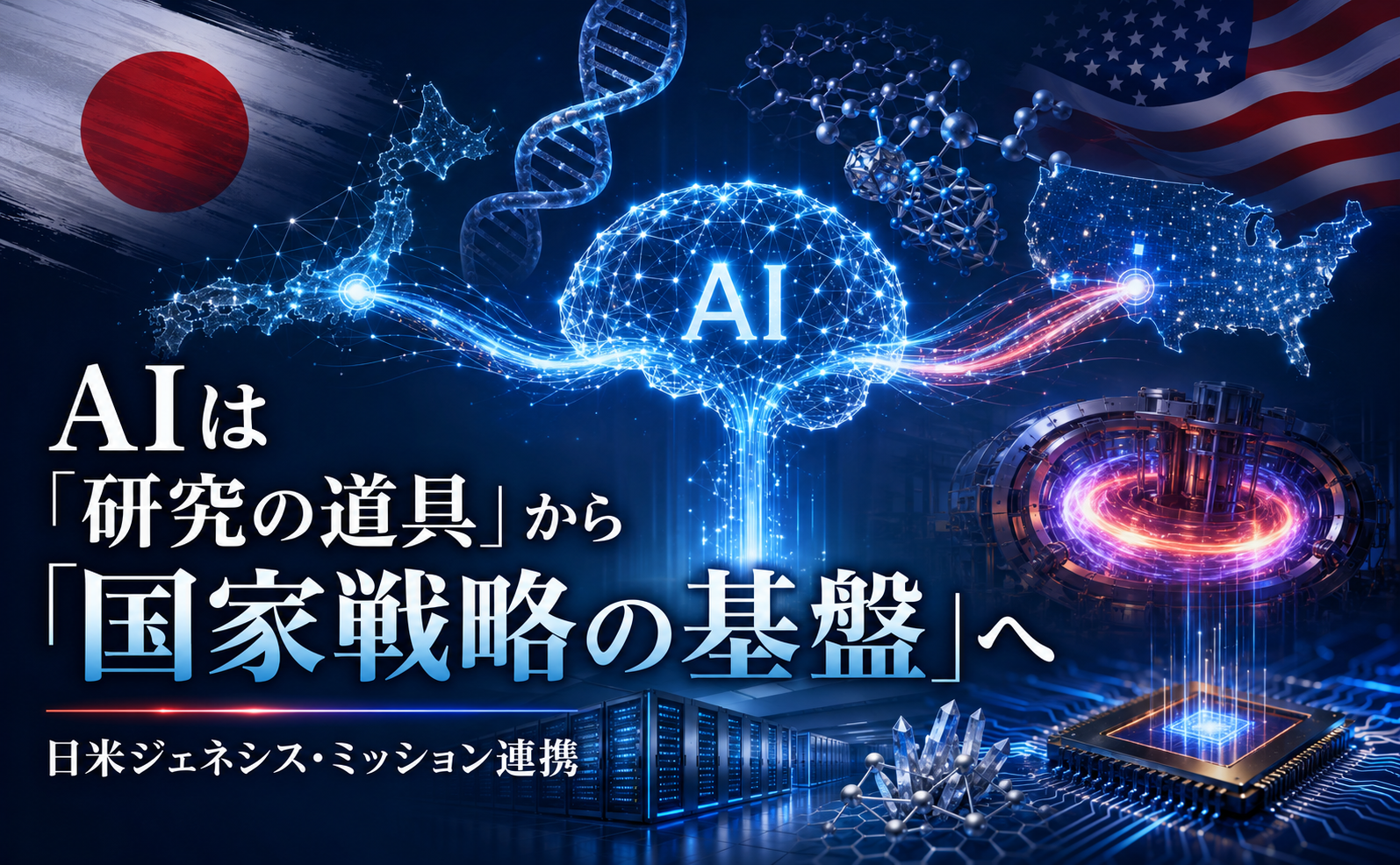
Japan is set to participate in Genesis Mission, a U.S. national project aimed at accelerating innovation in science and technology through the use of AI. The governments of Japan and the United States have announced plans to invest 500 million dollars each over the next five years, equivalent to approximately 80 billion yen on the Japanese side. In addition to U.S. national laboratories, Japanese institutions such as RIKEN and the National Institute for Materials Science are expected to participate in the project, strengthening research cooperation in fields such as quantum technology, nuclear fusion, and biotechnology. Behind this initiative lies the recognition that competition in AI-driven scientific research is no longer merely a race in research and development, but is now directly linked to national competitiveness and economic security.
AI That Transforms Scientific Research Itself
What is important about this partnership is that AI is not being positioned simply as a tool to support research. Rather, it is being treated as a foundation that can change the very way research and development are conducted.
In conventional scientific research, the central process has been for researchers to formulate hypotheses, conduct experiments or simulations, analyze the results, and then develop the next hypothesis. By contrast, combining high-performance AI with supercomputers makes it possible to rapidly narrow down promising materials, reactions, and design conditions from an enormous number of candidates. In fields where the search space is extremely broad, such as quantum technology, nuclear fusion, drug discovery, and materials development, this difference appears as a difference in research speed.
In other words, AI for Science is not merely a technology for making research more efficient. It has the potential to change how research themes are selected, how experimental plans are designed, how data are interpreted, and how research outcomes are implemented in society.
What It Means for Japan
For Japan, participation in this initiative provides an opportunity to connect the United States’ world-leading computational resources and AI infrastructure with the research data and experimental technologies that Japan has accumulated over many years.
Japan has a strong research base rooted in experimentation and manufacturing in areas such as materials, robotics, quantum technology, life sciences, and energy-related technologies. At the same time, U.S. companies and research institutions have a major presence in generative AI, large-scale AI models, and cloud computing infrastructure. By combining these strengths, it may become possible to conduct research and development on a scale that would be difficult for Japan to achieve on its own.
However, it will not be sufficient for Japan merely to provide data and research sites. What matters is the extent to which Japanese research institutions and companies can take an active role in the design of AI models, the construction of data infrastructure, the intellectual property protection of research outcomes, and discussions on standardization.
Science and Technology Competition with China in Mind
This news also needs to be viewed in the context of U.S.-China competition over science and technology. AI, quantum technology, nuclear fusion, semiconductors, and biotechnology are all critical technologies that affect not only future industrial competitiveness, but also military affairs, energy, and security.
As China rapidly strengthens its scientific and technological capabilities, the United States is deepening technological cooperation with allies and friendly countries. The fact that Japan will become the first international partner in Genesis Mission shows that the Japan-U.S. alliance is deepening not only in the areas of security and trade, but also at the level of research and development infrastructure.
In future international competition, it will not be enough simply to have excellent researchers and companies. Countries that can develop computational resources, research data, AI infrastructure, intellectual property systems, and security management frameworks in an integrated manner will gain the initiative in technology.
Data and Intellectual Property Protection Will Become Key Issues
One particularly noteworthy aspect of this partnership is that the Japanese and U.S. governments also plan to examine the protection of important data and intellectual property.
In AI-driven scientific research, the value of data becomes extremely significant. High-quality experimental data, failed experiment data, long-accumulated observational data, and datasets containing research know-how all influence the performance of AI models. Therefore, it becomes important to determine who provides the data, who develops the AI models, who obtains rights to the resulting outcomes, and which countries, institutions, and companies are allowed to use them.
From a patent perspective as well, there are many issues that need to be considered, including the ownership of AI-assisted inventions, the handling of results from joint research, data that should be protected as trade secrets, and filing strategies in international joint research. The further AI for Science advances, the more important intellectual property strategy will become in determining how research outcomes are protected and utilized.
Expectations and Challenges
There are high expectations for this partnership. If research in fields such as nuclear fusion, quantum technology, biotechnology, and materials development accelerates, it could lead to major achievements in energy, medicine, and industrial competitiveness. The ability of Japanese research institutions to connect with world-class AI research infrastructure will also provide important opportunities for young researchers and companies.
At the same time, there are challenges. If the Japanese side participates without sufficient computational resources, personnel, and data management capabilities, the core of the resulting achievements could become dependent on the United States. In addition, if economic security is emphasized too strongly, there is a risk that academic freedom and international exchange of knowledge could be narrowed.
What matters is striking a balance between open science and technology control. While advancing international cooperation, it will be necessary to appropriately protect important technologies and sensitive data, while at the same time maintaining an environment in which researchers can work creatively.
Conclusion
Japan’s participation in Genesis Mission symbolizes the fact that AI-driven scientific research is becoming central to national strategy. This is not merely news about research cooperation. It is a sign of the beginning of an era in which science and technology, industrial policy, economic security, and intellectual property strategy are becoming integrated.
What Japan needs to do is not only make use of U.S. AI infrastructure, but also strengthen its own research data, computational infrastructure, human resources, and intellectual property strategy. In the age of AI-driven science and technology competition, both the ability to generate research outcomes and the ability to protect and implement those outcomes in society will be tested. Whether this partnership can become a substantive opportunity to raise Japan’s research and development capabilities will be the key issue going forward.