
Introduction
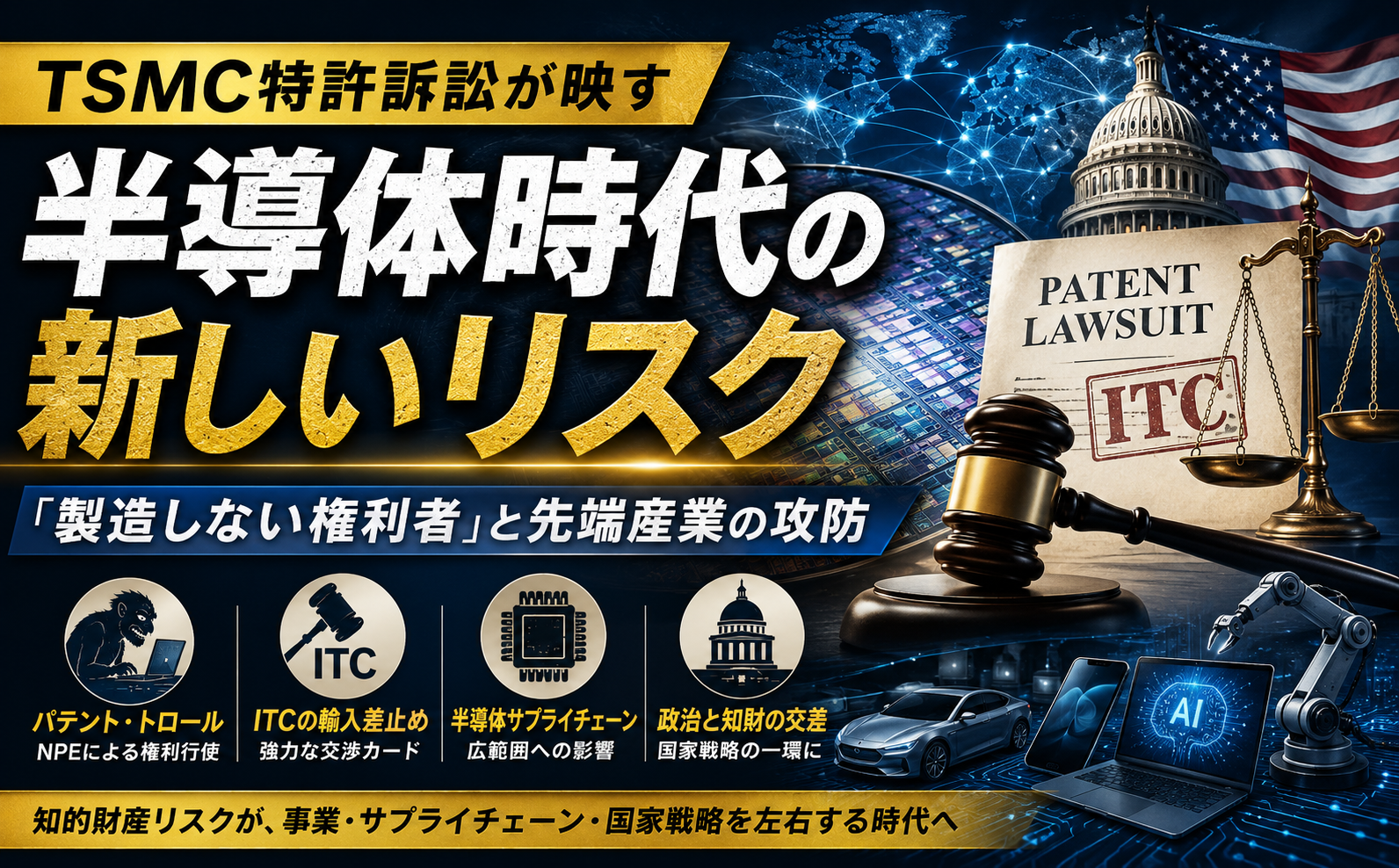
TSMC, the world’s largest semiconductor foundry, has attracted attention after being sued in the United States by two Irish patent management companies alleging that semiconductors manufactured using TSMC’s advanced processes infringe their patents. The matter has now entered proceedings before the U.S. International Trade Commission, commonly known as the ITC. The semiconductors at issue are those manufactured using TSMC’s advanced processes. If the ITC were to find infringement and issue an exclusion order, the supply of related semiconductor products, as well as electronic devices incorporating those products, to the U.S. market could be affected.
In response, Liao Cheng-wei, Director-General of Taiwan’s Intellectual Property Office under the Ministry of Economic Affairs, expressed the view that the companies bringing the lawsuits fall under what is commonly called “patent trolls.” He also explained that TSMC has already filed proceedings with the Patent Trial and Appeal Board of the U.S. Patent and Trademark Office seeking to invalidate the patents at issue. This news can be seen not merely as a patent dispute involving a single company, but as a demonstration of a modern risk arising at the intersection of semiconductors, intellectual property, trade policy, and geopolitics.
The Essence of the Issue Is Not Merely “Patent Infringement”
An important point in considering this litigation is that the issue is not limited to the simple question of whether patent infringement has occurred. The patent system is originally designed to grant, for a certain period of time, exclusive rights to those who have invested in technological development, thereby encouraging the disclosure of inventions and the development of industry. In that sense, the exercise of patent rights itself is a legitimate exercise of rights.
However, when the entity holding the patent does not manufacture products itself and instead relies mainly on litigation and licensing negotiations as its source of revenue, the way the matter appears from an industrial policy perspective changes significantly. Such entities are generally referred to as NPEs, or non-practicing entities. Among them, entities that seek large settlements or license fees through litigation are sometimes referred to critically as “patent trolls.”
The fact that a Taiwanese official used this expression should be understood not as a simple repetition of TSMC’s legal position, but rather as an attempt to characterize the nature of the litigation from the perspective of industrial defense. In other words, this is being viewed less as ordinary competition between technology companies and more as a move to use a patent portfolio as a weapon to strike at a key point in a massive semiconductor supply chain.
The Strong Pressure Created by ITC Proceedings
One reason this case is attracting particular attention is that the matter involves not only ordinary U.S. courts, but also proceedings before the ITC. The ITC examines whether products imported into the United States infringe intellectual property rights and, if infringement is found, can issue an order excluding those products from importation.
In an ordinary damages lawsuit, the central issue is monetary compensation for past acts of infringement. By contrast, an ITC exclusion order has the powerful effect of stopping future imports. In the case of semiconductors, which are incorporated not only into standalone products but also into a wide range of downstream products such as smartphones, PCs, AI accelerators, automobiles, and telecommunications equipment, the impact can be extremely broad.
For this reason, ITC proceedings become a powerful negotiating card for plaintiffs. Regardless of whether an import ban is ultimately imposed, the mere existence of that possibility places significant pressure on the defendant company and its customers. This is why the present litigation has drawn the attention of market participants.
Patent Invalidation Proceedings as TSMC’s Countermeasure
It is also important that TSMC has reportedly already filed patent invalidation proceedings with the Patent Trial and Appeal Board of the USPTO. In patent infringement litigation, defendants generally have two main countermeasures. One is to argue that they do not infringe. The other is to argue that the other party’s patent is not valid in the first place.
If the latter argument is accepted, the patent right itself loses its force, and the premise for infringement collapses. Particularly in a technologically advanced and complex field such as leading-edge semiconductor processes, the interpretation of patent claims, differences from prior art, and the existence or absence of inventive step become extremely important.
A major company such as TSMC can naturally be expected to respond by mobilizing its internal intellectual property department, outside law firms, and technical experts. The background to the Taiwanese official’s expression of confidence in TSMC’s intellectual property team lies in the fact that the company has experienced international patent disputes in the past. In this case as well, TSMC appears to be pursuing a strategy not merely of defending itself, but of attacking the validity of the opposing party’s patents themselves.
Semiconductor Supply Chains Are Also Affected by “IP Risk”
Discussions concerning the semiconductor industry have so far focused mainly on manufacturing capacity, advanced processes, geopolitical risk, export controls, a potential Taiwan contingency, and U.S.-China tensions. However, the present case shows that intellectual property risk is also a factor that can shake supply chains.
TSMC’s advanced processes support the products of major technology companies around the world. Therefore, patent litigation against TSMC is not a problem for TSMC alone. It may also affect its customers and, further downstream, entire industries that use those customers’ products.
In particular, amid the rapidly expanding demand for AI semiconductors, the possibility that the supply of advanced processes could be constrained by legal risk goes beyond a mere corporate legal issue. The impact could extend across a wide range of fields, including AI infrastructure, defense, telecommunications, cloud services, and consumer electronics. In this sense, patent litigation is no longer a matter for legal departments alone, but also a matter of corporate strategy, procurement strategy, and national industrial policy.
Can the Matter Be Dismissed Simply as “Patent Troll” Litigation?
That said, it would be somewhat simplistic to view this litigation only as a nuisance lawsuit brought by patent trolls. The patent system is designed to protect technological achievements as rights even when inventors or research and development entities do not themselves own manufacturing facilities. The licensing of patents by universities, research institutions, startups, and individual inventors is itself an important function that supports innovation.
The issue is whether the exercise of patent rights is working in a way that promotes industrial development, or whether it is exploiting vulnerabilities in a massive supply chain to create excessive negotiating pressure. The exercise of rights by non-practicing entities cannot be rejected across the board. However, when powerful remedies such as import exclusion are involved, the public interest and the impact on industry should also be carefully considered.
In particular, in a foundational industry such as semiconductors, a single patent dispute can potentially affect consumer products, AI development, national defense, and communications infrastructure. For this reason, the balance between the legitimate interests of patent holders and the stability of supply for society as a whole is being called into question.
An Era in Which Politics Casts a Shadow Over Litigation
The fact that a Republican lawmaker in the United States sent a letter to the ITC calling for strict enforcement is also symbolic. Ordinarily, whether patent infringement has occurred is treated as a legal and technical issue. However, TSMC is a company deeply connected to U.S. semiconductor policy, relations with Taiwan, AI competition, and national security. As a result, this litigation is not confined to the courtroom, but has also taken on political significance.
On the one hand, there is an argument that U.S. intellectual property rights should be strictly protected. On the other hand, there are also concerns that an import ban on TSMC-related products could adversely affect U.S. industrial competitiveness and national security. This shows that intellectual property protection and industrial policy do not necessarily always point in the same direction.
In the international competition surrounding semiconductors, not only subsidies, export controls, and the reshoring of domestic production, but also patent litigation carries policy significance. This case shows that intellectual property rights are not only weapons in competition between companies, but also tools connected to industrial strategies between nations.
Implications for Japanese Companies
This news is not someone else’s problem for Japanese companies. Many Japanese companies, even if they do not manufacture semiconductors directly, design, manufacture, and sell products incorporating semiconductors. Industries that depend on semiconductors are extensive, including automobiles, industrial equipment, telecommunications equipment, medical devices, robots, and home appliances.
For this reason, the intellectual property risks of component suppliers also become important risks for final product manufacturers. When evaluating supply chain stability, it is necessary to consider not only price, delivery time, quality, and geopolitics, but also patent litigation and the risk of import exclusion.
In addition, when a company conducts business in global markets, it may itself face patent infringement allegations from NPEs. Especially in the U.S. market, the cost of responding to patent litigation is high, and the litigation itself can become a business burden. Therefore, advance clearance searches, the development of patent portfolios, contractual indemnity clauses, and the allocation of responsibility with business partners become important.
Conclusion
The present patent litigation against TSMC is not merely a single intellectual property dispute. It brings together the exercise of rights by NPEs, the ITC’s import exclusion system, the supply chain for advanced semiconductors, U.S. politics, and industrial security in the AI era.
At this point, it is impossible to state definitively whether TSMC will ultimately prevail, whether the patents will be invalidated, or whether the matter will be resolved through some form of settlement. What this case shows, however, is that in advanced technology industries, intellectual property is not merely a legal asset, but strategic infrastructure that can determine business continuity and market power.
Semiconductors are the foundation of modern society, and patent disputes involving semiconductors are no longer topics only for specialists. For companies developing technology, companies procuring components, companies selling products, and governments considering industrial policy, how to manage intellectual property risk is becoming an increasingly important issue.