
Introduction
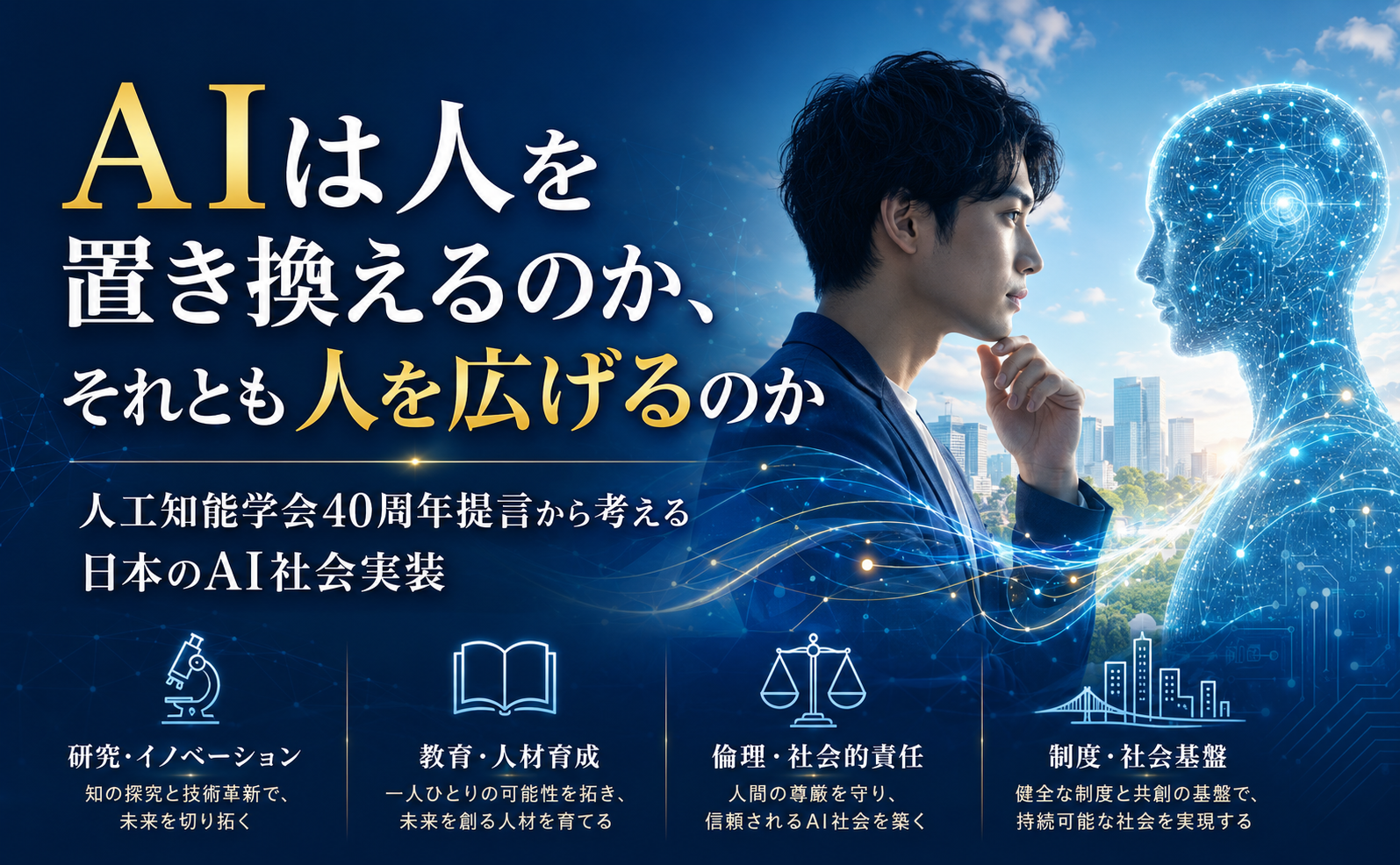
On June 15, the Japanese Society for Artificial Intelligence announced a proposal for the social implementation of AI in Japan, coinciding with the 40th anniversary of its founding. In this proposal, AI is positioned not as “something that replaces humans,” but as “a technology that expands human intelligence and creativity and supports social sustainability.”
The proposal sets out four pillars for realizing a society in which humans and AI coexist: original AI research, the use of AI in education, responsible use based on public interest and ethics, and the development of institutional foundations.
With the rapid spread of generative AI, AI is no longer a topic only for researchers and engineers. It has become an issue that concerns society as a whole, including education, work, creative activities, government administration, defense, and industrial policy. In this era, the proposal represents an important milestone in considering how Japan should engage with AI.
A Shift Away from the Fear of Being “Replaced by AI”
Discussions about AI often involve concerns such as “human jobs will be taken away” or “human thinking ability will decline.” Of course, these concerns cannot be ignored. In reality, the range of tasks that AI can handle is rapidly expanding, including writing, image generation, programming, translation, and research support.
However, what the proposal by the Japanese Society for Artificial Intelligence emphasizes is the perspective of viewing AI not as a substitute for humans, but as a tool that expands human capabilities. This is an extremely important viewpoint in discussions about the AI era.
It is inevitable that AI will replace some tasks performed by humans. However, this does not immediately mean that human value will be lost. Rather, by having AI handle routine processing and the organization of large volumes of information, humans may be able to focus more on areas such as judgment, creativity, dialogue, and the assumption of responsibility.
The issue is not whether AI will replace humans, but how human roles should be redesigned through AI. This proposal can be seen as encouraging that shift in thinking.
The Importance of a Foundation That Supports Original Research
The first pillar, “strengthening original AI research and sustainable research infrastructure,” is a particularly important issue for Japan’s AI strategy.
In today’s AI development, large-scale computing resources, enormous amounts of data, highly skilled talent, and long-term research investment are indispensable. As major overseas IT companies and research institutions lead the development of large-scale models, if Japan remains merely in the position of using existing technologies, its technological and industrial dependence will increase.
Of course, not every country or company needs to develop giant foundation models from scratch. However, in order to realize AI suited to the Japanese language, domestic industries, education, healthcare, government administration, manufacturing, and regional issues, Japan needs its own research infrastructure and applied technologies.
What is especially important is that this is not a simple choice between “using overseas technologies” and “building everything domestically.” The key is to make use of advanced overseas technologies while securing originality in areas where it is necessary, and to foster AI that fits the context of society and industry. To achieve this, mechanisms that continuously support not only short-term results but also basic research, human resource development, and the development of computing resources are essential.
The Difficulty of Using AI in Education
The second pillar calls for the use of AI in a way that supports human intelligence and learning. What deserves attention here is that the Japanese Society for Artificial Intelligence refers not only to the benefits of using AI, but also to the possible decline in thinking and judgment caused by excessive dependence on AI.
In educational settings, generative AI can be an extremely useful tool. It can support learning in many situations, such as explaining unfamiliar concepts, checking the structure of a piece of writing, assisting with foreign language study, and investigating programming errors.
On the other hand, if students simply have AI produce answers to assignments, they will have fewer opportunities to think for themselves. In particular, the processes of researching, comparing, forming hypotheses, structuring writing, and correcting mistakes lie at the heart of learning. If AI takes over all of these processes, learning may appear to become more efficient, while in reality the training of thought may be lost.
For this reason, discussions about AI use in education are insufficient if they are limited to whether AI should be prohibited or used freely. What matters is enabling learners to use AI not by accepting its output uncritically, but as a means to deepen their own thinking.
The roles of teachers and parents will also change. They will be expected not to act as monitors who prevent the use of AI, but as guides who teach how to engage with AI. In future education, AI literacy itself will likely become a basic skill as important as reading, writing, and information literacy.
How to Balance Public Interest, Security, and Ethics
The third pillar, “promoting responsible AI based on public interest, security, and ethics,” is an issue that will become increasingly important.
AI is likely to be used in highly public areas such as defense, cybersecurity, disaster response, the protection of critical infrastructure, and government services. In these fields, AI may enable rapid decision-making, efficient monitoring, and risk detection. At the same time, however, it may also give rise to problems such as erroneous judgments, discriminatory operation, the development of a surveillance society, and a lack of accountability.
In the field of security in particular, the use of AI cannot be treated as a mere matter of introducing technology. Its relationship with human rights, democracy, the international order, and peace must be carefully considered. Rather than adopting AI simply because it is technically possible, it is important to clarify for what purpose it will be used, who will bear responsibility, and within what scope its use will be permitted.
What is needed here is not a discussion among engineers alone. Broad dialogue is necessary, involving law, ethics, international relations, government administration, industry, and civil society. As AI becomes more deeply implemented in society, the question will increasingly shift from whether it “works accurately” to whether it is “used properly.”
A Society That Coexists with AI Cannot Be Realized Without Institutional Design
The fourth pillar calls for solving social issues and building institutional foundations for a society that coexists with AI. This shows that the spread of AI cannot be completed by technology alone.
As AI and robotics permeate society, employment and industrial structures will change. Some jobs will be automated, while other jobs will require the ability to use AI effectively. To respond to these changes, reskilling and vocational training will be indispensable.
In addition, the spread of generative AI has made issues related to copyright and data use more significant. There are many issues that need to be organized, including data used for AI training, rights in generated outputs, returns to creators, and the handling of trade secrets and personal information.
What is important is neither to excessively discourage the use of AI in the name of rights protection, nor to disregard the interests of rights holders in the name of technological progress. Institutional design is needed to balance the use of AI with the protection of rights.
A society that coexists with AI is not simply a society with more convenient tools. It is a society in which people can use AI with confidence, widely share the benefits of AI, and at the same time reduce disadvantages and risks. For that reason, rulemaking and social consensus are as important as technological development.
What Japan Needs Is Not “Following the Trend,” but “Implementation Suited to Its Context”
Reading this proposal, I feel that what Japan needs is not simply to follow the overseas AI boom. It is important not to fall behind in the large-scale AI development race, but that alone is not enough.
Japan has its own social contexts, including the Japanese-language environment, an aging population, local communities, manufacturing, the education system, administrative procedures, and disaster response. In order for AI to truly take root in society, it must be designed in accordance with these contexts.
For example, in healthcare and nursing care, the issue is not only how to compensate for labor shortages, but also how to protect the dignity and sense of security of users. In education, the issue is not only efficiency, but also how to foster learners’ independence. In government administration, the issue is not only speeding up procedures, but also how to ensure fairness and accountability.
The success or failure of AI implementation in society will not be determined by technological performance alone. What matters is whether AI is accepted in actual workplaces, whether it is consistent with institutions, and whether it supports human judgment. Japan may be able to demonstrate its strengths precisely in this kind of careful implementation.
Conclusion
The 40th anniversary proposal by the Japanese Society for Artificial Intelligence takes discussions about AI one step beyond the simple opposition between “threat” and “convenient tool.” AI should not be viewed only as something that replaces humans. At the same time, it is not an all-purpose technology that will unconditionally improve society.
Whether AI can become a technology that expands human intelligence and creativity depends on the design of society as a whole, including research infrastructure, education, ethics, security, legal systems, and employment policy.
The question in the coming AI society is not whether we use AI or do not use it. The question is under what values we use AI, for whom we make it useful, and how we take responsibility for it.
This proposal shows that, in envisioning a society in which Japan coexists with AI, comprehensive discussion is necessary not only from a technological perspective, but also from the perspectives of humanity, education, and institutional design. Precisely because we are entering the age of AI, the ultimate question is what kind of society humans wish to create.